Chapter 8 of 8
CHAPTER EIGHTWho did it?
Seven events. One newspaper. What a headline says about who is responsible, and what it leaves unsaid.
Forty-five days
On 29 October 1956 Israeli Border Police shot dead dozens of Palestinian citizens of Israel as they came home from their fields to the village of Kafr Qasim. A curfew had been brought forward that afternoon. Most of them had not been told.
FROM OUTSIDE
What happened next in Israel is documented from Israeli state papers by Akevot, an Israeli archival institute. Ben-Gurion’s military adjutant asked the chief military censor to place a blackout on the entire affair, and the next day the order to continue it was relayed from the chief of staff, Moshe Dayan. The blackout held for about two months. It broke because two communist members of the Knesset, Tawfik Toubi and Meir Vilner, used parliamentary immunity to raise the killings, and because journalists kept pushing. Death tolls in the sources differ: 48, 49 and 50 all appear.
So the silence in the American papers was made in Israel, not in New York. That has to be said first. A newspaper cannot print what a censor has forbidden.
What belongs to the New York Times is the sentence it wrote on the day the story could finally be told. Here it is.

The smaller line underneath does say the Border Police shot them, and it says so by quoting the prime minister. Somebody official had to say it first.
THE LIMIT
This is the earliest report we could find, which is not the same as the earliest one printed. We searched those seven weeks four different ways: for the word curfew, for border police, for Arab villagers, and for the village’s name spelled two ways. Between them they turn up one article, the one above. The village’s name does not appear in the paper at all until November 1957. Four searches coming back empty is strong evidence. It is not proof. An article worded in some way none of those searches catch would still be sitting there.
Twenty-two months later
In October 1958 a military court convicted eight border policemen. Here is the same newspaper, on the same story, once a court had ruled.

Nothing about the killing changed between those two front pages. What changed is that a court had said a sentence out loud, and the paper could repeat it.
Seven events
The same question, asked of six more killings. Each one is well documented, and between them they change the thing that might matter: whether the person who pulled the trigger was working for a government.
| Event | Who did it | First located NYT headline | Days | Page | Headline says who? |
|---|---|---|---|---|---|
| Kafr Qasim1956 · victims: Palestinian citizens of Israel | Israeli Border Policepolice, on duty | 48 ARABS KILLED; ISRAEL PENITENT13 Dec 1956 | 45 | — | no |
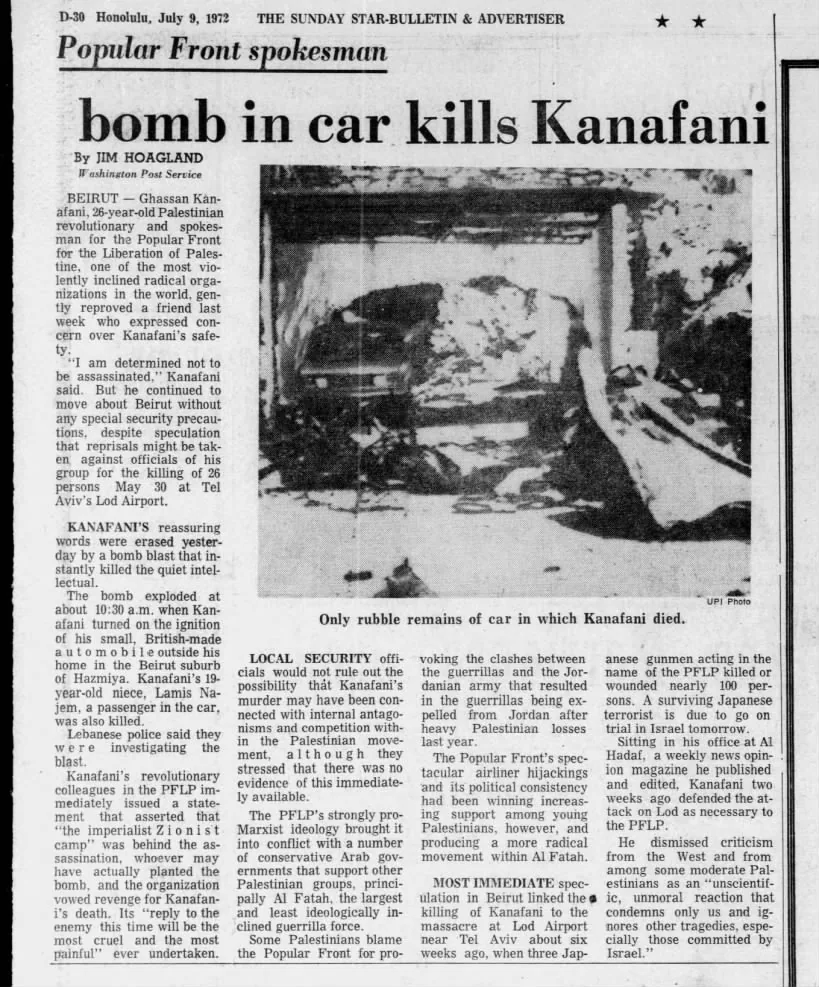
| Ghassan Kanafani1972 · victims: Palestinian | Widely attributed to Mossad; never acknowledgedintelligence service; never admitted | World News Briefs9 Jul 1972 | 1 | — | no |
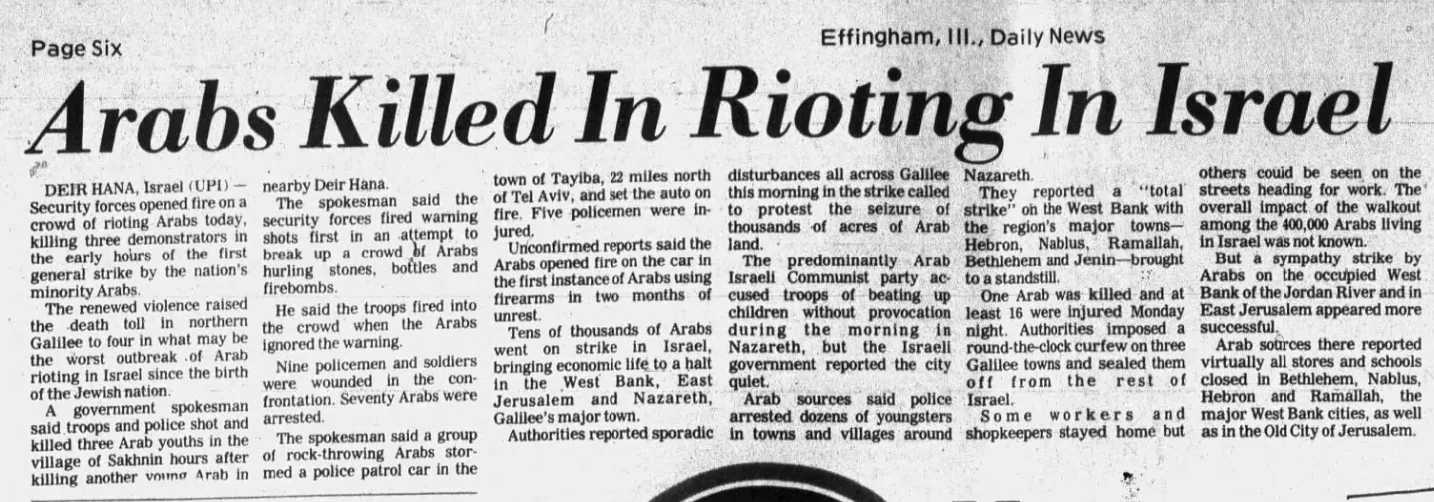
| Land Day1976 · victims: Palestinian citizens of Israel | Israeli police and security forcespolice and army, on duty | Israeli Arab Dies in Riot on Strike’s Eve30 Mar 1976 | 0 | — | no |
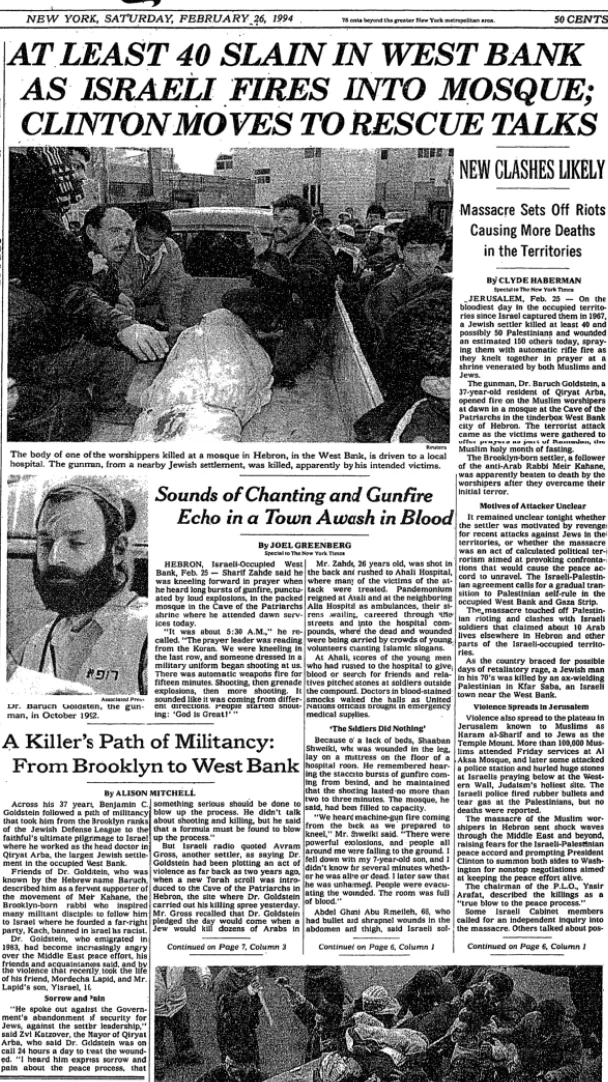
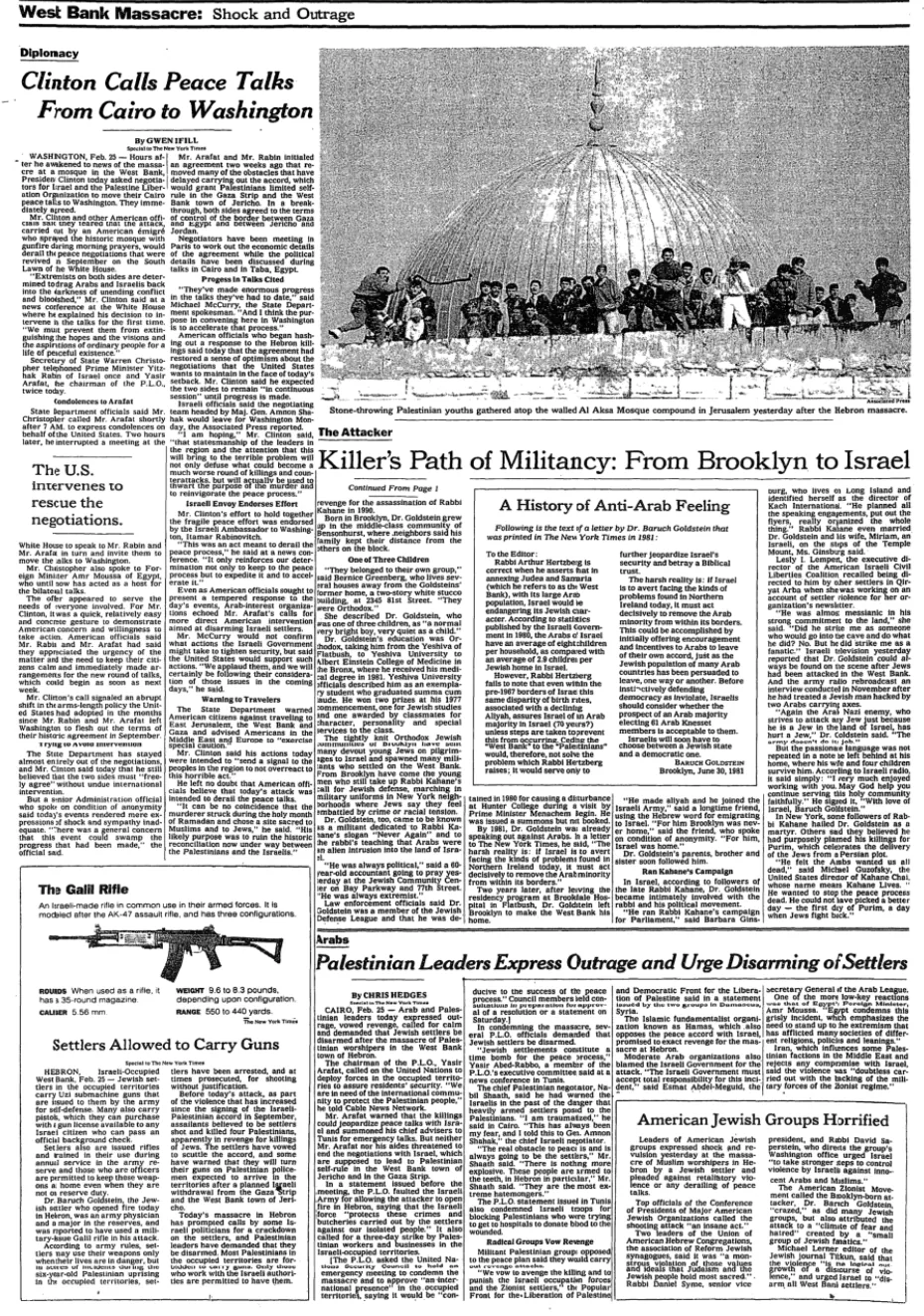
| Hebron, Ibrahimi Mosque1994 · victims: Palestinian | Baruch Goldsteinacted alone; state disowned him | GUNMAN SLAYS 20 AT SITE OF MOSQUE, ISRAEL REPORTS SAY25 Feb 1994 | 0 | A1 | yes |
| Yitzhak Rabin1995 · victims: Israeli | Yigal Amiracted alone; state disowned him | RABIN SLAIN AFTER PEACE RALLY IN TEL AVIV; ISRAELI GUNMAN5 Nov 1995 | 1 | A1 | yes |
| Park Hotel, Netanya2002 · victims: Israeli | Hamas, which claimed responsibilityarmed group | BOMB KILLS AT LEAST 19 IN ISRAEL AS ARABS MEET OVER PEACE PLAN28 Mar 2002 | 1 | A1 | no |
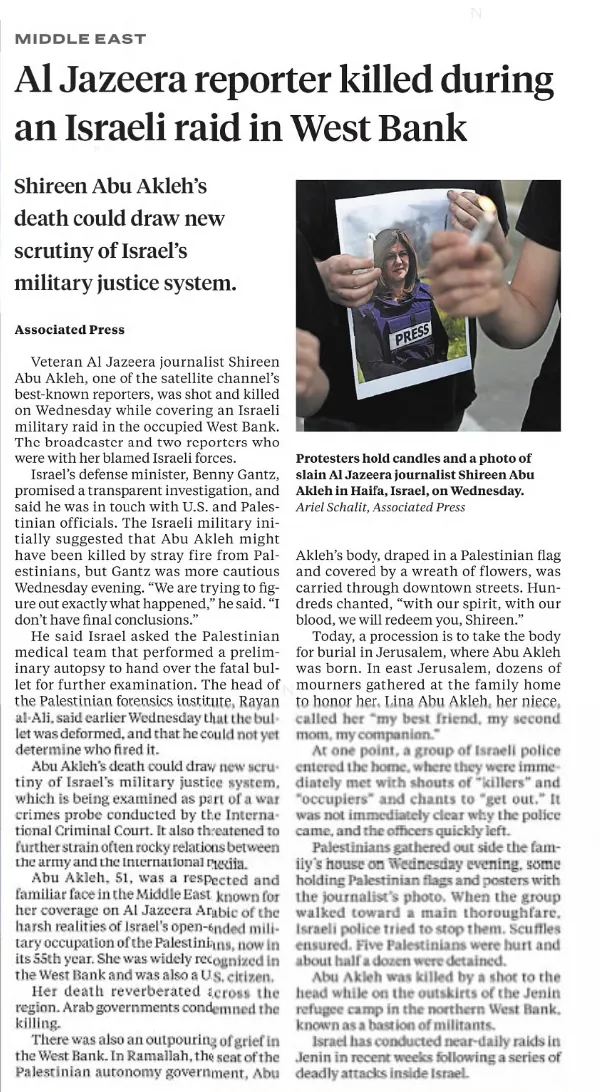
| Shireen Abu Akleh2022 · victims: Palestinian-American | Israeli soldier; army later conceded a “high possibility”soldier, on duty | Journalist for Al Jazeera Is Shot and Killed in West Bank12 May 2022 | 1 | A5 | no |
THE LIMIT
Seven events are seven events. They were selected for being well documented, which is not random, and nothing here is an estimate of how the paper behaved across the century. The Rabin window returned 120 results and the first 50 were read; the rest of the windows were read in full. Print page numbers are not exposed in Times search results before about 1980, which is why four rows carry none.
The individual and the institution
Baruch Goldstein killed 29 Palestinians at prayer in Hebron on 25 February 1994. The Times had GUNMAN SLAYS 20 AT SITE OF MOSQUE on the front page the same day. By the next morning his nationality was on the front page too, and inside the same edition the paper was already tracing his life backwards from Brooklyn.
Yigal Amir shot Yitzhak Rabin on the evening of 4 November 1995.
Rabin is the case that makes the comparison worth anything. A Jewish Israeli shot a Jewish Israeli prime minister, and the front page identified him the next morning, exactly as fast as it identified the Jewish settler who had massacred Palestinians at prayer. Whatever is slowing things down in the other cases, it is not that the killer was Israeli or Jewish.
Now set those two beside the others. On Land Day the Times reported a death the same day, under the headline Israeli Arab Dies in Riot on Strike’s Eve. For the next two weeks no headline says who shot him. Shireen Abu Akleh was shot in the head wearing a vest marked PRESS, and the Times ran it on page A5 as Journalist for Al Jazeera Is Shot and Killed in West Bank. The next day, on A7, the headline is about the bullet rather than about anyone who fired it.
READ AS
In these five cases, a killer the government has disowned turns up in the headline straight away, and a killer in uniform does not. That is a description of what five headlines did. Why they did it is still a guess.
THE LIMIT
Three things complicate it. Kafr Qasim was censored, so that delay was not the paper’s decision at all. Who shot Abu Akleh was genuinely disputed on the first day, and hedging a disputed fact is what a newspaper is supposed to do, though the hedging carried on past September 2022, after the Israeli army itself conceded that one of its soldiers probably fired. And in both Hebron and Rabin the headline gives a type of person and a nationality, never a name. Goldstein and Amir are both named inside the articles on day one. Neither name reaches a headline in the first week, as far as we could find.
PRINTED
On Land Day the thing the headline leaves out is sitting right underneath it. The Times’ own abstracts for 31 March and 5 April 1976 record a general strike erupting into “violent clashes with security forces” and an Israeli cabinet endorsing “police action”. The paper reported who did it. The headline did not.
When the bomb becomes the subject
We have spent time on the ten American papers that reported the killing of the novelist Ghassan Kanafani in 1972. Seven of them wrote the sentence so that a bomb did it. We took that to be about whose death it was. Then we checked a case with the nationalities the other way around, and it wasn’t.
The second is the Park Hotel bombing in Netanya, which killed 30 people at a Passover seder. Hamas claimed it that day.
READ AS
Same shape of sentence, opposite victims, and this time everyone knew who was responsible because Hamas said so that day. A bomb doing the killing in a headline tells you nothing about how the paper saw the dead. It is what the first report of a bombing looks like.
So the argument gets narrower, not cancelled. It still does not explain the shootings, where there is a person to name from the first minute.
What the evidence establishes
PRINTED
Every headline quoted in this chapter was retrieved from the New York Times’ own search and is reproduced as that search returns it. The 13 December 1956 headline, the two front pages of February 1994 and November 1995, the Land Day headlines of March 1976, the Park Hotel front page of March 2002 and the Abu Akleh page A5 of May 2022 are all in the record and all checkable.
FROM OUTSIDE
The censorship of Kafr Qasim, the two-month blackout and the role of Toubi and Vilner in breaking it come from Akevot’s documentation of Israeli state papers, not from this archive and not from the Times.
READ AS
In these seven cases, a killer the government has disowned is identified in a headline within a day, and a killer in uniform is not identified in a headline at all in the first week. Rabin shows the difference is not the killer’s nationality. Park Hotel shows it is not the bomb sentence either.
THE LIMIT
Seven events, not a sample. Nothing here says anything about what an editor intended, and nothing could. A paper that does not name a shooter might be waiting for confirmation, following its own house style, or cutting a line to fit a column, and from the outside those look identical. One of the seven delays was the work of a censor, not an editor. The dataset, every search, the terms that came back empty and the windows only partly read are all in the sources below, so anyone who thinks this is wrong can go and find out where.
The next time you read that someone was killed in a raid, or died in a riot, or was shot and killed in the West Bank, look for the person who did it. Sometimes they are in the sentence underneath.
Sources, queries, and what was not found
The dataset
- Seven events, verified — CSV. Eighteen fields per event, including the search terms tried, the completeness of each capture and a confidence note.
- Vocabulary counts — CSV. Twenty-one phrases. Not used in this chapter; published because it exists and is incomplete.
- The whole archive as JSON.
Search protocol
Every query used the Times’ own search with &sort=oldest and an explicit date range. This is not cosmetic: under the default relevance sort the search pads its reported total with articles that do not contain the phrase, about 540 of them over a thirty-six-year window. A nonsense phrase returns 540 results sorted by relevance and 0 sorted by date. Result lists were expanded until exhausted and the reported total compared against the rows actually captured.
Negative controls run
"zzqx were killed", 1970–1989 → 0"zzqx militant", 1987–2023 → 0
Queries behind each event
- Kafr Qasim —
"curfew","border police","Arab villagers","Kafr Kasim","Kfar Kasim", 29 Oct–13 Dec 1956. Returns between them: 34, 1, 0, 0, 0. - Kanafani —
Kanafani, Jul–Dec 1972. 6 results. - Land Day —
"Galilee"and"Israeli Arabs", 30 Mar–12 Apr 1976. 8 and 6 results, the same set. - Hebron —
"Hebron"and"Goldstein", 25 Feb–4 Mar 1994. 71 results, read in full. - Rabin —
"Rabin"and"Yigal Amir", 4–11 Nov 1995. 120 results, first 50 read. - Park Hotel —
"Netanya", 27 Mar–3 Apr 2002. 35 results. - Abu Akleh —
"Abu Akleh", 11–18 May 2022. 30 results.
Known problems with the index
- Print page numbers are not exposed in search results before about 1980, which is why four of the seven rows carry no page.
- From about 2005 most results are digital-first and carry no print page.
- Wide modern windows do not fully expand; a partial capture under oldest-first sort is time-biased rather than random, so such windows were not used.
- TimesMachine serves page images with no extractable text, so it can confirm placement one article at a time and cannot be queried.
Partial captures and absences
- Rabin: 120 results, 50 read. The day-one front page is among them, so the timing is unaffected, but that window is not a census.
- Kafr Qasim: four term families returned nothing before 13 December 1956. That is convergent evidence of silence, not proof of it.
- Goldstein and Amir are named in article bodies on day one. Neither name appears in a first-week headline this study located.
Coding definitions
Days is the gap between the killing and the earliest report located, not necessarily the earliest published. Headline says who is yes only where the headline itself identifies the actor by category, nationality, organization or name; an actor named only in a subhead, a dek or the body is no. State agent means acting in an official capacity at the time, whether or not the state later acknowledged it.
Corrections
- 9 October 2026. We had read the Kanafani headlines, where a bomb does the killing, as evidence about how Palestinian deaths were written up. The Park Hotel front page of 28 March 2002 uses the same sentence with the nationalities the other way around. The claim has been narrowed, and the case that narrowed it is in the chapter above rather than buried down here.
- 9 October 2026. The civilians chart in chapter four now states that its figures are counts of reported search matches rather than verified distinct articles, after inspection found the same opinion piece returned four times in one sample.
This research is still being worked through. Every count drawn from the archive is recomputed from the records each time the page is built, and every figure from outside it is printed with the query that produced it. Where a finding has changed, the correction is printed beside it rather than quietly swapped in. More of it is still being checked, and some of it will move.
Last updated 2 November 2026
Every figure about this archive is computed from the records at build time. Every figure from outside it is logged with the query that produced it.
All eight chapters · How this archive was built · What the papers repeated · Search the archive · The data
Collected, transcribed and checked by Maria Robles · maria@rozumstudio.com