Pittsburgh Press · 19 September 1934
CP-1934-021
The Modern Palestine
Economic Reasons, Not Religion At Root Of Jewish-Arab Riots
Transcribed from the clipping
This is the last of a series of three stories on how the Jews who have gone to Palestine from all part of the world are progressing, finding peace, hope, and prosperity in their ancient homeland, written by Marion Rubinstein, who recently returned from a tour of that country. THE SONS of Sarah and the sons of Hagar live side by side today in Palestine.
And every once in a while, the newspapers of the world let us know that these descendants of the same father Abraham do not live in peace, that they fight and kill one another, because each is trying to defend its religious rights against the other. Contrary to popular belief, the conflict between Jew and Arab is not a religious one.
While it is true that events occur periodically which tend to strengthen that belief, careful investigation proves that these events have been carefully planned to give just that effect, to spread the idea to a world interested in the Holy Land that the Arabs, angered because their Mosque of Omar or some other holy spot has been threatened, turned to bloodshed in defense.
Economic Reason Basically, the reason behind the conflict between Jew and Arab in Palestine is economic. To find exactly how true this is, one has to return to the time before the Jews came back into Palestine to rebuild that country.
In his report upon the administration of Palestine for 1920-1925, Sir Herbert Samuel, first high commissioner, referring to the state of the country in 1920, said: “Villages have been destroyed; the stock of cattle and horses has been depleted; olive trees have been cut down for fuel for the Turkish troops and military trains; many orange groves left without irrigation have ceased to bear fruit; there is a general air of poverty and depression.”
How this transcription was made
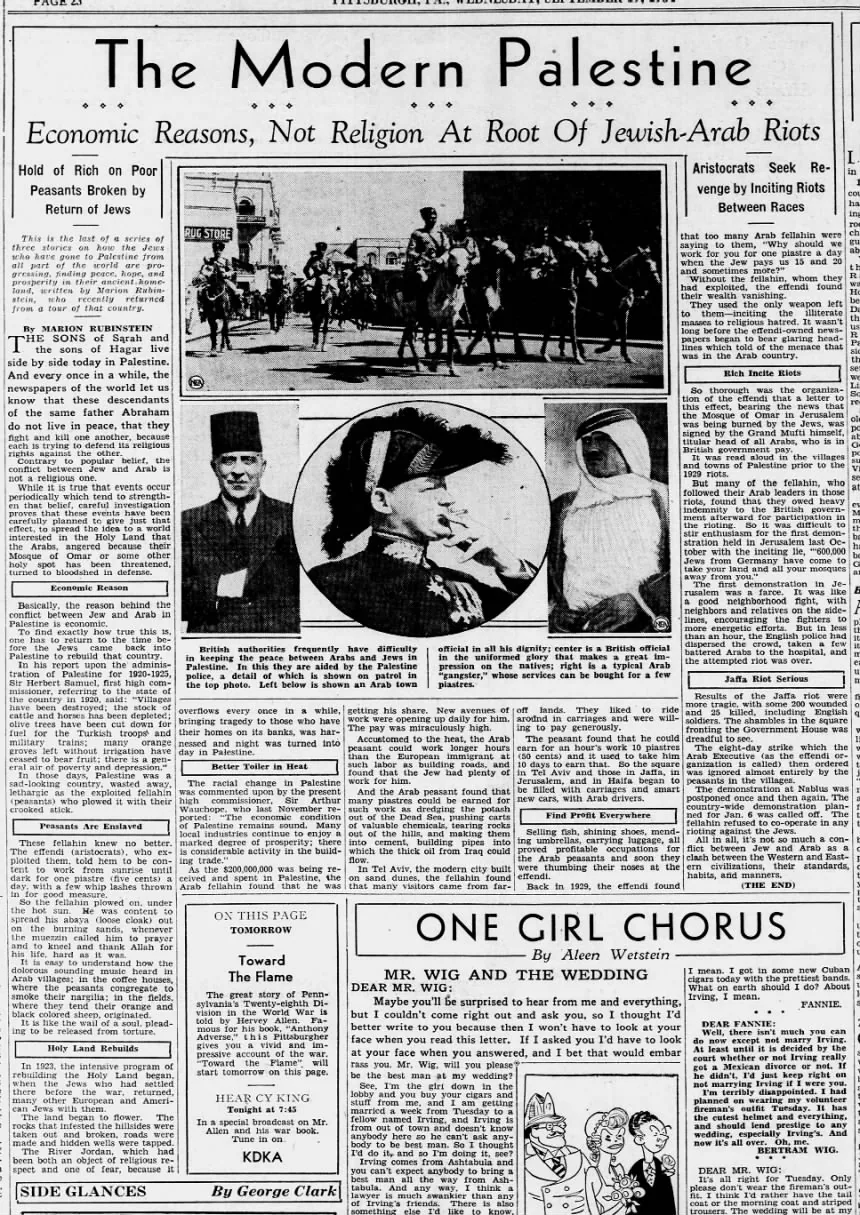
Read from the scan at 3x to 9x with the contrast stretched. THE FOLIO IS CUT BY THE TOP EDGE OF THE SCAN and only the lower halves of its letters survive. The city and state and the weekday and month can be made out; THE DATE FIGURES CANNOT, being half-letters. 19 September 1934 was a Wednesday, which the surviving weekday supports, and the label agrees, but the folio has been read only in part. The paper’s own name is above the cut and is nowhere on the scan, so the title rests on the hand-typed slide label; the city is confirmed by the folio and by a Pittsburgh radio listing in the next column, but the city does not settle which Pittsburgh paper this is. The photograph caption is transcribed in full because it is the most revealing text on the page: it labels three men, an Arab town official, a British official and “a typical Arab ‘gangster,’ whose services can be bought for a few piastres”, and names none of them. “From all part of the world” in the italic standfirst is singular as printed. The lines at the head of the first and last columns are column heads, not decks; the deck is the single centred line under the main title.
Cite this clipping
"The Modern Palestine," Pittsburgh Press, 19 September 1934, p. 23. Covering Palestine archive, CP-1934-021. https://coveringpalestine.org/archive/cp-1934-021
More from Pittsburgh Press
- Hoover Urges Plan to Move Arabs from PalestinePittsburgh Press · 19 November 1945
- Israel Fights ‘Worst Arab Riot’Pittsburgh Press · 30 March 1976
- U.S. approved Israeli raid, Arafat saysPittsburgh Press · 6 October 1985
More from the 1930s
- Palestine Allows Arabs to ParadeThe New York Times · 14 January 1934
- British Policy Now Forces It to Help Arabs Ousted From Palestine FarmsEvening Star · 14 January 1934
- Palestine Arabs Enumerate GrievancesThe New York Times · 18 January 1934
- Racial Separation in Palestine UrgedThe New York Times · 21 January 1934
- 'Down With the Government' Shouts Were FrequentThe New York Times · 28 January 1934
- Police Cleared in Palestine RiotsThe New York Times · 18 February 1934
- All 218 clippings from the 1930s →
Last updated 2 November 2026
This record is part of Covering Palestine, an archive of American newspaper clippings about Palestinians, 1724 to 2023. Researched and assembled by Maria Robles.
The clipping belongs to the newspaper that printed it, or to the news agency that supplied the copy. It is reproduced here for research, criticism and commentary. A city here is where the newspaper was published, not where the story came from, and on most records it was taken from the masthead.
Something wrong here, or something you know about this clipping? The archive is still being built and corrections are wanted: maria@rozumstudio.com, quoting CP-1934-021.
Everything printed in 1934 · Printed on this day · See it in the archive reel · Full text of every clipping · Dataset