New Pittsburgh Courier · 21 February 1948
CP-1948-091
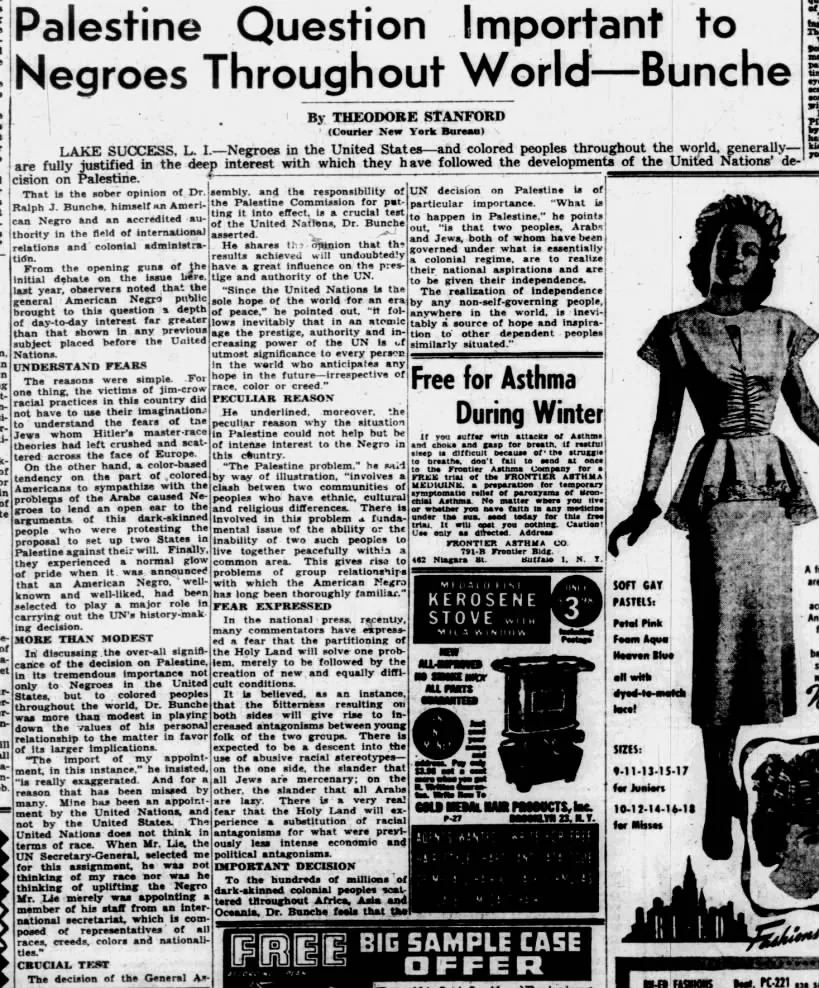
Palestine Question Important to Negroes Throughout World—Bunche
By Theodore Stanford, Courier New York Bureau, Lake Success, L. I.
Transcribed from the clipping
“LAKE SUCCESS, L. I.—Negroes in the United States—and colored peoples throughout the world, generally—are fully justified in the deep interest with which they have followed the developments of the United Nations’ decision on Palestine. That is the sober opinion of Dr. Ralph J. Bunche, himself an American Negro and an accredited authority in the field of international relations and colonial administration. From the opening guns of the initial debate on the issue here, last year, observers noted that the general American Negro public brought to this question a depth of day-to-day interest far greater than that shown in any previous subject placed before the United Nations. The reasons were simple. For one thing, the victims of jim-crow racial practices in this country did not have to use their imagination to understand the fears of the Jews whom Hitler’s master-race theories had left crushed and scattered across the face of Europe. On the other hand, a color-based tendency on the part of colored Americans to sympathize with the problems of the Arabs caused Negroes to lend an open ear to the arguments of this dark-skinned people who were protesting the proposal to set up two States in Palestine against their will… ‘The Palestine problem,’ he said by way of illustration, ‘involves a clash between two communities of peoples who have ethnic, cultural and religious differences. There is involved in this problem a fundamental issue of the ability or the inability of two such peoples to live together peacefully within a common area. This gives rise to problems of group relationship with which the American Negro has long been thoroughly familiar.’… In the national press, recently, many commentators have expressed a fear that the partitioning of the Holy Land will solve one problem merely to be followed by the creation of new and equally difficult conditions. It is believed, as an instance, that the bitterness resulting on both sides will give rise to increased antagonisms between young folk of the two groups. There is expected to be a descent into the use of abusive racial stereotypes—on the one side, the slander that all Jews are mercenary; on the other, the slander that all Arabs are lazy. There is a very real fear that the Holy Land will experience a substitution of racial antagonisms for what were previously less intense economic and political antagonisms… ‘What is to happen in Palestine,’ he points out, ‘is that two peoples, Arabs and Jews, both of whom have been governed under what is essentially a colonial regime, are to realize their national aspirations and are to be given their independence. The realization of independence by any non-self-governing people, anywhere in the world, is inevitably a source of hope and inspiration to other dependent peoples similarly situated.’”
Context added by this archive
A Black newspaper in 1948 setting out why its readers were following partition more closely than anything the United Nations had done, and getting Ralph Bunche to call the mandate what it was: essentially a colonial regime. The subheadings are the paper’s own: “Understand Fears,” “More Than Modest,” “Crucial Test,” “Peculiar Reason,” “Fear Expressed” and “Important Decision.” It runs beside an advertisement for a kerosene stove and one for asthma powder.
Cite this item
"Palestine Question Important to Negroes Throughout World—Bunche," New Pittsburgh Courier, 21 February 1948. Covering Palestine archive, CP-1948-091. https://coveringpalestine.org/archive/cp-1948-091
Elsewhere in the archive
- Palestine Column Called MisleadingNew Pittsburgh Courier · 17 January 1948 · the same newspaper
- Palestine Affair Essentially WickedNew Pittsburgh Courier · 7 February 1948 · the same newspaper
- World TodayNew Pittsburgh Courier · 5 June 1948 · the same newspaper
- JEWS TAKE TWO FORTS FROM ARABSMt. Vernon Register-News · 1948 · the same year
- Jewish Reprisal Raids On Two Arab Villages Take Toll of 8 LivesThe News Journal · 1 January 1948 · the same year
- Jews Steal Into Jaffa, Set Blast Killing 14 Arabs and Injuring 90Times Herald · 5 January 1948 · the same year
This record is part of Covering Palestine, an archive of American and Anglophone newspaper clippings about Palestinians, 1812 to 2022. Researched and assembled by Maria Robles.
The clipping belongs to the newspaper that printed it, or to the wire service that supplied the copy. It is reproduced here for research, criticism and commentary.
Something wrong here, or something you know about this clipping? The archive is still being built and corrections are wanted: maria@rozumstudio.com, quoting CP-1948-091.
See it in the archive reel · Full text of every clipping · Dataset