Honolulu Star-Bulletin · Honolulu, Hawaii · 21 September 1982
CP-1982-013
Questions from Shatila and Sabra
A Washington Post editorial, reprinted, beside an editorial cartoon of an Israeli tank sinking in Lebanese quicksand
From the Washington Post
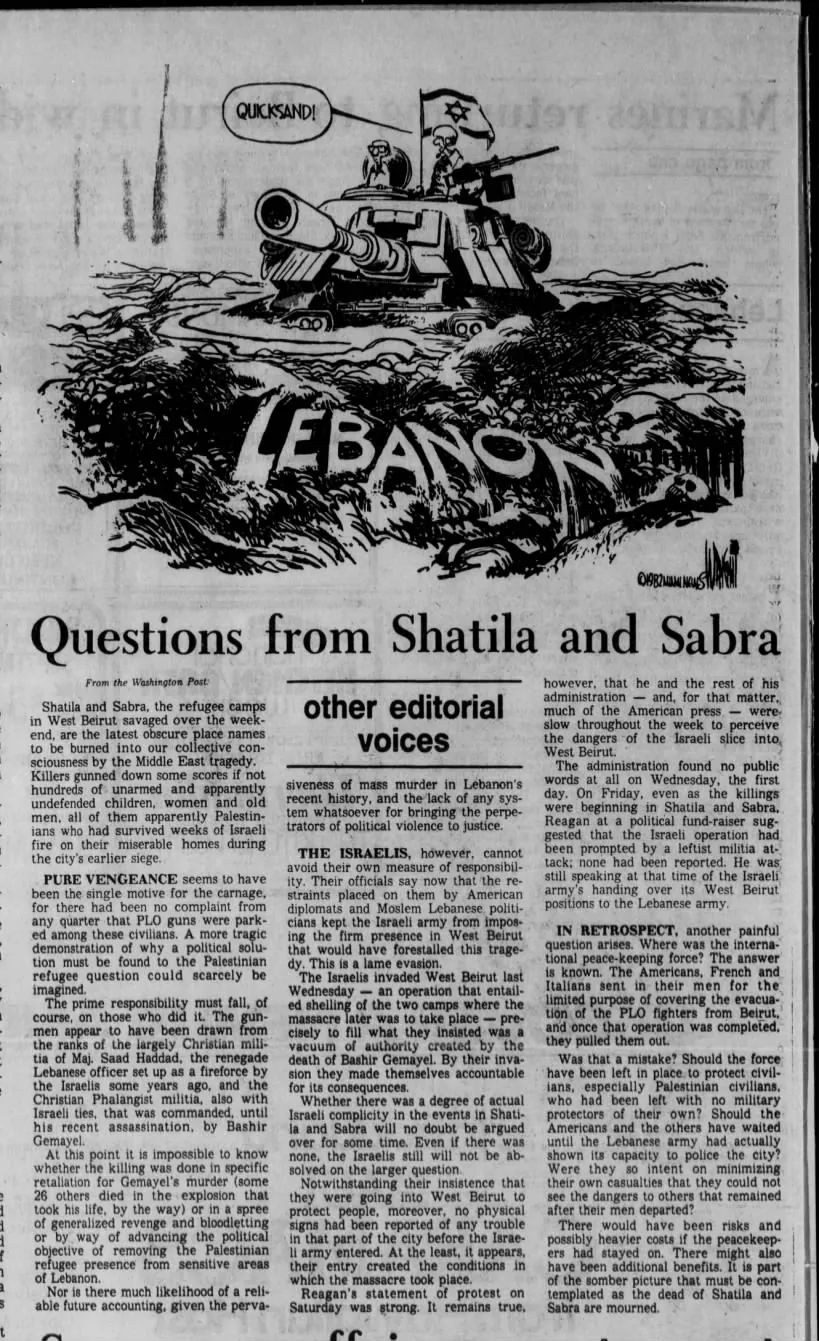
Transcribed from the clipping
“Questions from Shatila and Sabra. Shatila and Sabra, the refugee camps in West Beirut savaged over the weekend, are the latest obscure place names to be burned into our collective consciousness by the Middle East tragedy.
Killers gunned down some scores if not hundreds of unarmed and apparently undefended children, women and old men, all of them apparently Palestinians who had survived weeks of Israeli fire on their miserable homes during the city’s earlier siege.
Pure vengeance seems to have been the single motive for the carnage, for there had been no complaint from any quarter that PLO guns were parked among these civilians. A more tragic demonstration of why a political solution must be found to the Palestinian refugee question could scarcely be imagined. The prime responsibility must fall, of course, on those who did it.
The gunmen appear to have been drawn from the ranks of the largely Christian Phalangist militia of Maj. Saad Haddad, the renegade Lebanese officer set up as a fireforce by the Israelis some years ago, and the Christian Phalangist militia, also with Israeli ties, that was commanded, until his recent assassination, by Bashir Gemayel.
At this point it is impossible to know whether the killing was done in specific retaliation for Gemayel’s murder (some 26 others died in the explosion that took his life, by the way) or in a spree of generalized revenge and bloodletting or by way of advancing the political objective of removing the Palestinian refugee presence from sensitive areas of Lebanon.
Nor is there much likelihood of a reliable future accounting, given the pervasiveness of mass murder in Lebanon’s recent history, and the lack of any system whatsoever for bringing the perpetrators of political violence to justice.
The Israelis, however, cannot avoid their own measure of responsibility. Their officials say now that the restraints placed on them by American diplomats and Moslem Lebanese politicians kept the Israeli army from imposing the firm presence in West Beirut that would have forestalled this tragedy. This is a lame evasion.
The Israelis invaded West Beirut last Wednesday — an operation that entailed shelling of the two camps where the massacre later was to take place — precisely to fill what they insisted was a vacuum of authority created by the death of Bashir Gemayel. By their invasion they made themselves accountable for its consequences.
Whether there was a degree of actual Israeli complicity in the events in Shatila and Sabra will no doubt be argued over for some time. Even if there was none, the Israelis still will not be absolved on the larger question.
Notwithstanding their insistence that they were going into West Beirut to protect people, moreover, no physical signs had been reported of any trouble in that part of the city before the Israeli army entered. At the least, it appears, their entry created the conditions in which the massacre took place…
In retrospect, another painful question arises. Where was the international peace-keeping force? The answer is known. The Americans, French and Italians sent in their men for the limited purpose of covering the evacuation of the PLO fighters from Beirut, and once that operation was completed, they pulled them out. Was that a mistake?
Should the force have been left in place to protect civilians, especially Palestinian civilians, who had been left with no military protectors of their own?… It is part of the somber picture that must be contemplated as the dead of Shatila and Sabra are mourned.”
Context added by this archive
A Washington Post editorial reprinted in Honolulu. It says the massacre cannot be excused by the absence of PLO guns among the civilians, and it puts the question to the Americans as well.
Cite this clipping
"Questions from Shatila and Sabra," Honolulu Star-Bulletin, 21 September 1982, p. 1. Covering Palestine archive, CP-1982-013. https://coveringpalestine.org/archive/cp-1982-013
This clipping is read closely in the section below
More from Honolulu Star-Bulletin
- Zionism and RacismHonolulu Star-Bulletin · 12 March 1976
- Israel Soldiers Patrol Town; Shops ClosedHonolulu Star-Bulletin · 10 November 1981
- Rev. Jackson gets caught in violence in Hebron during tripHonolulu Star-Bulletin · 8 April 1994
- Palestinian poet told of his people’s plightHonolulu Star-Bulletin · 12 August 2008
More from the 1980s
- Even Israelis protest West Bank university shutdownThe Evening Sun · 11 January 1982
- Israel renews charge against PalestiniansThe Baltimore Sun · 3 March 1982
- Israelis Survive Storm Over Bedouin Baby’s DeathThe New York Times · 9 March 1982
- art review/Childhood reflectionsNewsday · 12 March 1982
- Looking the Other WayThe New York Times · 15 March 1982
- Begin will stay on despite voteStamford Advocate · 24 March 1982
- All 527 clippings from the 1980s →
In these collections
Last updated 2 November 2026
This record is part of Covering Palestine, an archive of American newspaper clippings about Palestinians, 1724 to 2023. Researched and assembled by Maria Robles.
The clipping belongs to the newspaper that printed it, or to the news agency that supplied the copy. It is reproduced here for research, criticism and commentary. A city here is where the newspaper was published, not where the story came from, and on most records it was taken from the masthead.
Something wrong here, or something you know about this clipping? The archive is still being built and corrections are wanted: maria@rozumstudio.com, quoting CP-1982-013.
Read in: Sabra and Shatila: from who fired to who knew
Everything printed in 1982 · Printed on this day · See it in the archive reel · Full text of every clipping · Dataset