Evening Star · 30 January 1949
CP-1949-027
Life Harsh in Arab Refugee Camps
By Max Boyd, Associated Press, Gaza, Palestine
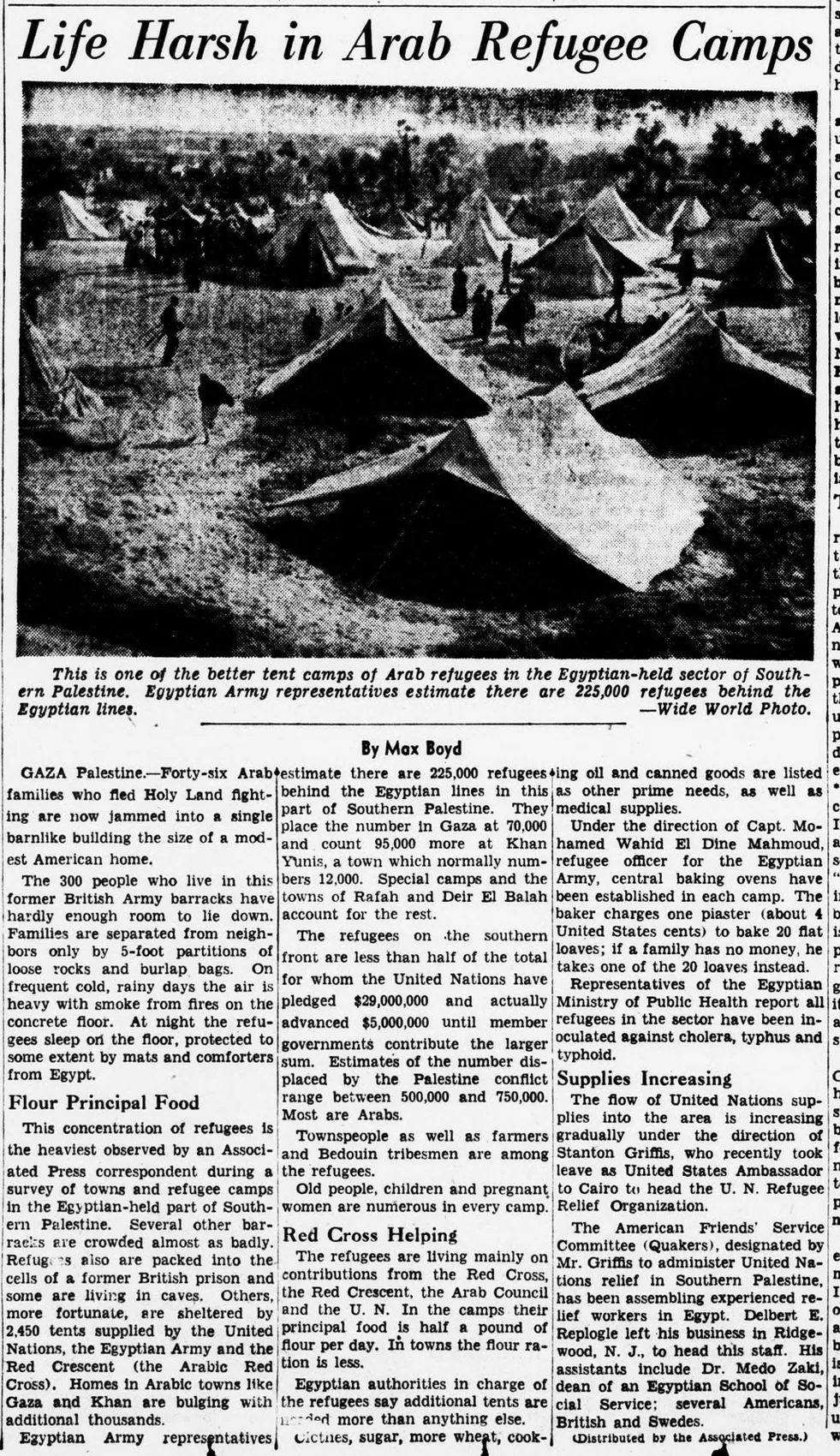
Transcribed from the clipping
“GAZA, Palestine.—Forty-six Arab families who fled Holy Land fighting are now jammed into a single barnlike building the size of a modest American home. The 300 people who live in this former British Army barracks have hardly enough room to lie down. Families are separated from neighbors only by 5-foot partitions of loose rocks and burlap bags. On frequent cold, rainy days the air is heavy with smoke from fires on the concrete floor. At night the refugees sleep on the floor, protected to some extent by mats and comforters from Egypt. This concentration of refugees is the heaviest observed by an Associated Press correspondent during a survey of towns and refugee camps in the Egyptian-held part of Southern Palestine. Several other barracks are crowded almost as badly. Refugees also are packed into the cells of a former British prison and some are living in caves. Others, more fortunate, are sheltered by 2,450 tents supplied by the United Nations, the Egyptian Army and the Red Crescent (the Arabic Red Cross). Homes in Arabic towns like Gaza and Khan are bulging with additional thousands. Egyptian Army representatives estimate there are 225,000 refugees behind the Egyptian lines in this part of Southern Palestine. They place the number in Gaza at 70,000 and count 95,000 more at Khan Yunis, a town which normally numbers 12,000. Special camps and the towns of Rafah and Deir El Balah account for the rest. The refugees on the southern front are less than half of the total for whom the United Nations have pledged $29,000,000 and actually advanced $5,000,000 until member governments contribute the larger sum. Estimates of the number displaced by the Palestine conflict range between 500,000 and 750,000. Most are Arabs. Townspeople as well as farmers and Bedouin tribesmen are among the refugees. Old people, children and pregnant women are numerous in every camp… In the camps their principal food is half a pound of flour per day. In towns the flour ration is less… Under the direction of Capt. Mohamed Wahid El Dine Mahmoud, refugee officer for the Egyptian Army, central baking ovens have been established in each camp. The baker charges one piaster (about 4 United States cents) to bake 20 flat loaves; if a family has no money, he takes one of the 20 loaves instead.”
Photograph caption
“This is one of the better tent camps of Arab refugees in the Egyptian-held sector of Southern Palestine. Egyptian Army representatives estimate there are 225,000 refugees behind the Egyptian lines.” —Wide World Photo.
Context added by this archive
January 1949, eight months after the state was declared. Khan Yunis normally holds twelve thousand people and is holding ninety-five thousand. Half a pound of flour a day. The baker takes one loaf in twenty from families who cannot pay. The subheadings are “Flour Principal Food,” “Red Cross Helping” and “Supplies Increasing.”
Cite this item
"Life Harsh in Arab Refugee Camps," Evening Star, 30 January 1949. Covering Palestine archive, CP-1949-027. https://coveringpalestine.org/archive/cp-1949-027
Elsewhere in the archive
- Britain Gives $2,000,000 To Resettle Arab RefugeesEvening Star · 2 August 1949 · the same newspaper
- Arabs Claim Capture Of Kastel, but Jews Say Town Is TheirsEvening Star · 12 April 1948 · the same newspaper
- Jewish Militia Occupies Two More Arab VillagesEvening Star · 23 April 1948 · the same newspaper
- Palestinian Arabs In Distress, Hope For Speedy War EndAda Evening News · 11 January 1949 · the same year
- Palestinian Arabs, Embittered At War’s Course, Invites Abdullah To Act in Hope for Speedy PeaceSun Journal · 11 January 1949 · the same year
- Palestinian Arabs Hope For PeaceMcAlester News-Capital · 11 January 1949 · the same year
This record is part of Covering Palestine, an archive of American and Anglophone newspaper clippings about Palestinians, 1812 to 2022. Researched and assembled by Maria Robles.
The clipping belongs to the newspaper that printed it, or to the wire service that supplied the copy. It is reproduced here for research, criticism and commentary.
Something wrong here, or something you know about this clipping? The archive is still being built and corrections are wanted: maria@rozumstudio.com, quoting CP-1949-027.
See it in the archive reel · Full text of every clipping · Dataset