The News (Van Nuys) · Van Nuys, California · 13 December 1964
CP-1964-001
Palestinian Artists Depict Tragedy of Great Exodus
Worth a Thousand Words
Transcribed from the clipping
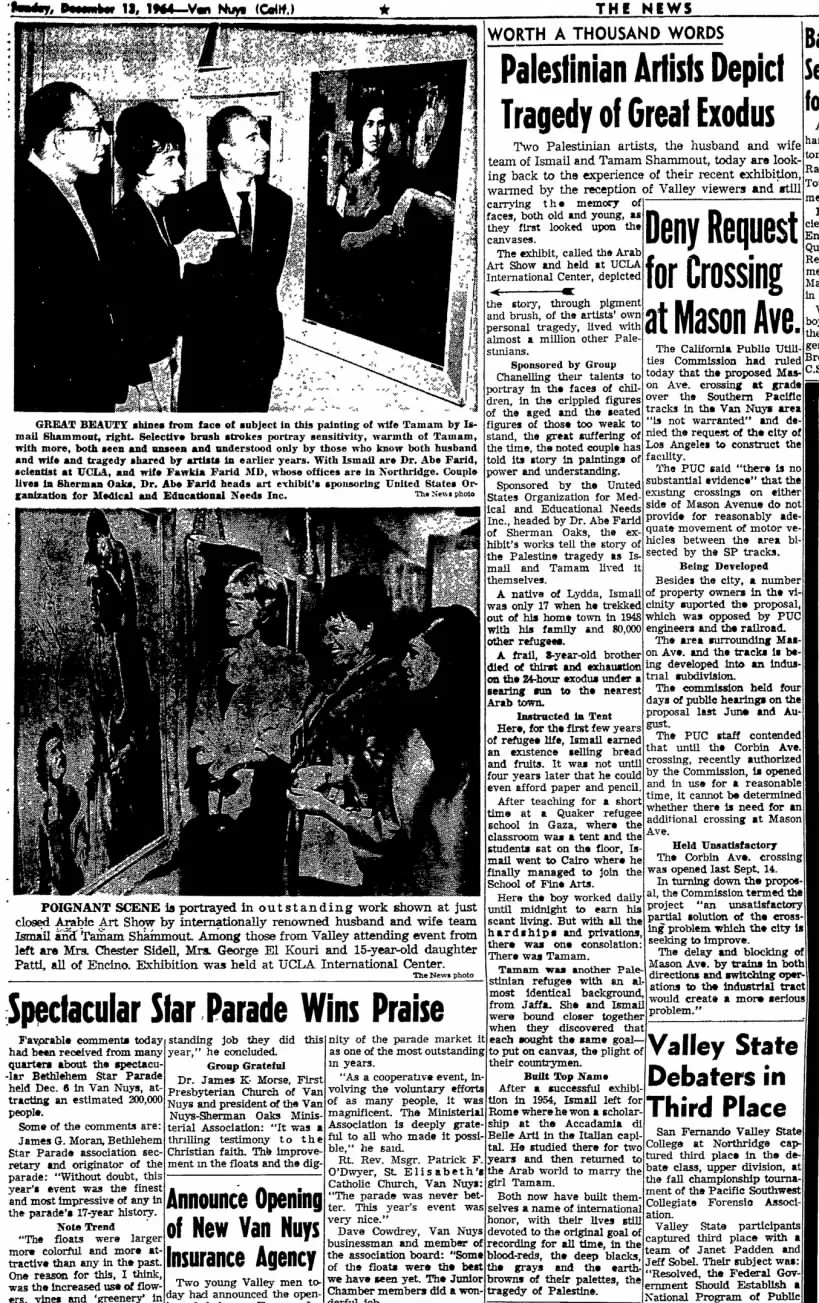
“Two Palestinian artists, the husband and wife team of Ismail and Tamam Shammout, today are looking back to the experience of their recent exhibition, warmed by the reception of Valley viewers and still carrying the memory of faces, both old and young, as they first looked upon the canvases.
The exhibit, called the Arab Art Show and held at UCLA International Center, depicted the story, through pigment and brush, of the artists’ own personal tragedy, lived with almost a million other Palestinians… A native of Lydda, Ismail was only 17 when he trekked out of his home town in 1948 with his family and 80,000 other refugees.
A frail, 3-year-old brother died of thirst and exhaustion on the 24-hour exodus under a searing sun to the nearest Arab town. Here, for the first few years of refugee life, Ismail earned an existence selling bread and fruits. It was not until four years later that he could even afford paper and pencil.
After teaching for a short time at a Quaker refugee school in Gaza, where the classroom was a tent and the students sat on the floor, Ismail went to Cairo where he finally managed to join the School of Fine Arts. Here the boy worked daily until midnight to earn his scant living. But with all the hardships and privations, there was one consolation: There was Tamam.
Tamam was another Palestinian refugee with an almost identical background, from Jaffa.
She and Ismail were bound closer together when they discovered that each sought the same goal — to put on canvas, the plight of their countrymen… Both now have built themselves a name of international honor, with their lives still devoted to the original goal of recording for all time, in the blood-reds, the deep blacks, the grays and the earth-browns of their palettes, the tragedy of Palestine.”
How this transcription was made
Scan replaced on 17 November 2026 with the whole broadsheet page Maria supplied, read at magnification. The page prints its own date line: “Sunday, December 13, 1964—Van Nuys (Calif.)” under the running head THE NEWS, and 13 December 1964 was a Sunday. The date line at the top of the page reads "Sunday, December 13, 1964—Van Nuys (Calif.)" with a star rule and the running head "THE NEWS" at the right. December 13, 1964 was in fact a Sunday, which corroborates the 13 against a blurred "12/13" numeral. Agrees with the label date 1964-12-13. REPLACEMENT, NOT A NEW RECORD. The coordinator has since confirmed this page is already in the archive as CP-1964-001, headline "Palestinian Artists Depict Tragedy of Great Exodus", filed under the paper name "The News (Van Nuys)". It must be ingested as a replacement of CP-1964-001, not accessioned afresh. The deck scan is the whole broadsheet page and carries two photographs with captions the existing record does not have; those captions are the new material. MASTHEAD AGAINST pub. The page prints itself as "THE NEWS" (running head) over the date line "Van Nuys (Calif.)". The input pub is "Valley News"; the existing record uses "The News (Van Nuys)". These are three spellings of one paper and the archive already holds at least two of them. I have changed nothing. Whoever ingests must pick one spelling deliberately, because filing this under "Valley News" while CP-1964-001 sits under "The News (Van Nuys)" is exactly what hid the duplicate in the first place. DEK. The coordinator reports the existing record carries the dek "Worth a Thousand Words". On the page that phrase is set in small caps on a rule ABOVE the headline, across the top of the story block — a standing kicker, not a deck. There is no deck under the headline. I have left dek empty per the rule that a kicker is not a deck, and flag the disagreement with CP-1964-001 rather than silently matching it. UNRESOLVED DIGIT. The sentence about Ismail's brother reads "A frail, [3 or 8]-year-old brother died of thirst and exhaustion on the 24-hour exodus under a searing sun to the nearest Arab town." At this scan's resolution the numeral is about eight pixels tall and will not resolve; magnified to 30x it shows a two-bowl form that leans toward 8, but I will not call it. The coordinator's note says three-year-old. The existing CP-1964-001 excerpt, read from a different scan, should be treated as the authority for that digit, not this image. I have left the sentence out of excerpt and quoted it with the digit bracketed in excerpt_additional. EXCERPT OVERLAP. The existing record already holds a 1,793-character excerpt. The excerpt above was read independently off this scan and runs the full length of the story column; it is not copied from the existing record and may differ from it in small ways. If the two disagree anywhere, that is a flag worth Eva's eye, not a merge to be done quietly. UCLA, THREE TIMES, FOR THE CONSORTIUM BRIEF. The body: "The exhibit, called the Arab Art Show and held at UCLA International Center". The lower caption: "Exhibition was held at UCLA International Center." The upper caption: "Dr. Abe Farid, scientist at UCLA". The show is called the Arab Art Show in the body and the "Arabic Art Show" in the lower caption — the paper set it both ways on the same page; both stay as printed. Sponsor is the United States Organization for Medical and Educational Needs Inc., headed by Dr. Abe Farid of Sherman Oaks. The artists are named in the paper as Ismail and Tamam Shammout (one m in Tamam, two in Shammout, throughout the page). Ismail is given as a native of Lydda who left at 17 in 1948 with his family and 80,000 other refugees; Tamam as a Palestinian refugee from Jaffa. The paper sets the Rome academy as "Accadamia di Belle Arti". That is the paper's spelling and it stays. This record was nearly duplicated: the clipping came back in the November 2026 Los Angeles deck labelled Valley News, and the archive holds this paper under at least two names, so a check on paper and date did not match it. It was caught by reading the masthead.
Context added by this archive
The archive had nothing from 1964 before this. A suburban California paper, nineteen years before the word Nakba reaches American print, describing the expulsion from Lydda, eighty thousand people on the road and a three-year-old dead of thirst on the way — on a page of local news, under a standing head that reads Worth a Thousand Words.
The dead child is the only person in the story who is not named. The exhibition was held at the UCLA International Center, and one of the two photographs on the page names Dr. Abe Farid, a scientist at UCLA, who headed its sponsor — the United States Organization for Medical and Educational Needs.
Twenty-three years later the same Los Angeles organisation appears in the government’s case against the eight Palestinians arrested in Los Angeles in 1987.
Cite this clipping
"Palestinian Artists Depict Tragedy of Great Exodus," The News (Van Nuys), 13 December 1964. Covering Palestine archive, CP-1964-001. https://coveringpalestine.org/archive/cp-1964-001
More from the 1960s
- U.N. Refugee Head on Way to BeirutThe New York Times · 8 January 1964
- Arabs See Pope to Press Plea to Re-enter PalestineThe New York Times · 3 March 1964
- Ahmed Shukairy, Chosen by Arab LeadersThe New York Times · 28 March 1964
- Jordan's Exhibit Assailed by JewsThe New York Times · 25 April 1964
- Weizmann's Book Disavers Alleged Bribe to Ibn SaudWisconsin Jewish Chronicle · 29 May 1964
- Arabs Create Organization For Recovery of PalestineThe New York Times · 29 May 1964
- All 232 clippings from the 1960s →
In these collections
Last updated 17 November 2026
This record is part of Covering Palestine, an archive of American newspaper clippings about Palestinians, 1724 to 2023. Researched and assembled by Maria Robles.
The clipping belongs to the newspaper that printed it, or to the news agency that supplied the copy. It is reproduced here for research, criticism and commentary. A city here is where the newspaper was published, not where the story came from, and on most records it was taken from the masthead.
Something wrong here, or something you know about this clipping? The archive is still being built and corrections are wanted: maria@rozumstudio.com, quoting CP-1964-001.
Everything printed in 1964 · Printed on this day · See it in the archive reel · Full text of every clipping · Dataset