Times Tribune · 8 December 1969
CP-1969-019
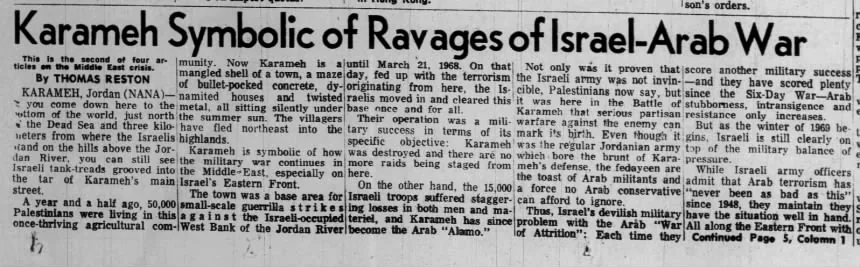
Karameh Symbolic of Ravages of Israel-Arab War
Transcribed from the clipping
KARAMEH, Jordan (NANA)— [first word cut off by the scan] you come down here to the bottom of the world, just north [of] the Dead Sea and three kilometers from where the Israelis stand on the hills above the Jordan River, you can still see Israeli tank-treads grooved into the tar of Karameh’s main street.
A year and a half ago, 50,000 Palestinians were living in this once-thriving agricultural community. Now Karameh is a mangled shell of a town, a maze of bullet-pocked concrete, dynamited houses and twisted metal, all sitting silently under the summer sun. The villagers have fled northeast into the highlands.
Karameh is symbolic of how the military war continues in the Middle-East, especially on Israel’s Eastern Front. The town was a base area for small-scale guerrilla strikes against the Israeli-occupied West Bank of the Jordan River until March 21, 1968. On that day, fed up with the terrorism originating from here, the Israelis moved in and cleared this base once and for all.
Their operation was a military success in terms of its specific objective: Karameh was destroyed and there are no more raids being staged from here. On the other hand, the 15,000 Israeli troops suffered staggering losses in both men and materiel, and Karameh has since become the Arab “Alamo.”
Not only was it proven that the Israeli army was not invincible, Palestinians now say, but it was here in the Battle of Karameh that serious partisan warfare against the enemy can mark it’s birth.
Even though it was the regular Jordanian army which bore the brunt of Karameh’s defense, the fedayeen are the toast of Arab militants and a force no Arab conservative can afford to ignore.
Thus, Israel’s devilish military problem with the Arab “War of Attrition”: Each time they score another military success—and they have scored plenty since the Six-Day War—Arab stubbornness, intransigence and resistance only increases. But as the winter of 1969 begins, Israeli is still clearly on top of the military balance of pressure.
While Israeli army officers admit that Arab terrorism has “never been as bad as this” since 1948, they maintain they have the situation well in hand.
How this transcription was made
Read from the scan by a machine looking at the image of the page, not by optical character recognition and not by a person. The clipping carries no masthead and no dated folio line, so the date recorded here could not be checked against anything printed on the page. Nothing on the page contradicts it.
Cite this clipping
"Karameh Symbolic of Ravages of Israel-Arab War," Times Tribune, 8 December 1969. Covering Palestine archive, CP-1969-019. https://coveringpalestine.org/archive/cp-1969-019
More from Times Tribune
- Violence rips MideastTimes Tribune · 7 October 2000
- Step toward apartheidTimes Tribune · 30 January 2020
More from the 1960s
- Israel Integrating Druze AreasThe Plain Dealer · 1969
- Arabs Create 'Schools of Hate' for YoungSan Francisco Examiner · 12 January 1969
- Arab textbooks carry message of hatredAlbany Democrat-Herald · 22 January 1969
- Dayan Tours Four Towns in West-Bank RegionThe New York Times · 12 February 1969
- Israelis Slaughter Palestine ArabsFlorida Today · 13 February 1969
- Another View On Justice, TruthWorcester Telegram · 19 February 1969
- All 227 clippings from the 1960s →
The same copy, in 1 other paper
Their text and this one are nearly identical. Found by comparing transcriptions, not by reading them side by side, so this establishes that the text overlaps and not that these papers ran the same dispatch. How this was done.
Last updated 2 November 2026
This record is part of Covering Palestine, an archive of American newspaper clippings about Palestinians, 1724 to 2023. Researched and assembled by Maria Robles.
The clipping belongs to the newspaper that printed it, or to the news agency that supplied the copy. It is reproduced here for research, criticism and commentary. A city here is where the newspaper was published, not where the story came from, and on most records it was taken from the masthead.
Something wrong here, or something you know about this clipping? The archive is still being built and corrections are wanted: maria@rozumstudio.com, quoting CP-1969-019.
Everything printed in 1969 · Printed on this day · See it in the archive reel · Full text of every clipping · Dataset