Fall River Herald News · 12 November 1969
CP-1969-029
Palestine Could Be Another Vietnam
By C. L. SULZBERGER / (C) New York Times News Service
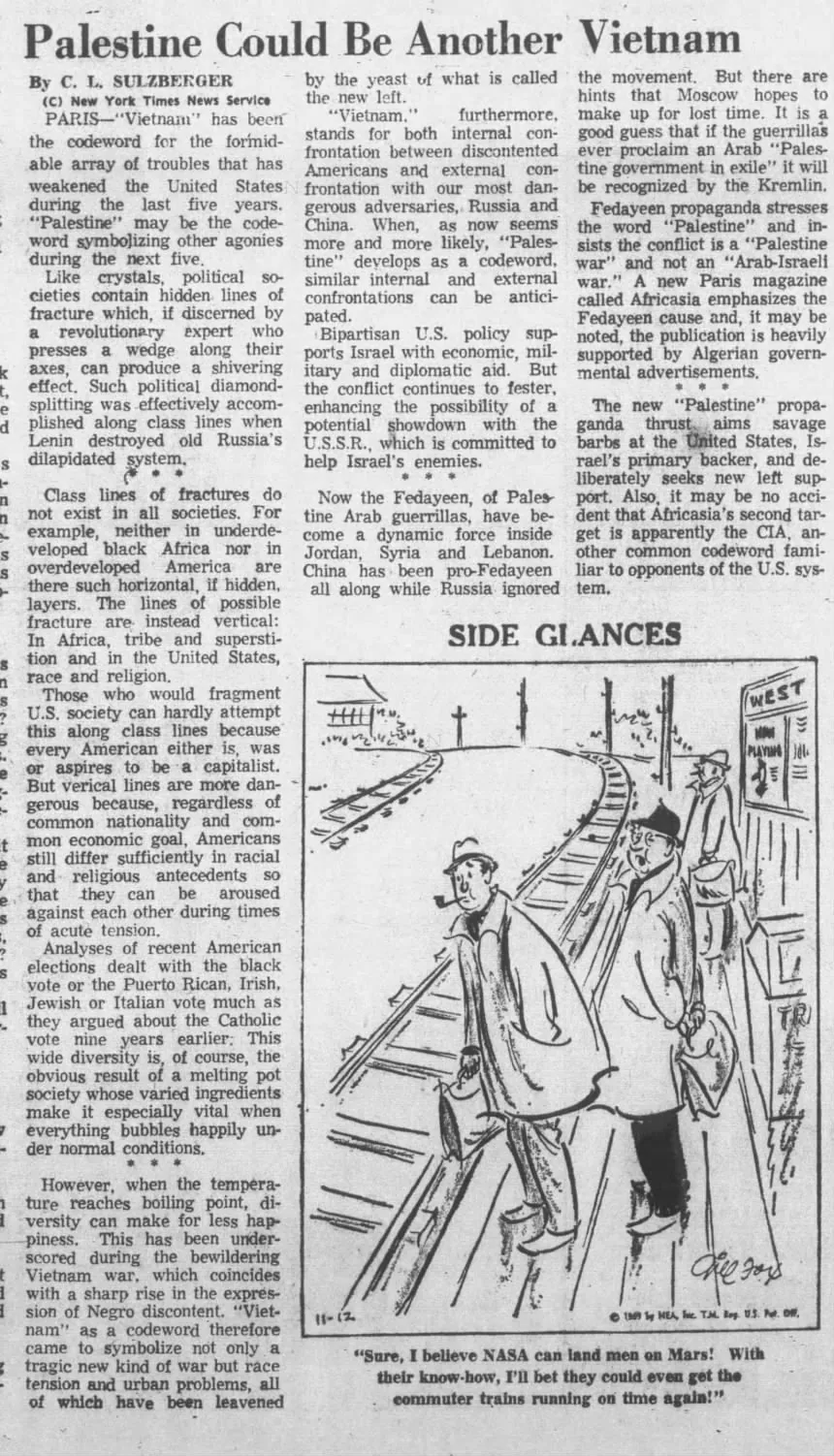
Transcribed from the clipping
PARIS—"Vietnam" has been the codeword for the formidable array of troubles that has weakened the United States during the last five years. "Palestine" may be the codeword symbolizing other agonies during the next five.
Like crystals, political societies contain hidden lines of fracture which, if discerned by a revolutionary expert who presses a wedge along their axes, can produce a shivering effect. Such political diamond-splitting was effectively accomplished along class lines when Lenin destroyed old Russia's dilapidated system. Class lines of fractures do not exist in all societies.
For example, neither in underdeveloped black Africa nor in overdeveloped America are there such horizontal, if hidden, layers. The lines of possible fracture are instead vertical: In Africa, tribe and superstition and in the United States, race and religion.
Those who would fragment U.S. society can hardly attempt this along class lines because every American either is, was or aspires to be a capitalist.
But verical lines are more dangerous because, regardless of common nationality and common economic goal, Americans still differ sufficiently in racial and religious antecedents so that they can be aroused against each other during times of acute tension.
Analyses of recent American elections dealt with the black vote or the Puerto Rican, Irish, Jewish or Italian vote much as they argued about the Catholic vote nine years earlier. This wide diversity is, of course, the obvious result of a melting pot society whose varied ingredients make it especially vital when everything bubbles happily under normal conditions.
However, when the temperature reaches boiling point, diversity can make for less happiness. This has been underscored during the bewildering Vietnam war, which coincides with a sharp rise in the expression of Negro discontent.
"Vietnam" as a codeword therefore came to symbolize not only a tragic new kind of war but race tension and urban problems, all of which have been leavened by the yeast of what is called the new left. "Vietnam," furthermore, stands for both internal confrontation between discontented Americans and external confrontation with our most dangerous adversaries, Russia and China.
When, as now seems more and more likely, "Palestine" develops as a codeword, similar internal and external confrontations can be anticipated. Bipartisan U.S. policy supports Israel with economic, military and diplomatic aid. But the conflict continues to fester, enhancing the possibility of a potential showdown with the U.S.S.R., which is committed to help Israel's enemies.
Now the Fedayeen, of Palestine Arab guerrillas, have become a dynamic force inside Jordan, Syria and Lebanon. China has been pro-Fedayeen all along while Russia ignored the movement. But there are hints that Moscow hopes to make up for lost time.
It is a good guess that if the guerrillas ever proclaim an Arab "Palestine government in exile" it will be recognized by the Kremlin.
Fedayeen propaganda stresses the word "Palestine" and insists the conflict is a "Palestine war" and not an "Arab-Israeli war." A new Paris magazine called Africasia emphasizes the Fedayeen cause and, it may be noted, the publication is heavily supported by Algerian governmental advertisements.
The new "Palestine" propaganda thrust aims savage barbs at the United States, Israel's primary backer, and deliberately seeks new left support. Also, it may be no accident that Africasia's second target is apparently the CIA, another common codeword familiar to opponents of the U.S. system.
How this transcription was made
Date confirmed on the page (eva-folio). Adjudicated corrected against the printed page: The 'SIDE GLANCES' single-panel cartoon printed on the same page, directly beneath the Sulzberger column, carries the artist's date stamp '11-12' in the lower left corner of the panel, and the copyrig.
Context added by this archive
AN OP-ED COLUMN, and the one clipping in the batch that is explicitly ABOUT the word Palestine rather than about events in it. Sulzberger's thesis is that 'Palestine' is becoming a codeword in American politics the way 'Vietnam' did — a term that fuses an external confrontation with the Soviet Union to an internal one among Americans divided by 'race and religion'.
He is not reporting a claim that talking about liberating Palestine is anti-Jewish; he is doing something adjacent and, for Maria's purposes, more interesting.
He treats Palestinian self-naming as itself a propaganda operation: 'Fedayeen propaganda stresses the word "Palestine" and insists the conflict is a "Palestine war" and not an "Arab-Israeli war."' The insistence on the name is the evidence of the propaganda. Every use of the word in the column is inside quotation marks.
So the column records, in 1969 and in a New York Times News Service column syndicated to small American dailies, the exact moment the term was contested — and comes down on the side of treating it as a Soviet- and Chinese-adjacent slogan rather than a description.
Note also the frame he builds around it: Palestine as a wedge to 'fragment U.S. society' along lines of 'racial and religious antecedents', with American Jews and the new left named as the two poles. That is one step from the argument Maria flagged, and it is in a column, not a news story. No Palestinian is quoted. No Palestinian is named.
The only actors are Moscow, Peking, Algiers, the Kremlin, the CIA, the new left and 'the Fedayeen'. TERMINOLOGY: 'Palestine Arab guerrillas', 'the Fedayeen', 'an Arab "Palestine government in exile"'. The word 'Palestinian' does not appear once.
Cite this clipping
"Palestine Could Be Another Vietnam," Fall River Herald News, 12 November 1969. Covering Palestine archive, CP-1969-029. https://coveringpalestine.org/archive/cp-1969-029
More from the 1960s
- Israel Integrating Druze AreasThe Plain Dealer · 1969
- Arabs Create 'Schools of Hate' for YoungSan Francisco Examiner · 12 January 1969
- Arab textbooks carry message of hatredAlbany Democrat-Herald · 22 January 1969
- Dayan Tours Four Towns in West-Bank RegionThe New York Times · 12 February 1969
- Israelis Slaughter Palestine ArabsFlorida Today · 13 February 1969
- Another View On Justice, TruthWorcester Telegram · 19 February 1969
- All 227 clippings from the 1960s →
Last updated 2 November 2026
This record is part of Covering Palestine, an archive of American newspaper clippings about Palestinians, 1724 to 2023. Researched and assembled by Maria Robles.
The clipping belongs to the newspaper that printed it, or to the news agency that supplied the copy. It is reproduced here for research, criticism and commentary. A city here is where the newspaper was published, not where the story came from, and on most records it was taken from the masthead.
Something wrong here, or something you know about this clipping? The archive is still being built and corrections are wanted: maria@rozumstudio.com, quoting CP-1969-029.
Everything printed in 1969 · Printed on this day · See it in the archive reel · Full text of every clipping · Dataset