Southern Illinoisan · Carbondale, Illinois · 20 May 1976
CP-1976-009
Do Americans know how the Palestinians suffer?
Commentary
Hatem Hussaini, Washington
Transcribed from the clipping
“Wherever I move or turn in this country I see images of my occupied country, Palestine, and its dispossessed people, the Palestinians. Every breathing moment I feel the exile, suffering and pain of it all. As if mankind’s wounds and tragedies are centered in Palestine, in me. And I keep asking: Do Americans really know the suffering of my people? I have seen myself distorted on United States television so many times. ‘Terrorists, infiltrators, murderers.’ Even my five-year-old daughter, born in this country, said suddenly to her mother, ‘Palestinians are bad.’ And we have to explain: No, beautiful one, we Palestinians are good; we want peace, brotherhood, happiness. But very few listen and understand… Of the thousands expelled since 1967 two came here to explain, Hanna Nasir, a humane president of Birzeit College expelled by the Israeli military on Nov. 21, 1974, and Abdel Jawad Saleh, a popular mayor of the town of Al-Birah, expelled on Dec. 10, 1973. No charges, no trial, simply a military order of ‘deportation’ read by Israeli soldiers at the border. They tried to explain here that this is illegal, contrary to Geneva Convention agreements. No response. The only moving thing they did was to speak by telephone to their wives and children, whom they cannot see on the occupied West Bank. I will never forget Mr. Nasir’s emotional words: ‘Don’t worry, son. I will return. I love you all.’… Wael Zeiter, a young Palestinian activist murdered in Rome on Oct. 16, 1972, was denied the right by the Israeli authorities to be buried in his hometown, Nablus… When I applied in 1972, two Israeli officials interviewed me at length in Washington, D.C., and demanded, ‘Why do you want to return?’ Because I love my people and want to live in peace and teach at a college. They made me fill seven long application forms and never replied to me… And we to become like the native Indians, faceless, strangers in our own land, withering away in reservations?… We have learned, however, the humane thought of Jews like Ahad Ha’am and Judah Magnes and Israelis like Israel Shahaq and Felicia Langer who have spoken of justice for Palestinians… I tell my daughter and my angry conscience: We want peace and brotherhood in Palestine. The guns will be turned into plowshares soon, so my child, all children, will play in peace under the ancient olive trees and sing and learn the Arab and Jewish humane heritage and culture.”
Photograph caption
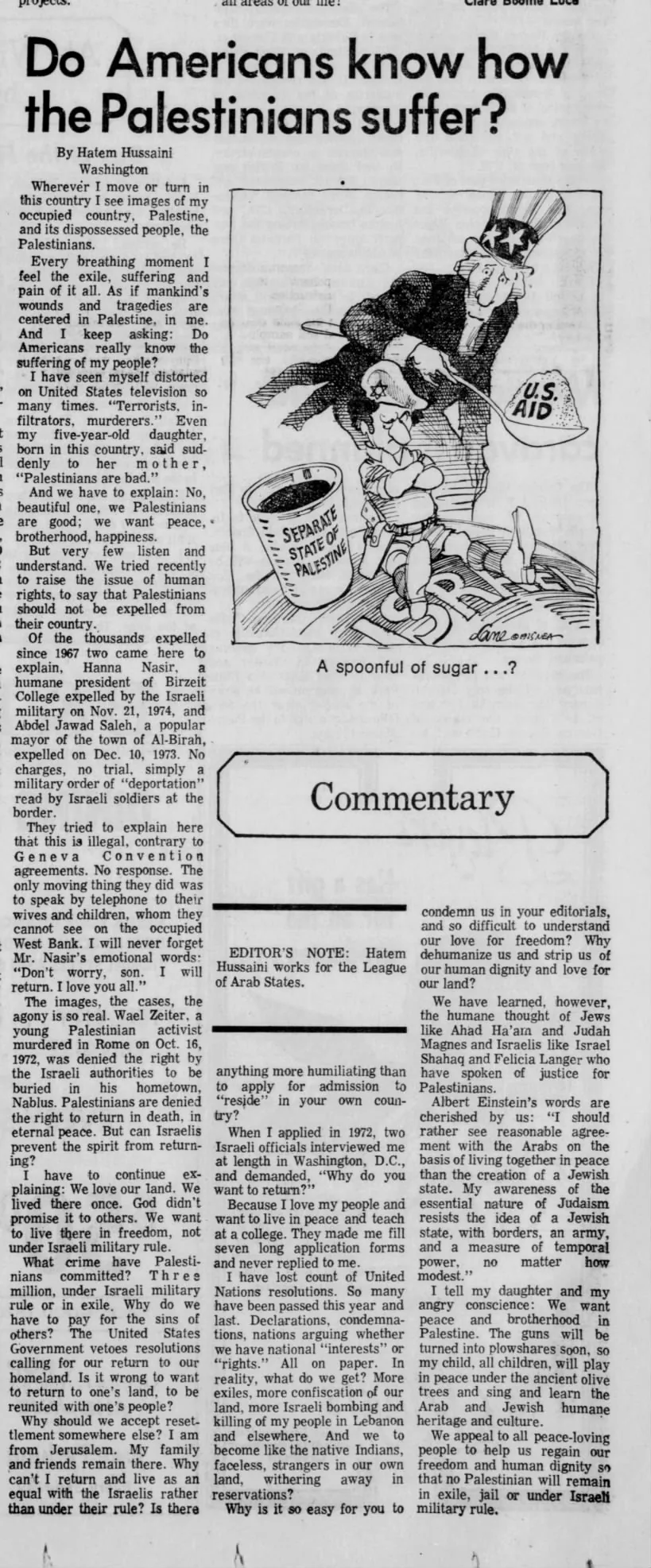
A cartoon captioned “A spoonful of sugar …?” shows Uncle Sam spooning U.S. AID into an armed figure standing on the word ISRAEL, beside an untouched cup labelled SEPARATE STATE OF PALESTINE.
Context added by this archive
A signed Palestinian commentary in a southern Illinois daily. The editor’s note says only that Hatem Hussaini works for the League of Arab States. The archive already holds him speaking two years later at the Palestine Information Office in Washington. Hanna Nasir, Israel Shahak and Felicia Langer each appear in other clippings here across the 1970s and 1980s.
Cite this item
"Do Americans know how the Palestinians suffer?," Southern Illinoisan, 20 May 1976. Covering Palestine archive, CP-1976-009. https://coveringpalestine.org/archive/cp-1976-009
Elsewhere in the archive
- What’s Happening In GazaSouthern Illinoisan · 10 March 1955 · the same newspaper
- Israel kills Palestinian in renewed hostilitiesSouthern Illinoisan · 13 December 2000 · the same newspaper
- Plight of four schoolgirls illustrates frustration of West Bank occupationBellingham Herald · 17 March 1976 · the same year
- Arabs Killed In Rioting In IsraelEffingham Daily News · 30 March 1976 · the same year
- Israel Fights ‘Worst Arab Riot’Pittsburgh Press · 30 March 1976 · the same year
This record is part of Covering Palestine, an archive of American and Anglophone newspaper clippings about Palestinians, 1812 to 2022. Researched and assembled by Maria Robles.
The clipping belongs to the newspaper that printed it, or to the wire service that supplied the copy. It is reproduced here for research, criticism and commentary. The city is derived from the masthead, not read off the clipping.
Something wrong here, or something you know about this clipping? The archive is still being built and corrections are wanted: maria@rozumstudio.com, quoting CP-1976-009.
See it in the archive reel · Full text of every clipping · Dataset