The New York Times · 18 May 1976
CP-1976-048
ISRAELI SOLDIERS KILL ARAB YOUTH
2d Such Death in 2 Days—Government Fears Unrest Is Growing Worse
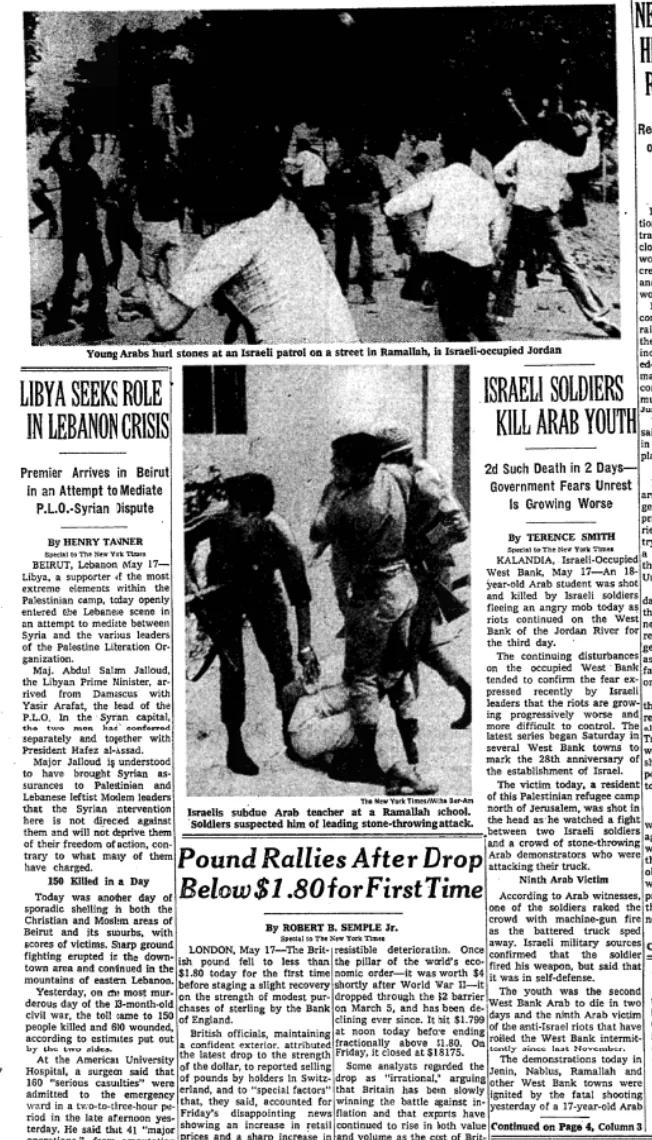
Transcribed from the clipping
KALANDIA, Israeli-Occupied West Bank, May 17—An 18-year-old Arab student was shot and killed by Israeli soldiers fleeing an angry mob today as riots continued on the West Bank of the Jordan River for the third day.
The continuing disturbances on the occupied West Bank tended to confirm the fear expressed recently by Israeli leaders that the riots are growing progressively worse and more difficult to control. The latest series began Saturday in several West Bank towns to mark the 28th anniversary of the establishment of Israel.
The victim today, a resident of this Palestinian refugee camp north of Jerusalem, was shot in the head as he watched a fight between two Israeli soldiers and a crowd of stone-throwing Arab demonstrators who were attacking their truck. Ninth Arab Victim According to Arab witnesses, one of the soldiers raked the crowd with machine-gun fire as the battered truck sped away.
Israeli military sources confirmed that the soldier fired his weapon, but said that it was in self-defense. … Apparently in fear of their lives, the soldiers pulled away. Fifty yards further down the road they passed the Kalandia Vocational Training School, a project of the United Nations Relief and Works Agency. The headmaster, Nabih M.
Awad, was standing at the gate with a group of students watching the fighting. “As the truck raced by I suddenly saw an Uzi submachine gun barrel poke out of the driver’s window,” Mr. Awad said. “There was a burst of fire and we all dived to the ground. When I looked up I saw that one boy had been hit in the head. The truck never stopped.”
The victim was Abdullah Mustapha Halil Hawas, a student whose family lives in the nearby Shuafat refugee camp. Mr. Awad said that neither he nor any of the boys from the school had participated in the fight against the truck. … Israeli Soldiers Kill an Arab Youth on West Bank Continued From Page 1, Col. 4 student by Israeli soldiers in Nablus.
Both that incident and the shooting today are being investigated by military authorities. It was also announced that Clara Guinness, a 32-year-old immigrant from Colombia, died last night of the wounds she received two weeks ago in a bomb explosion in downtown Jerusalem. Mrs.
Guiness was one of 30 people wounded in the attack, for which a Palestinian guerrilla organization in Beirut took responsibility. Mrs. Guinness had given birth to a baby nine days before the explosion. In Nablus, thousands of residents thronged the streets waving Palestinian flags, chanting slogans and shouting “murderers” at Israeli soldiers on patrol.
Heavy reinforcements were called in and beat back the crowds with baton charges and water cannon. All the shops and schools in Nablus were closed as part of a two-day general strike to protest the shooting yesterday. The young woman, Hassan Lina Hassan Nabulsi, was the daughter of an influential family and a relative of a former prime minister of Jordan, Suleiman Nabulsi.
The army imposed a curfew on many sectors of Nablus, the northern town of Jenin and the camp at Balata, where 20,000 Palestinian refugees live in squalid one-story shacks. In Ramallah, where this reporter spent much of the day, there were demonstrations throughout the morning and afternoon.
Angry crowds of Arabs surged through the streets throwing up stone barricades and setting fire to tires. Black smoke from dozens of such fires drifted across the mountain town. Truckloads of armed, helmeted border police moved through the town, breaking up crowds wherever they could catch them.
In one instance, the border guards fought a pitched battle with a mob of 200 high school students. They chased the students into the grounds of the Ramallah Teachers College, picking up the stones that had been thrown at them and hurling them back. Despite standing orders not to enter schools, the enraged soldiers rushed into the college with their white riot batons swinging.
Several persons were injured, including three members of the faculty who tried to block the soldiers at the entrance. The shooting incident at Kalandia illustrated the problems encountered by Israeli soldiers who lack any special riot training but now are being forced almost every day to battle an aroused civilian population.
The two soldiers involved were driving in an army truck from Jerusalem to Ramallah about 8 A.M. when they suddenly encountered a roadblock across the highway opposite the Kalandia refugee camp. A crowd estimated by Israeli sources at 200 descended on the truck, showered it with rocks and shattered all the windows. Apparently in fear of their lives, the soldiers pulled away.
Fifty yards further down the road they passed the Kalandia Vocational Training School, a project of the United Nations Relief and Works Agency. The headmaster, Nabih M. Awad, was standing at the gate with a group of students watching the fighting. “As the truck raced by I suddenly saw an Uzi submachine gun barrel poke out of the driver’s window,” Mr.
Awad said. “There was a burst of fire and we all dived to the ground. When I looked up I saw that one boy had been hit in the head. The truck never stopped.” The victim was Abdullah Mustapha Halil Hawas, a student whose family lives in the nearby Shuafat refugee camp. Mr.
Awad said that neither he nor any of the boys from the school had participated in the fight against the truck. The youth was buried this evening in a ceremony at the Mosque of Al Aksa that followed an hour-long funeral procession through East Jerusalem. The several hundred mourners marched through the streets carrying Palestinian flags and flower wreaths.
After the ceremony, several dozen of the mourners clashed with a phalanx of border policemen drawn up outside the walled Old City.
The border guards used clubs and tear gas to break up the crowd and ripped the Palestinian flags from their standards. [Below the article in the first column, a SEPARATE and unrelated story: “Canadian Labor Authorizes Strike Over Economic Curbs”, datelined QUEBEC, May 17 (UPI). Not transcribed — nothing to do with Palestine.
The lower half of the page is display advertising: Puro Corporation of America (Koldwave air conditioner), Mervin S. Levine Custom Tailors, Backgammon, and a Fresh Air Fund notice.]
How this transcription was made
Transcribed from scans of TWO printed pages, which together carry one article. The first, 53-image113, is the front page and ends 'Continued on Page 4, Column 3'; the second, 53-image115, is page 4, headed 'Continued From Page 1, Col. 4' under the jump headline 'Israeli Soldiers Kill an Arab Youth on West Bank'. They are two halves of one Terence Smith story, which is why the slide label gives the same date twice rather than two different dates; the record is written as one because everything the archive counts is on page 4 and none of it is on page 1. The jump page carries the running head 'THE NEW YORK TIMES, TUESDAY, MAY 18, 1976' - 18 May 1976 was a Tuesday - so the date and the newspaper are fixed from the page; the front page carries no masthead but agrees independently, its dateline reading 'KALANDIA, Israeli-Occupied West Bank, May 17' and its riots dated from the Saturday of the 28th anniversary of Israel's establishment. THE EXCERPT CONTAINS AN ELISION, marked with an ellipsis: everything before it is from the front page and everything after it from page 4. Front page and jump page name the same territory differently, the caption saying 'Ramallah, in Israeli-occupied Jordan' and the dateline 'Israeli-Occupied West Bank'. Read from crops magnified to between twelve and eighteen times page scale. The other part of this article was added on 2 November 2026 from a second clipping (m005_1.png).
Cite this clipping
"ISRAELI SOLDIERS KILL ARAB YOUTH," The New York Times, 18 May 1976. Covering Palestine archive, CP-1976-048. https://coveringpalestine.org/archive/cp-1976-048
More from The New York Times
- The Maine Colony in PalestineThe New York Times · 12 November 1866
- Jewish Colonization in PalestineThe New York Times · 9 December 1883
- Jewish State in Palestine OpposedThe New York Times · 9 July 1897
- ZIONIST CONGRESS IN BASELThe New York Times · 31 August 1897
- ROME FEARS THE ZIONISTSThe New York Times · 12 September 1897
- PROGRESS OF ZIONISMThe New York Times · 16 December 1901
- 852 more from this paper in the full text →
More from the 1970s
- Palestinians and Leftist Factions Open an Offensive in BeirutThe New York Times · 8 January 1976
- Equation Of Zionism With Racism Shocked CleaverPaducah Sun · 13 January 1976
- Arab prisoner manages to retain political attitudesMidland Reporter Telegram · 29 January 1976
- Drive to liberate Palestine intensifiesChicago Tribune · 29 February 1976
- Zionism and RacismHonolulu Star-Bulletin · 12 March 1976
- Plight of four schoolgirls illustrates frustration of West Bank occupationBellingham Herald · 17 March 1976
- All 338 clippings from the 1970s →
Last updated 2 November 2026
This record is part of Covering Palestine, an archive of American newspaper clippings about Palestinians, 1724 to 2023. Researched and assembled by Maria Robles.
The clipping belongs to the newspaper that printed it, or to the news agency that supplied the copy. It is reproduced here for research, criticism and commentary. A city here is where the newspaper was published, not where the story came from, and on most records it was taken from the masthead.
Something wrong here, or something you know about this clipping? The archive is still being built and corrections are wanted: maria@rozumstudio.com, quoting CP-1976-048.
Everything printed in 1976 · Printed on this day · See it in the archive reel · Full text of every clipping · Dataset