LA Weekly · 20 August 1987
CP-1987-076
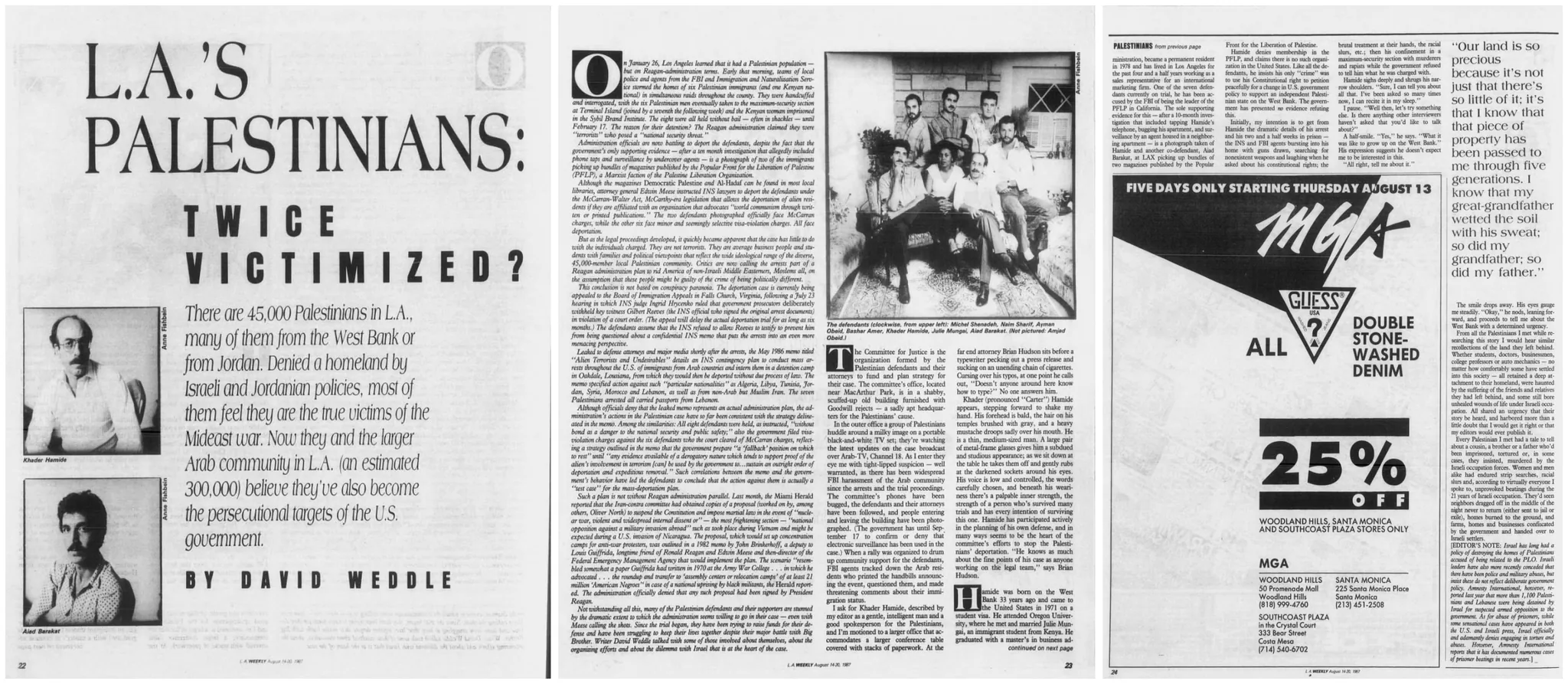
L.A.'S PALESTINIANS: TWICE VICTIMIZED?
There are 45,000 Palestinians in L.A., many of them from the West Bank or from Jordan. Denied a homeland by Israeli and Jordanian policies, most of them feel they are the true victims of the Mideast war. Now they and the larger Arab community in L.A. (an estimated 300,000) believe they’ve also become the persecutional targets of the U.S. government.
BY DAVID WEDDLE
Transcribed from the clipping
The Committee for Justice is the organization formed by the Palestinian defendants and their attorneys to fund and plan strategy for their case. The committee’s office, located near MacArthur Park, is in a shabby, scuffed-up old building furnished with Goodwill rejects — a sadly apt headquarters for the Palestinians’ cause.
In the outer office a group of Palestinians huddle around a milky image on a portable black-and-white TV set; they’re watching the latest updates on the case broadcast over Arab-TV, Channel 18.
As I enter they eye me with tight-lipped suspicion — well warranted, as there has been widespread FBI harassment of the Arab community since the arrests and the trial proceedings. The committee’s phones have been bugged, the defendants and their attorneys have been followed, and people entering and leaving the building have been photographed.
(The government has until September 17 to confirm or deny that electronic surveillance has been used in the case.) When a rally was organized to drum up community support for the defendants, FBI agents tracked down the Arab residents who printed the handbills announcing the event, questioned them, and made threatening comments about their immigration status.
I ask for Khader Hamide, described by my editor as a gentle, intelligent man and a good spokesperson for the Palestinians, and I’m motioned to a larger office that accommodates a larger conference table covered with stacks of paperwork.
At the far end attorney Brian Hudson sits before a typewriter pecking out a press release and sucking on an unending chain of cigarettes. Cursing over his typos, at one point he calls out, “Doesn’t anyone around here know how to type?” No one answers him.
How this transcription was made
Read from the scan Maria supplied on 17 November 2026, at magnification, band by band. DISAGREEMENT. All three pages carry the running foot "L.A. WEEKLY August 14-20, 1987". The label date 1987-08-20 is the last day of that issue week, not a date printed as the issue date. I have left date unchanged as instructed and report it here. The pages are numbered 22, 23 and 24. MASTHEAD AGAINST PUB. The running foot sets the paper's name as "L.A. WEEKLY", with periods, against pub "LA Weekly". I have not touched pub; flagging because a second spelling would ingest as a second paper. DATE. The three pages date the issue "August 14-20, 1987", not August 20. Repeated in date_check. date left as supplied. label_uncertain was true. The three images do belong to one article and the order is 22, 23, 24, fixed by the printed folios and confirmed by the sense: page 23 ends "continued on next page" and page 24 opens with the jump line "PALESTINIANS from previous page". Page 22 is the display page (headline, deck, byline, two portraits), page 23 opens the text, page 24 carries the continuation, a pull quote and the Editor's note. WHAT THE EDITOR'S NOTE SAYS AND WHY IT IS SET APART. It is a bracketed, italicised intervention by the editors inside Weddle's reporting, and it is placed immediately after the paragraph in which he reports what the Palestinians he interviewed told him: that every one of them had a cousin, a brother or a father imprisoned, tortured or in some cases murdered by Israeli occupation forces, that women and men alike had endured strip searches and racial slurs, that there had been unprovoked beatings, neighbours dragged off at night never to return, homes burned, farms and businesses confiscated and handed over to Israeli settlers. The note does not dispute any of that. What it does is interpose sourcing: it concedes Israel's long-standing policy of demolishing the homes of Palestinians accused of PLO ties, says Israeli leaders have recently conceded police and military abuses while denying deliberate policy, cites Amnesty International on more than 1,100 Palestinians and Lebanese detained for suspected armed opposition, and records that Israel officially and adamantly denies torture while Amnesty reports documented cases of prisoner beatings. It is set apart in brackets and italic precisely because it is not Weddle's voice: the paper is stepping into its own reporter's piece to corroborate and to balance the testimony of the Palestinians he interviewed at the exact point where that testimony is most damaging. For an archive about what American newspapers printed about Palestinians, the note is the story: the Palestinians' own accounts are the only passage in three pages that the editors felt needed a third party to vouch for them. There is a SECOND editorial text, separate from the Editor's note, which I have not put in context_note. Page 23's whole left half is an unsigned italic introduction, roughly eight paragraphs, running from "On January 26, Los Angeles learned that it had a Palestinian population..." to "...Writer David Weddle talked with some of those involved about themselves, about the organizing efforts and about the dilemma with Israel that is at the heart of the case." The third-person reference to Weddle shows it is the editors' voice, not his. The article proper begins after it, at the drop cap on "The Committee for Justice", which is where my excerpt starts. SPELLING, as printed, not repaired: this paper sets the defendant's surname "Shenadeh" in the group caption, where the Chicago Tribune of 21 June sets "Shehadeh". I checked the LA Weekly caption at 16x and it is Shenadeh. Also printed here as "Julie Mungai" and "Khader Hamide", against the Tribune's "Julie Nuangugi Mungai" and "Khader Musa Hamide". This caption names all eight defendants, which the Chicago Tribune's caption could not: Michel Shenadeh, Naim Sharif, Ayman Obeid, Bashar Amer, Khader Hamide, Julie Mungai, Aiad Barakat, and Amjad Obeid as not pictured. Taken with la055 it closes the gap left by the Tribune's "an unidentified woman". photo_caption holds three separate captions from two pages, separated by vertical bars: the two portrait labels on page 22 ("Khader Hamide", "Aiad Barakat", both credited "Anne Fishbein" in vertical type beside the frames) and the group photograph caption on page 23 (also credited Anne Fishbein). Quotations worth having that fall outside the excerpt, and so are not in quotes: the large pull quote on page 24, "Our land is so precious because it's not just that there's so little of it; it's that I know that that piece of property has been passed to me through five generations. I know that my great-grandfather wetted the soil with his sweat; so did my grandfather; so did my father." I could not find those words verbatim in the running text on these three pages, so I will not name the speaker; the narrative around it is Weddle's interview with Hamide, who the next paragraph describes telling him about the West Bank with a determined urgency. Also on page 24, Hamide: "I've been asked so many times now, I can recite it in my sleep." and "All right, tell me about it." Say the word and I will widen the excerpt to carry them properly. On MARIA'S NOTE that this is interesting for the Consortium: besides the Editor's note, the piece gives the figure of 45,000 Palestinians in Los Angeles and an estimated 300,000 in the larger Arab community — against the 20,000 the Los Angeles Times gave for the Palestinian community two months earlier in la054. The two figures cannot both be right and the gap is worth a look before either is quoted. University material: Hamide came to the United States in 1971 on a student visa and the paper says he "attended Oregon University" (set that way, presumably the University of Oregon), where he met and married Julie Mungai, an immigrant student from Kenya. The committee's office is near MacArthur Park; the community watches the case on Arab-TV, Channel 18. The word "persecutional" in the deck is the paper's, not a slip of mine. In the italic introduction the FEMA director's surname is set "Giuffrida" and then, four lines later, "Guiffrida". Both are as printed; I have repaired neither. PASSPORTS, against la054. The italic introduction states that the seven Palestinians arrested all carried passports from Lebanon, and that the leaked May 1986 INS memo named Algeria, Libya, Tunisia, Jordan, Syria, Morocco and Lebanon as "particular nationalities". The Los Angeles Times of 15 June called the same group "seven Jordanians and a Kenyan". The papers do not agree on what passports the eight held, and anything the archive says about their nationality should rest on something firmer than either.
Cite this clipping
"L.A.'S PALESTINIANS: TWICE VICTIMIZED?," LA Weekly, 20 August 1987, p. 22. Covering Palestine archive, CP-1987-076. https://coveringpalestine.org/archive/cp-1987-076
More from LA Weekly
- Delayed ReactionLA Weekly · 25 February 1988
- Westside Mideast ConflictLA Weekly · 6 September 1990
More from the 1980s
- Palestinians Under Israel: Bitter PoliticsThe New York Times · 12 January 1987
- Are jailed Palestinians terrorists or scapegoats?Los Angeles Herald Examiner · 15 February 1987
- Last 3 Arabs are freed in case of terrorist groupLos Angeles Herald Examiner · 19 February 1987
- Accused PLO members freedLos Angeles Times · 19 February 1987
- Jordanians tell of INS ‘nightmare’Los Angeles Herald Examiner · 26 February 1987
- Uneasy in ZionThe New York Times · 1 March 1987
- All 571 clippings from the 1980s →
Last updated 17 November 2026
This record is part of Covering Palestine, an archive of American newspaper clippings about Palestinians, 1724 to 2023. Researched and assembled by Maria Robles.
The clipping belongs to the newspaper that printed it, or to the news agency that supplied the copy. It is reproduced here for research, criticism and commentary. A city here is where the newspaper was published, not where the story came from, and on most records it was taken from the masthead.
Something wrong here, or something you know about this clipping? The archive is still being built and corrections are wanted: maria@rozumstudio.com, quoting CP-1987-076.
Everything printed in 1987 · Printed on this day · See it in the archive reel · Full text of every clipping · Dataset