The New York Times · 12 January 1987
CP-1987-053
Palestinians Under Israel: Bitter Politics
Transcribed from the clipping
RAMALLAH, Israeli-Occupied West Bank — In December, on a quiet morning in this Christian Arab town north of Jerusalem, a 16-year-old Palestinian schoolboy walked up behind an Israeli soldier, pulled an ax out of his blue schoolbag, started shouting something about “Palestine” and began striking the soldier on the head.
The wounded soldier was taken to a hospital with severe cuts. The youth was taken to prison. All the army spokesmen would say about the young Palestinian was that he was acting on his “own initiative” — that is, no one ordered or paid him to do it; he just did it on his own accord.
This scene has been repeated several times in the last year, with young Palestinians using kitchen knives or sharpened screwdrivers to attack Israeli soldiers or civilians in broad daylight. And at Bir Zeit University north of Jerusalem in December, Palestinian students threw stones at heavily armed Israeli troops, who responded with live ammunition.
Two students were shot to death, but the stone throwing continued for another week at schools all over the West Bank. The Post-1967 Generation These young Palestinians are members of the post-1967 generation, who have spent all their lives under Israeli rule in the occupied West Bank and Gaza Strip and are increasingly making their political views felt.
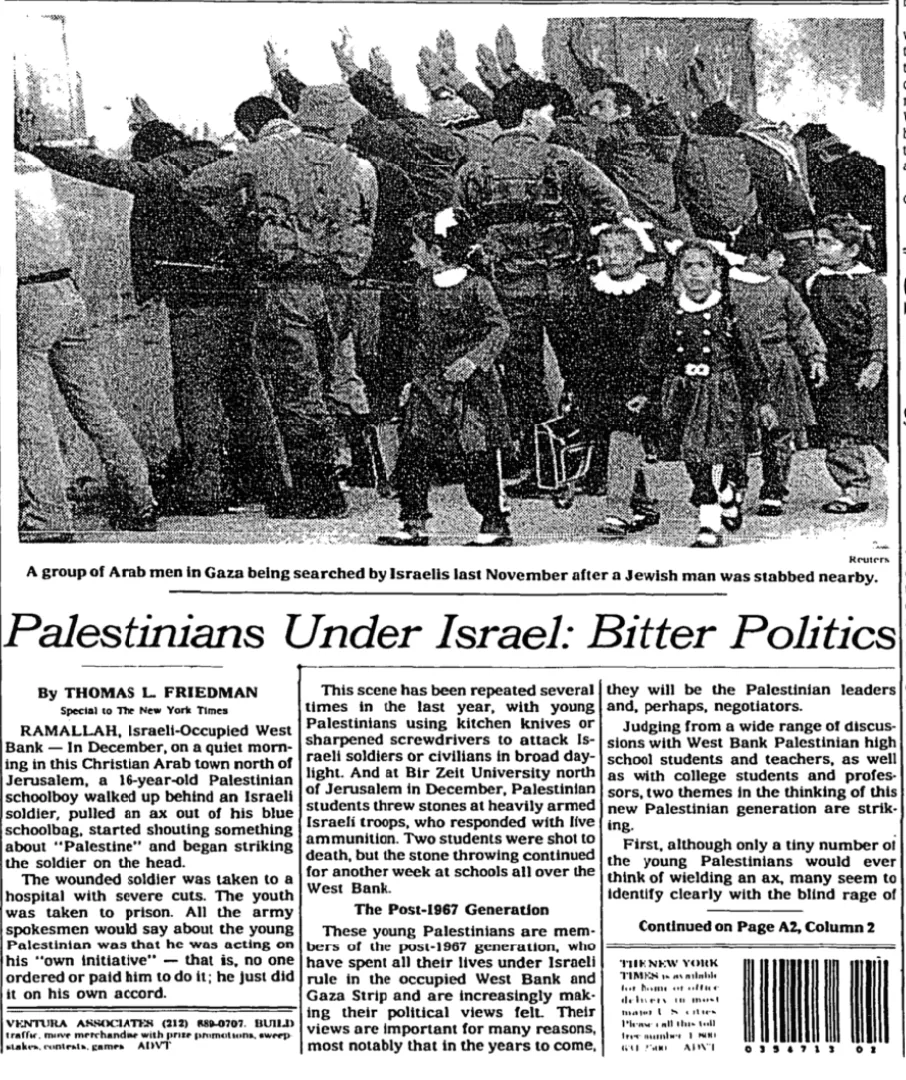
… [PHOTOGRAPH across the top of the page, with credit and caption:] United Press International Arab youths throwing rocks last month at Israeli troops at the Bureij refugee center in the Gaza Strip. Incident was in reaction to the killing of two Palestinian students by Israeli troops at Bir Zeit University on the West Bank.
Palestinians Under Israel: Bitter Politics Continued From Page A1 the ax wielders. They no longer seem to view violence as serving as a means toward a particular political objective; most say that they have given up hope for any solutions. Theirs is simply a politics of revenge.
Violence ‘Just Occurs’ “I think that our generation of Palestinians have reached a point psychologically where we want any means of getting back at the Jews,” said Meral, an 18-year-old Palestinian student at Bir Zeit University who did not want to give her last name, in order to avoid repercussions.
“You just get the feeling the Jews want to aggravate us. Palestinian violence now is something that just happens. It’s not planned; it just occurs.” Sara Salah, principal of the girls’ high school in the Aida refugee district near Bethlehem, said, “My students’ main problem is that they don’t like their lives with the Jews.”
The second striking feature about the new generation of Palestinians is that although they have had more direct contact with Israel and Israelis than previous generations of Palestinians, the experience in the occupied territories has done nothing to moderate their feelings. If anything, it has radicalized them.
This Palestinian generation seems to belie the conventional wisdom that the problem with the Arabs and the Israelis is that they do not know each other. Many of the young Palestinians say they believe the problem is that they and the Israelis do know each other, and hat each wants the same land free of the other.
“We are two generations that are basically brought up the same way,” said Serene, a 20-year-old Bir Zeit student who is studying literature, speaking of her Israeli and Palestinian peers. “They are a generation brought up to hate the Palestinians, and we were brought up think the same about them.
We don’t need to talk to them to know what they are thinking because we know that they were brought up to think the same way as we do — only opposite.” “I was driving on the road from Jerusalem to Jericho one day last year and was stopped at an army checkpoint” she added.
“We were there for a while, and at one point an Israeli soldier started trying to talk to me. I wasnt very friendly. Finally, he said to me, ‘You hate us, don’t you?’ I said, ‘What do you think?’
” ‘Not Going to Condemn Him’ “I would not go out and kill an Israeli civilian myself, but I also would not condemn someone who does,” Serene said. “They are killing so many of our civilians here and in Lebanon, if someone his the guts to go out and stab one of theirs, I am not going to condemn him.”
Another indication of how little living together has led to any deeper appreciation of the other’s point of view is that these young Palestinians almost never refer to Israelis as Israelis. Instead, they call them the “Jews.”
It appears from discussions that they believe that referring to Israelis as Israelis would be to acknowledge that there is another legitimate national collective on the land. So instead, they refer to them only as Jews, with no national connotations.
When this is pointed out to them, they quickly note that many Israelis do the equivalent to them, referring to them not as Palestinians but as “the Arabs of the land of Israel,” an amorphous ethnic group living in someone else’s country.
It seems that neither side can stand the symmetry of acknowledging that there is another legitimate collective on the land, because to do that would be to relinquish some of the exclusivity of their own claim and make their own “rights” relative instead of absolute.
Losing Control of Future The most important factor shaping the attitudes of the new generation seems to be the feeling that they have lost control over their own future, as individuals and as a collective. Because of the Israeli occupation, their opportunities as individuals are highly restricted.
After they graduate, they cannot obtain a license to start a new business if it competes with an existing Israeli industry. There are few interesting Government jobs available to them, because virtually all are controlled by Israelis.
They can leave to look for work in Jordan or the Persian Gulf, but under Israeli regulations any male between the ages of 16 and 26 who leaves cannot come back for at least nine months. The regulation was imposed to prevent gun-running and to encourage settlement abroad.
One of the paradoxes of the last 20 years is that it was the Israelis who, by offering many employment opportunities to West Bank Palestinians in manual labor inside Israel, created a huge Palestinian middle class that could afford to send its children to colleges and technical schools.
When the West Bank was under Jordan, there was only a tiny middle class, and the mass of the population was composed either of peasant farmers or landed gentry. Historically, it has been the middle classes who have most often had the sophistication and the motivation for serious upheavals.
Today, according to the Center for Palestinian Studies, an Arab research organization in Jerusalem, there are 17,000 Arab youths in the West Bank and Gaza studying at 20 post-high-school institutions. Many of those who graduate from these institutions, however, never end up working at what they were trained for.
Their frustrations derive from the Palestinian identity that has been shaped in the West Bank in the last 20 years of Israeli occupation. Under the Jordanian occupation, Palestinians were never quite sure what their identity was.
Their passports were issued by Jordan, and they were represented in the Jordanian Parliament; but although some thought of themselves as Jordanian nationals and assimilated into Jordanian society, many others viewed themselves as Palestinians and resented the Jordanian attempts to play down their separate identity.
Under the Israeli occupation, by contrast, they no longer had an option of assimilating. The challenge of the Israeli occupation, coupled with the rise of the Palestine Liberation Organization and the collapse of Pan-Arabism as a predominant ideology after the 1967 war, all combined to forge a Palestinian national consciousness among West Bank youth.
“Between 1949 and 1967, whenever anyone asked me what I was, I always hesitated,” said Munir Fasheh, Dean of Students at Bir Zeit University, who grew up in Ramallah. “Legally, I was Jordanian, but emotionally I was Palestinian. Now, there is no kid on the West Bank under the age of 25 who has ever experienced anything other than being a Palestinian.
When you consider that 60 percent of the West Bank population is under the age of 20, it means that for three-quarters of them Jordan is something that doesn’t exist.” But under the Israeli occupation, his Palestinian political identity is not allowed to find expression in political parties, political assembly or self-rule.
Israel, Jordan and the United States are trying to help King Hussein reassert his traditional influence over the West Bank and to undermine the P.L.O.’s popularity there, in hopes of being able one day to arrange a Jordanian-Israeli solution.
‘60 or 70 Years Before Victory’ This policy, however, seems to be in contradiction with the mood among the young generation, whose attitudes about peace have been shaped almost entirely by the P.L.O. “For tomorrow, we want the West Bank and Gaza, with the P.L.O. in charge,” said Abdallah, a 23-year-old engineering student at Bir Zeit.
“For the day after tomorrow, we want a democratic, secular state in all of Palestine, so that the Palestinians from Haifa and Jaffa can go back home. I estimate 60 or 70 years before victory.” Zuhad, a veiled 20-year-old Moslem fundamentalist who is majoring in linguistics, said: “I want an independent state in all of Palestine by armed struggle.
Why not all tomorrow? They took it with armed struggle, so we’ll get it back with armed struggle.” As for the future of the Israelis, Serene said: “Don’t worry — we are not going to throw the Jews into the sea It is just that Jews are a religion, no a nationality. All those Jews who were here before 1917 can stay.
Those who came later will have to return to the countries they came from.” But what if they cannot? “I think they can,” she said. The Israeli authorities are not unaware of the hard-line views of many educated Palestinian youths.
They tend, however, to view the hard-liners as a minority elite that has intimidated, or out-talked, a majority who only want to be left in peace and accommodate with the status quo. “Maybe we are are talking about 12,000 students who are now intensely pro-P.L.O.,” said a top Israeli Army officer in the West Bank administration.
“We assume that whatever solution will be achieved here, this group will be out in the streets opposing it.” Arafat Is Still a Hero Moreover, the officer said, when these youths grow up and have to get jobs they will moderate their views, both because they have matured and because Jordan and Israel together control most of the employment opportunities in the area.
But others say this could lead to more frustration rather than more stability. It is hard to sit with young people anywhere in the West Bank today and not find them expressing support for Yasir Arafat, the P.L.O. chairman. This may seem incomprehensible, in that Mr. Arafat has only losses to show.
But it seems that the more he loses, the more the young Palestians identify with him as someone who, like themselves, is caught in a vise between Israel and the Arabs. “Arafat is like the stones we throw in demonstrations,” Meral said. “When we stand against the Jews, all we have is this stone.
He may be weak in what he can do, but he is the symbol of the Palestinians.
He is the stone we throw against the world.” [PULL QUOTE set between the first and second columns, boxed by rules:] ‘We want any means of getting back at the Jews.’ [The lower left of the clipping is a display advertisement (a men’s clothing “WINTER SALE”) and the newspaper’s own mail-subscription box. Not transcribed.]
How this transcription was made
Transcribed from a scan of the printed page. NO DATE IS PRINTED ANYWHERE ON THIS CLIPPING - no masthead, no folio, no page line - so the date rests entirely on the slide label and has NOT been confirmed from the page. The only internal dating is the lede's bare 'In December' and the caption's 'last November', which are consistent with the December 1986 killings of two Bir Zeit University students but fix neither the month nor the day of publication. The newspaper is identified from the printed credit line 'Special to The New York Times' and from the paper's own subscription box at the foot of the clipping. The page is marked 'Continued on Page A2, Column 2', so it is a front page, but no page number is printed on the scan. The photograph is of Gaza while the article is datelined Ramallah; caption and article do not describe the same scene. Read from crops magnified to six times page scale. The other part of this article was added on 2 November 2026 from a second clipping (m005_2.png).
Cite this clipping
"Palestinians Under Israel: Bitter Politics," The New York Times, 12 January 1987. Covering Palestine archive, CP-1987-053. https://coveringpalestine.org/archive/cp-1987-053
More from The New York Times
- The Maine Colony in PalestineThe New York Times · 12 November 1866
- Jewish Colonization in PalestineThe New York Times · 9 December 1883
- Jewish State in Palestine OpposedThe New York Times · 9 July 1897
- ZIONIST CONGRESS IN BASELThe New York Times · 31 August 1897
- ROME FEARS THE ZIONISTSThe New York Times · 12 September 1897
- PROGRESS OF ZIONISMThe New York Times · 16 December 1901
- 852 more from this paper in the full text →
More from the 1980s
- Uneasy in ZionThe New York Times · 1 March 1987
- Israeli Officials Meet on Corruption ChargesThe New York Times · 14 April 1987
- PALESTINIAN KILLED BY ISRAELI TROOPSThe New York Times · 14 April 1987
- Arabs and Jews in Israeli Schools Rally Against Unequal TuitionsThe New York Times · 19 May 1987
- A Palestinian’s Plan to Run Stirs Up JerusalemThe New York Times · 18 June 1987
- Israeli Arabs Stage a Strike, Charging Unequal TreatmentThe New York Times · 25 June 1987
- All 527 clippings from the 1980s →
Last updated 2 November 2026
This record is part of Covering Palestine, an archive of American newspaper clippings about Palestinians, 1724 to 2023. Researched and assembled by Maria Robles.
The clipping belongs to the newspaper that printed it, or to the news agency that supplied the copy. It is reproduced here for research, criticism and commentary. A city here is where the newspaper was published, not where the story came from, and on most records it was taken from the masthead.
Something wrong here, or something you know about this clipping? The archive is still being built and corrections are wanted: maria@rozumstudio.com, quoting CP-1987-053.
Everything printed in 1987 · Printed on this day · See it in the archive reel · Full text of every clipping · Dataset