The Island Packet · Hilton Head Island, South Carolina · 25 October 1991
CP-1991-031
Peace talks
Who will win? Who will lose? Don’t expect a quick answer
By PATRICK MARTIN, Toronto Globe and Mail
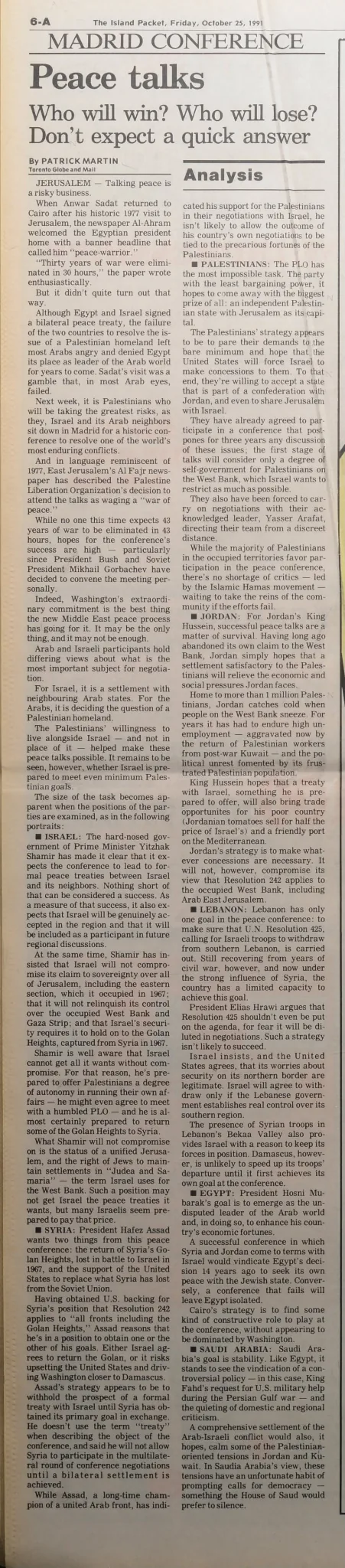
Shown from the top. The whole column — 4.5 times taller than it is wide — is in the enlargement.
Transcribed from the clipping
JERUSALEM — Talking peace is a risky business. When Anwar Sadat returned to Cairo after his historic 1977 visit to Jerusalem, the newspaper Al-Ahram welcomed the Egyptian president home with a banner headline that called him “peace-warrior.” “Thirty years of war were eliminated in 30 hours,” the paper wrote enthusiastically. But it didn’t quite turn out that way.
Although Egypt and Israel signed a bilateral peace treaty, the failure of the two countries to resolve the issue of a Palestinian homeland left most Arabs angry and denied Egypt its place as leader of the Arab world for years to come. Sadat’s visit was a gamble that, in most Arab eyes, failed.
Next week, it is Palestinians who will be taking the greatest risks, as they, Israel and its Arab neighbors sit down in Madrid for a historic conference to resolve one of the world’s most enduring conflicts.
And in language reminiscent of 1977, East Jerusalem’s Al Fajr newspaper has described the Palestine Liberation Organization’s decision to attend the talks as waging a “war of peace.”
While no one this time expects 43 years of war to be eliminated in 43 hours, hopes for the conference’s success are high — particularly since President Bush and Soviet President Mikhail Gorbachev have decided to convene the meeting personally. Indeed, Washington’s extraordinary commitment is the best thing the new Middle East peace process has going for it.
It may be the only thing, and it may not be enough. Arab and Israeli participants hold differing views about what is the most important subject for negotiation. For Israel, it is a settlement with neighbouring Arab states. For the Arabs, it is deciding the question of a Palestinian homeland.
The Palestinians’ willingness to live alongside Israel — and not in place of it — helped make these peace talks possible. It remains to be seen, however, whether Israel is prepared to meet even minimum Palestinian goals.
How this transcription was made
Read from the scan by a machine looking at the image of the page, not by optical character recognition and not by a person. The printed date on the page agrees with the date recorded here.
Cite this clipping
"Peace talks," The Island Packet, 25 October 1991, p. 6-A. Covering Palestine archive, CP-1991-031. https://coveringpalestine.org/archive/cp-1991-031
More from The Island Packet
- University degree can be Palestinian bride’s biggest assetThe Island Packet · 21 January 2007
More from the 1990s
- 2 killed in West Bank protestsThe Kansas City Star · 2 January 1991
- Two top men in PLO assassinatedTimes Record News · 17 January 1991
- Both Saddam Hussein, Israel blamed for PLO slayingsLa Crosse Tribune · 18 January 1991
- Palestinians Are Buoyed By the Attacks on Israel(newspaper unidentified) · 21 January 1991
- ‘Administrative detention’: Israelis skip due processThe Baltimore Sun · 6 February 1991
- Books About the Arab WorldSyracuse Herald Journal · 24 February 1991
- All 374 clippings from the 1990s →
Last updated 2 November 2026
This record is part of Covering Palestine, an archive of American newspaper clippings about Palestinians, 1724 to 2023. Researched and assembled by Maria Robles.
The clipping belongs to the newspaper that printed it, or to the news agency that supplied the copy. It is reproduced here for research, criticism and commentary. A city here is where the newspaper was published, not where the story came from, and on most records it was taken from the masthead.
Something wrong here, or something you know about this clipping? The archive is still being built and corrections are wanted: maria@rozumstudio.com, quoting CP-1991-031.
Everything printed in 1991 · Printed on this day · See it in the archive reel · Full text of every clipping · Dataset