The Register-Guard · 22 January 1991
CP-1991-061
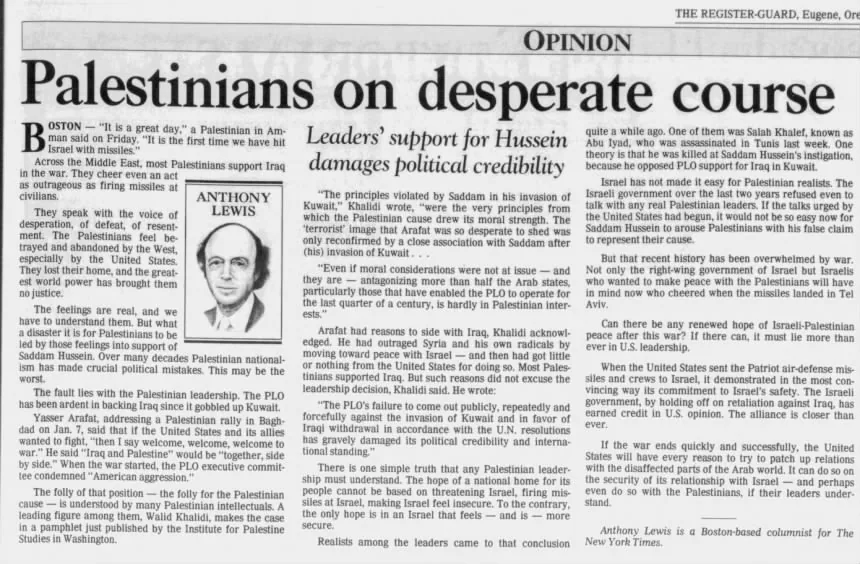
Palestinians on desperate course
Leaders' support for Hussein damages political credibility
Transcribed from the clipping
BOSTON — “It is a great day,” a Palestinian in Amman said on Friday. “It is the first time we have hit Israel with missiles.” Across the Middle East, most Palestinians support Iraq in the war. They cheer even an act as outrageous as firing missiles at civilians. They speak with the voice of desperation, of defeat, of resentment.
The Palestinians feel betrayed and abandoned by the West, especially by the United States. They lost their home, and the greatest world power has brought them no justice. The feelings are real, and we have to understand them. But what a disaster it is for Palestinians to be led by those feelings into support of Saddam Hussein.
Over many decades Palestinian nationalism has made crucial political mistakes. This may be the worst. The fault lies with the Palestinian leadership. The PLO has been ardent in backing Iraq since it gobbled up Kuwait. Yasser Arafat, addressing a Palestinian rally in Baghdad on Jan.
7, said that if the United States and its allies wanted to fight, “then I say welcome, welcome, welcome to war.” He said “Iraq and Palestine” would be “together, side by side.” When the war started, the PLO executive committee condemned “American aggression.”
The folly of that position — the folly for the Palestinian cause — is understood by many Palestinian intellectuals. A leading figure among them, Walid Khalidi, makes the case in a pamphlet just published by the Institute for Palestine Studies in Washington.
“The principles violated by Saddam in his invasion of Kuwait,” Khalidi wrote, “were the very principles from which the Palestinian cause drew its moral strength. The 'terrorist' image that Arafat was so desperate to shed was only reconfirmed by a close association with Saddam after (his) invasion of Kuwait . . .
“Even if moral considerations were not at issue — and they are — antagonizing more than half the Arab states, particularly those that have enabled the PLO to operate for the last quarter of a century, is hardly in Palestinian interests.”
How this transcription was made
Read from the scan Maria supplied on 17 November 2026, at magnification, band by band. The folio line at the top right reads "THE REGISTER-GUARD, Eugene, Ore…" and is then cut off by the right edge of the scan, so the printed date is not on the image. Internal evidence fits 22 January 1991 closely: the Palestinian in Amman speaks "on Friday" about hitting Israel with missiles for the first time (the first Scud attacks on Israel were Friday 18 January 1991), and Salah Khalef is described as "assassinated in Tunis last week" (14 January 1991). Jan. 22, 1991 was a Tuesday. Masthead agrees with pub. The folio prints "THE REGISTER-GUARD", matching the archive spelling The Register-Guard. The city line "Eugene, Ore…" is sliced off mid-word at the right edge, and whatever date followed it went with it. "OPINION" is a section flag in a rule across the top of the page, not a deck. The deck recorded here is the italic two-line standfirst set above the columnist's photograph: "Leaders' support for Hussein damages political credibility". The byline is the standing head over the columnist's portrait, "ANTHONY LEWIS", in a boxed sig. The tagline at the foot reads: "Anthony Lewis is a Boston-based columnist for The New York Times.". SPELLING AS SET. The page prints "Salah Khalef, known as Abu Iyad" — Khalef, not the more usual Khalaf. Not corrected. The ellipsis at the end of the first Khalidi quotation is printed as a spaced ". . ." and the quotation runs on into the next paragraph without an intervening closing quotation mark, as newspapers set continued quotations. Transcribed as set. The parenthesis in "after (his) invasion of Kuwait" is the paper's own, inside Khalidi's quoted words. Walid Khalidi is entered with ordinary false. He is a Palestinian named here, but as a leading intellectual quoted from a published pamphlet rather than an ordinary person caught up in events; flagging the call since the archive's review pages filter on that field. Nothing on this page touches Los Angeles, Southern California or a named university. The Institute for Palestine Studies in Washington is named, which may interest the Consortium work, but it is an institute, not a university. The anonymous Palestinian in Amman who opens the column is quoted but not named, so he cannot go in people. TWO QUOTATIONS LEFT OUT ON PURPOSE, both fragments rather than whole sentences. Arafat at the Baghdad rally on Jan. 7: the paper sets "...said that if the United States and its allies wanted to fight, 'then I say welcome, welcome, welcome to war.'" — the quoted words begin mid-sentence in lower case. And Khalidi's first sentence is broken by its attribution ("The principles violated by Saddam in his invasion of Kuwait," Khalidi wrote, "were the very principles..."), so no continuous verbatim span of it exists in the excerpt. Both appear in the excerpt and Maria may want them anyway.
Cite this clipping
"Palestinians on desperate course," The Register-Guard, 22 January 1991. Covering Palestine archive, CP-1991-061. https://coveringpalestine.org/archive/cp-1991-061
More from The Register-Guard
- West Bank to have new Jewish outpostsThe Register-Guard · 26 January 1981
- ‘Palestine’ still a knotty issueThe Register-Guard · 2 September 1982
- PalestiniansThe Register-Guard · 4 December 1983
- Education more than anything else distinguishes PalestiniansThe Register-Guard · 4 December 1983
- White House, Arafat condemn U.S. bombingThe Register-Guard · 13 October 1985
- Palestinian negotiator enters self-rule areasThe Register-Guard · 10 September 1994
- 10 more from this paper in the full text →
More from the 1990s
- 2 killed in West Bank protestsThe Kansas City Star · 2 January 1991
- Two top men in PLO assassinatedTimes Record News · 17 January 1991
- Both Saddam Hussein, Israel blamed for PLO slayingsLa Crosse Tribune · 18 January 1991
- Palestinians Are Buoyed By the Attacks on Israel(newspaper unidentified) · 21 January 1991
- ‘Administrative detention’: Israelis skip due processThe Baltimore Sun · 6 February 1991
- Books About the Arab WorldSyracuse Herald Journal · 24 February 1991
- All 383 clippings from the 1990s →
Last updated 17 November 2026
This record is part of Covering Palestine, an archive of American newspaper clippings about Palestinians, 1724 to 2023. Researched and assembled by Maria Robles.
The clipping belongs to the newspaper that printed it, or to the news agency that supplied the copy. It is reproduced here for research, criticism and commentary. A city here is where the newspaper was published, not where the story came from, and on most records it was taken from the masthead.
Something wrong here, or something you know about this clipping? The archive is still being built and corrections are wanted: maria@rozumstudio.com, quoting CP-1991-061.
Everything printed in 1991 · Printed on this day · See it in the archive reel · Full text of every clipping · Dataset