Las Cruces Sun News · Las Cruces, NM · 3 July 1999
CP-1999-024
Israeli Arabs face uphill battle for equal status
The Washington Post
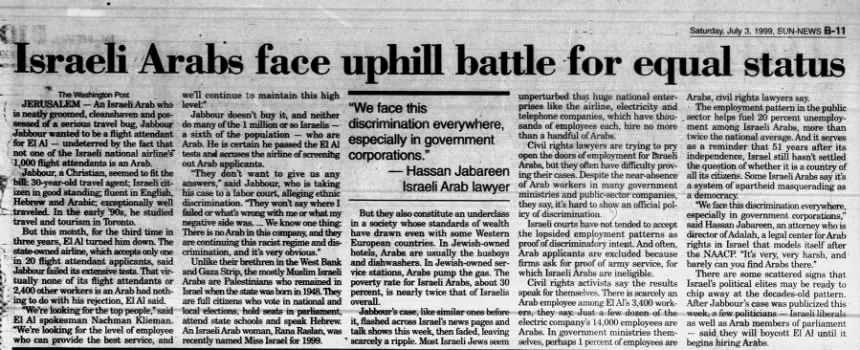
Transcribed from the clipping
JERUSALEM — An Israeli Arab who is neatly groomed, cleanshaven and possessed of a serious travel bug, Jabbour Jabbour wanted to be a flight attendant for El Al — undeterred by the fact that not one of the Israeli national airline’s 1,000 flight attendants is an Arab.
Jabbour, a Christian, seemed to fit the bill: 30-year-old travel agent; Israeli citizen in good standing; fluent in English, Hebrew and Arabic; exceptionally well traveled. In the early ’90s, he studied travel and tourism in Toronto. But this month, for the third time in three years, El Al turned him down.
The state-owned airline, which accepts only one in 20 flight attendant applicants, said Jabbour failed its extensive tests. That virtually none of its flight attendants or 2,400 other workers is an Arab had nothing to do with his rejection, El Al said. “We’re looking for the top people,” said El Al spokesman Nachman Klieman.
“We’re looking for the level of employee who can provide the best service, and we’ll continue to maintain this high level.” Jabbour doesn’t buy it, and neither do many of the 1 million or so Israelis — a sixth of the population — who are Arab. He is certain he passed the El Al tests and accuses the airline of screening out Arab applicants.
“They don’t want to give us any answers,” said Jabbour, who is taking his case to a labor court, alleging ethnic discrimination. “They won’t say where I failed or what’s wrong with me or what my negative side was. ... We know one thing. There is no Arab in this company, and they are continuing this racist regime and discrimination, and it’s very obvious.”
Unlike their brethren in the West Bank and Gaza Strip, the mostly Muslim Israeli Arabs are Palestinians who remained in Israel when the state was born in 1948. They are full citizens who vote in national and local elections, hold seats in parliament, attend state schools and speak Hebrew. An Israeli Arab woman, Rana Raslan, was recently named Miss Israel for 1999.
But they also constitute an underclass in a society whose standards of wealth have drawn even with some Western European countries. In Jewish-owned hotels, Arabs are usually the busboys and dishwashers. In Jewish-owned service stations, Arabs pump the gas. The poverty rate for Israeli Arabs, about 30 percent, is nearly twice that of Israelis overall.
Jabbour’s case, like similar ones before it, flashed across Israel’s news pages and talk shows this week, then faded, leaving scarcely a ripple. Most Israeli Jews seem unperturbed that huge national enterprises like the airline, electricity and telephone companies, which have thousands of employees each, hire no more than a handful of Arabs.
Civil rights lawyers are trying to pry open the doors of employment for Israeli Arabs, but they often have difficulty proving their cases. Despite the near-absence of Arab workers in many government ministries and public-sector companies, they say, it’s hard to show an official policy of discrimination.
Israeli courts have not tended to accept the lopsided employment patterns as proof of discriminatory intent. And often, Arab applicants are excluded because firms ask for proof of army service, for which Israeli Arabs are ineligible. Civil rights activists say the results speak for themselves. There is scarcely an Arab employee among El Al’s 3,400 workers, they say.
Just a few dozen of the electric company’s 14,000 employees are Arabs. In government ministries themselves, perhaps 1 percent of employees are Arabs, civil rights lawyers say. The employment pattern in the public sector helps fuel 20 percent unemployment among Israeli Arabs, more than twice the national average.
And it serves as a reminder that 51 years after its independence, Israel still hasn’t settled the question of whether it is a country of all its citizens. Some Israeli Arabs say it’s a system of apartheid masquerading as a democracy.
“We face this discrimination everywhere, especially in government corporations,” said Hassan Jabareen, an attorney who is director of Adalah, a legal center for Arab rights in Israel that models itself after the NAACP. “It’s very, very harsh, and barely can you find Arabs there.”
There are some scattered signs that Israel’s political elites may be ready to chip away at the decades-old pattern. After Jabbour’s case was publicized this week, a few politicians — Israeli liberals as well as Arab members of parliament — said they will boycott El Al until it begins hiring Arabs.
How this transcription was made
Date confirmed on the page (folio-verified for date and partially for paper (the folio reads “Saturday, July 3, 1999, SUN-NEWS B-11”. 3 July 1999 was a Saturday. The folio gives the paper only as SUN-NEWS and). Legibility fair; any passage that could not be read is omitted rather than reconstructed.
Context added by this archive
Whole article transcribed. For the pattern question this is the spine clipping of the 1999 end of the range: it shows “Israeli Arabs” functioning as the unmarked American term, the word “Palestinians” present but quarantined in a single explanatory clause, and two Palestinian citizens of Israel speaking at length and choosing “Arab” themselves.
Cite this clipping
"Israeli Arabs face uphill battle for equal status," Las Cruces Sun News, 3 July 1999, p. B-11. Covering Palestine archive, CP-1999-024. https://coveringpalestine.org/archive/cp-1999-024
More from Las Cruces Sun News
- Liberation Of Palestine Aim Of GroupLas Cruces Sun News · 31 May 1964
- Israeli fire on town raises war crimes claimLas Cruces Sun News · 1 September 2014
More from the 1990s
- The One-State SolutionThe New York Times · 10 January 1999
- How Jews Turn Houses Into Homes on West BankThe New York Times · 17 March 1999
- Palestinians Seem Resigned to a Delay in StatehoodThe New York Times · 28 April 1999
- History of Palestinian-Israeli conflict can't be ignoredThe Beaufort Gazette · 16 August 1999
- Release of Palestinian prisoners tangled in years of suffering, rageThe Baltimore Sun · 4 September 1999
- Israel’s top court bans agents from torturing suspectsPress of Atlantic City · 7 September 1999
- All 374 clippings from the 1990s →
Last updated 2 November 2026
This record is part of Covering Palestine, an archive of American newspaper clippings about Palestinians, 1724 to 2023. Researched and assembled by Maria Robles.
The clipping belongs to the newspaper that printed it, or to the news agency that supplied the copy. It is reproduced here for research, criticism and commentary. A city here is where the newspaper was published, not where the story came from, and on most records it was taken from the masthead.
Something wrong here, or something you know about this clipping? The archive is still being built and corrections are wanted: maria@rozumstudio.com, quoting CP-1999-024.
Everything printed in 1999 · Printed on this day · See it in the archive reel · Full text of every clipping · Dataset