Las Cruces Sun News · Las Cruces, NM · 1 September 2014
CP-2014-066
Israeli fire on town raises war crimes claim
By Karin Laub, The Associated Press
Transcribed from the clipping
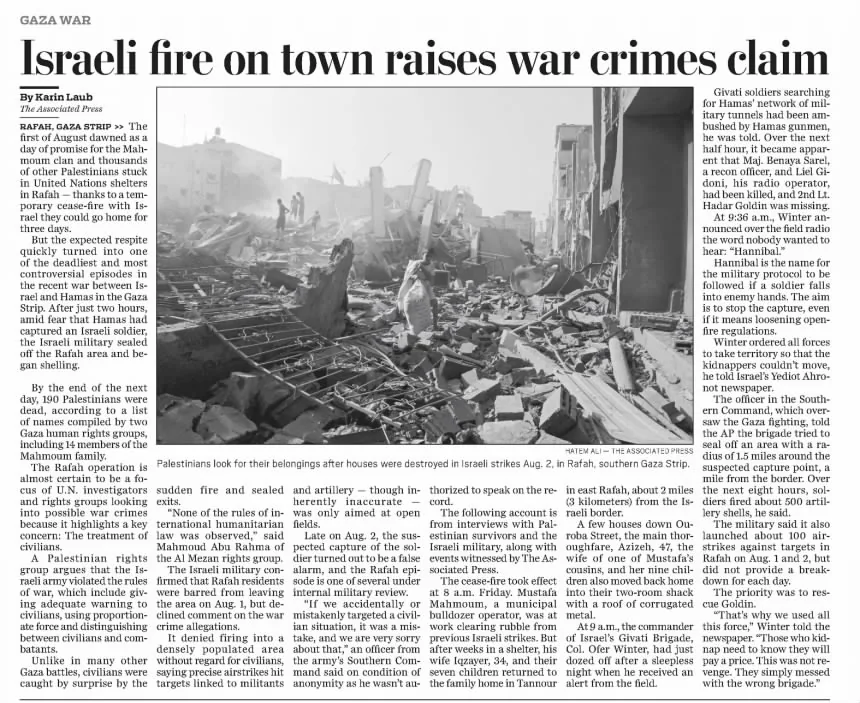
RAFAH, GAZA STRIP >> The first of August dawned as a day of promise for the Mahmoum clan and thousands of other Palestinians stuck in United Nations shelters in Rafah — thanks to a temporary cease-fire with Israel they could go home for three days.
But the expected respite quickly turned into one of the deadliest and most controversial episodes in the recent war between Israel and Hamas in the Gaza Strip. After just two hours, amid fear that Hamas had captured an Israeli soldier, the Israeli military sealed off the Rafah area and began shelling.
By the end of the next day, 190 Palestinians were dead, according to a list of names compiled by two Gaza human rights groups, including 14 members of the Mahmoum family. The Rafah operation is almost certain to be a focus of U.N. investigators and rights groups looking into possible war crimes because it highlights a key concern: The treatment of civilians.
A Palestinian rights group argues that the Israeli army violated the rules of war, which include giving adequate warning to civilians, using proportionate force and distinguishing between civilians and combatants. Unlike in many other Gaza battles, civilians were caught by surprise by the sudden fire and sealed exits.
“None of the rules of international humanitarian law was observed,” said Mahmoud Abu Rahma of the Al Mezan rights group. The Israeli military confirmed that Rafah residents were barred from leaving the area on Aug. 1, but declined comment on the war crime allegations.
It denied firing into a densely populated area without regard for civilians, saying precise airstrikes hit targets linked to militants and artillery — though inherently inaccurate — was only aimed at open fields. Late on Aug. 2, the suspected capture of the soldier turned out to be a false alarm, and the Rafah episode is one of several under internal military review.
“If we accidentally or mistakenly targeted a civilian situation, it was a mistake, and we are very sorry about that,” an officer from the army’s Southern Command said on condition of anonymity as he wasn’t authorized to speak on the record.
How this transcription was made
Date and publication rest on the collector's slide label; no masthead, folio or printed dateline appears on this clipping.
Context added by this archive
Answers Maria’s slide-44 question directly: the clipping does discuss the Hannibal Directive and NAMES it. The page prints: “At 9:36 a.m., Winter announced over the field radio the word nobody wanted to hear: ‘Hannibal.’ Hannibal is the name for the military protocol to be followed if a soldier falls into enemy hands.
The aim is to stop the capture, even if it means loosening open-fire regulations.” It does not use the phrase “Hannibal Directive” or “Hannibal Procedure” — just “Hannibal” and “the military protocol.” The page also prints Winter ordering all forces to take territory “so that the kidnappers couldn’t move,” 500 artillery shells over eight hours, and about 100 airstrikes on Aug.
1 and 2. Israeli soldiers named: Maj. Benaya Sarel, Liel Gidoni, 2nd Lt. Hadar Goldin (combatants, so not listed under named_individuals).
Cite this clipping
"Israeli fire on town raises war crimes claim," Las Cruces Sun News, 1 September 2014. Covering Palestine archive, CP-2014-066. https://coveringpalestine.org/archive/cp-2014-066
More from Las Cruces Sun News
- Liberation Of Palestine Aim Of GroupLas Cruces Sun News · 31 May 1964
- Israeli Arabs face uphill battle for equal statusLas Cruces Sun News · 3 July 1999
More from the 2010s
- Roger Waters rips Scarlett Johansson, Neil Young over Israel; SodaStream stock dipsSt. Louis Jewish Light · 5 February 2014
- Palestinian women make strides in high-tech jobsThe Sentinel · 12 February 2014
- Stories in and out of timeStar Tribune · 16 February 2014
- Conflict, paranoia, but little propaganda in ‘Omar’The Oregonian · 21 February 2014
- The front-runnersLos Angeles Times · 23 February 2014
- Masterful ‘Omar’ dives deep into notion of conflictHonolulu Star-Advertiser · 28 February 2014
- All 321 clippings from the 2010s →
Last updated 2 November 2026
This record is part of Covering Palestine, an archive of American newspaper clippings about Palestinians, 1724 to 2023. Researched and assembled by Maria Robles.
The clipping belongs to the newspaper that printed it, or to the news agency that supplied the copy. It is reproduced here for research, criticism and commentary. A city here is where the newspaper was published, not where the story came from, and on most records it was taken from the masthead.
Something wrong here, or something you know about this clipping? The archive is still being built and corrections are wanted: maria@rozumstudio.com, quoting CP-2014-066.
Everything printed in 2014 · Printed on this day · See it in the archive reel · Full text of every clipping · Dataset