Bristol Herald Courier · Bristol, VA · 1 September 2014
CP-2014-067
Israeli fire on Gaza town raises war crimes claim
The Associated Press
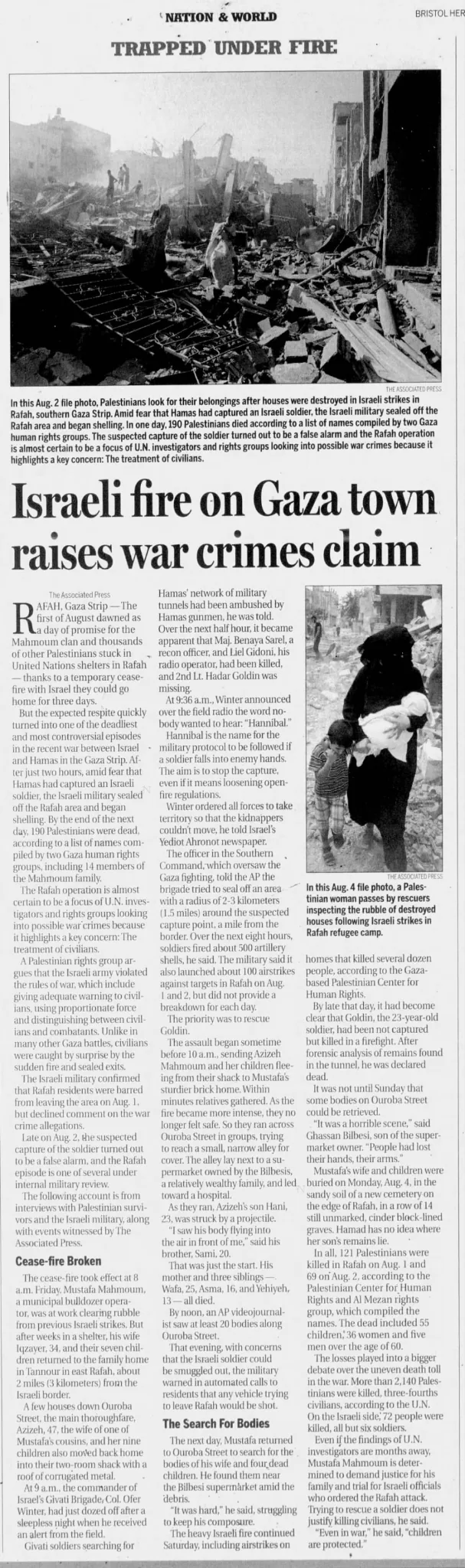
Shown from the top. The whole column — 3.4 times taller than it is wide — is in the enlargement.
Transcribed from the clipping
RAFAH, Gaza Strip — The first of August dawned as a day of promise for the Mahmoum clan and thousands of other Palestinians stuck in United Nations shelters in Rafah — thanks to a temporary cease-fire with Israel they could go home for three days.
But the expected respite quickly turned into one of the deadliest and most controversial episodes in the recent war between Israel and Hamas in the Gaza Strip. After just two hours, amid fear that Hamas had captured an Israeli soldier, the Israeli military sealed off the Rafah area and began shelling.
By the end of the next day, 190 Palestinians were dead, according to a list of names compiled by two Gaza human rights groups, including 14 members of the Mahmoum family. The Rafah operation is almost certain to be a focus of U.N. investigators and rights groups looking into possible war crimes because it highlights a key concern: The treatment of civilians.
A Palestinian rights group argues that the Israeli army violated the rules of war, which include giving adequate warning to civilians, using proportionate force and distinguishing between civilians and combatants. Unlike in many other Gaza battles, civilians were caught by surprise by the sudden fire and sealed exits.
The Israeli military confirmed that Rafah residents were barred from leaving the area on Aug. 1, but declined comment on the war crime allegations. Late on Aug. 2, the suspected capture of the soldier turned out to be a false alarm, and the Rafah episode is one of several under internal military review.
The following account is from interviews with Palestinian survivors and the Israeli military, along with events witnessed by The Associated Press.
How this transcription was made
Date and publication rest on the collector's slide label; no masthead, folio or printed dateline appears on this clipping.
Context added by this archive
Same AP story as slide 44 but a much longer run with the Palestinian survivors kept in. It names Hannibal the same way: “At 9:36 a.m., Winter announced over the field radio the word nobody wanted to hear: ‘Hannibal.’ Hannibal is the name for the military protocol to be followed if a soldier falls into enemy hands.” Also prints: 121 Palestinians killed in Rafah on Aug.
1 and 69 on Aug. 2 per the Palestinian Center for Human Rights and Al Mezan; the dead included 55 children, 36 women and five men over 60; more than 2,140 Palestinians killed in the war, three-fourths civilians, against 72 Israelis, all but six of them soldiers.
One sentence refers to “Hamad” (“Hamad has no idea where her son’s remains lie”) — that person is not introduced anywhere in the visible text, so she is not listed; the introducing passage may be in a part of the page cut off in the scan.
Cite this clipping
"Israeli fire on Gaza town raises war crimes claim," Bristol Herald Courier, 1 September 2014. Covering Palestine archive, CP-2014-067. https://coveringpalestine.org/archive/cp-2014-067
More from Bristol Herald Courier
- Palestine Arab Refugee Still RejectedBristol Herald Courier · 31 August 1967
- Israeli PM calls for unity after loss to NetanyahuBristol Herald Courier · 7 November 2022
More from the 2010s
- Roger Waters rips Scarlett Johansson, Neil Young over Israel; SodaStream stock dipsSt. Louis Jewish Light · 5 February 2014
- Palestinian women make strides in high-tech jobsThe Sentinel · 12 February 2014
- Stories in and out of timeStar Tribune · 16 February 2014
- Conflict, paranoia, but little propaganda in ‘Omar’The Oregonian · 21 February 2014
- The front-runnersLos Angeles Times · 23 February 2014
- Masterful ‘Omar’ dives deep into notion of conflictHonolulu Star-Advertiser · 28 February 2014
- All 321 clippings from the 2010s →
Last updated 2 November 2026
This record is part of Covering Palestine, an archive of American newspaper clippings about Palestinians, 1724 to 2023. Researched and assembled by Maria Robles.
The clipping belongs to the newspaper that printed it, or to the news agency that supplied the copy. It is reproduced here for research, criticism and commentary. A city here is where the newspaper was published, not where the story came from, and on most records it was taken from the masthead.
Something wrong here, or something you know about this clipping? The archive is still being built and corrections are wanted: maria@rozumstudio.com, quoting CP-2014-067.
Everything printed in 2014 · Printed on this day · See it in the archive reel · Full text of every clipping · Dataset