Fresno Bee · Fresno, CA · 31 May 2001
CP-2001-058
Two large obstacles
Settlements, violence aggravate Arab-Israeli stalemate.
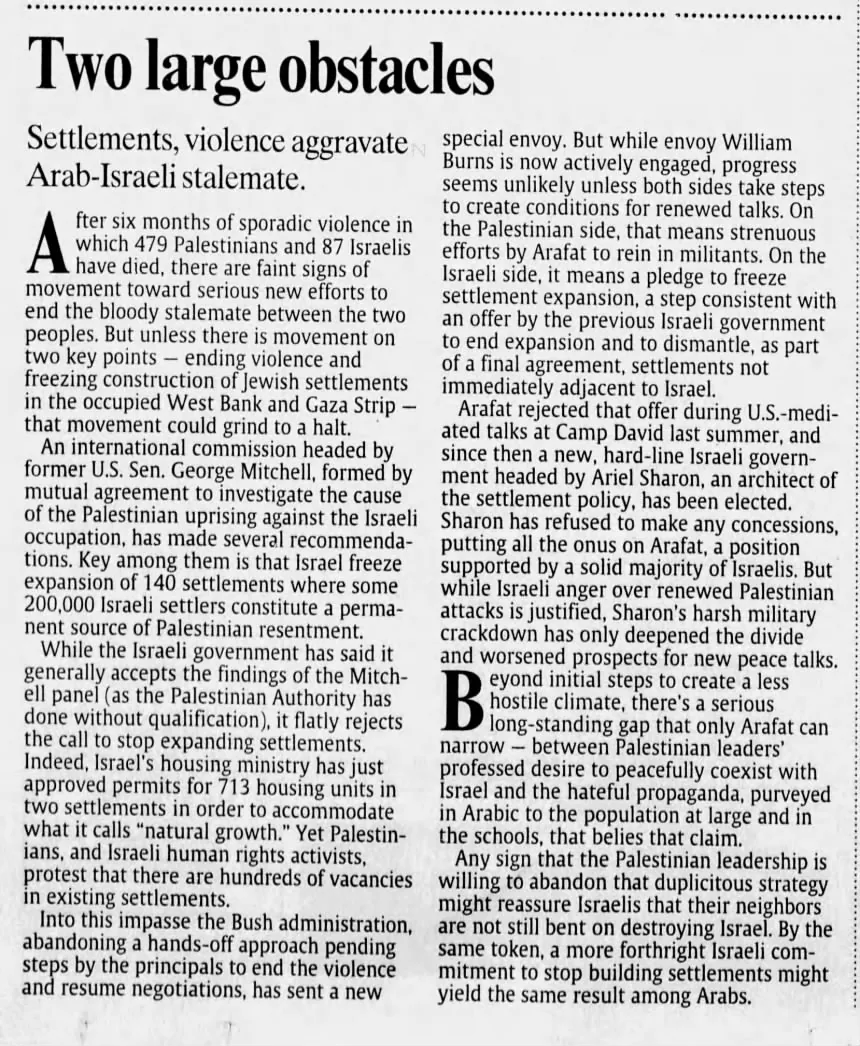
Transcribed from the clipping
After six months of sporadic violence in which 479 Palestinians and 87 Israelis have died, there are faint signs of movement toward serious new efforts to end the bloody stalemate between the two peoples.
But unless there is movement on two key points — ending violence and freezing construction of Jewish settlements in the occupied West Bank and Gaza Strip — that movement could grind to a halt. An international commission headed by former U.S. Sen.
George Mitchell, formed by mutual agreement to investigate the cause of the Palestinian uprising against the Israeli occupation, has made several recommendations. Key among them is that Israel freeze expansion of 140 settlements where some 200,000 Israeli settlers constitute a permanent source of Palestinian resentment.
While the Israeli government has said it generally accepts the findings of the Mitchell panel (as the Palestinian Authority has done without qualification), it flatly rejects the call to stop expanding settlements. Indeed, Israel’s housing ministry has just approved permits for 713 housing units in two settlements in order to accommodate what it calls “natural growth.”
Yet Palestinians, and Israeli human rights activists, protest that there are hundreds of vacancies in existing settlements. Into this impasse the Bush administration, abandoning a hands-off approach pending steps by the principals to end the violence and resume negotiations, has sent a new special envoy.
But while envoy William Burns is now actively engaged, progress seems unlikely unless both sides take steps to create conditions for renewed talks. On the Palestinian side, that means strenuous efforts by Arafat to rein in militants.
On the Israeli side, it means a pledge to freeze settlement expansion, a step consistent with an offer by the previous Israeli government to end expansion and to dismantle, as part of a final agreement, settlements not immediately adjacent to Israel.
Arafat rejected that offer during U.S.-mediated talks at Camp David last summer, and since then a new, hard-line Israeli government headed by Ariel Sharon, an architect of the settlement policy, has been elected. Sharon has refused to make any concessions, putting all the onus on Arafat, a position supported by a solid majority of Israelis.
But while Israeli anger over renewed Palestinian attacks is justified, Sharon’s harsh military crackdown has only deepened the divide and worsened prospects for new peace talks.
Beyond initial steps to create a less hostile climate, there’s a serious long-standing gap that only Arafat can narrow — between Palestinian leaders’ professed desire to peacefully coexist with Israel and the hateful propaganda, purveyed in Arabic to the population at large and in the schools, that belies that claim.
Any sign that the Palestinian leadership is willing to abandon that duplicitous strategy might reassure Israelis that their neighbors are not still bent on destroying Israel. By the same token, a more forthright Israeli commitment to stop building settlements might yield the same result among Arabs.
How this transcription was made
Date and publication rest on the collector's slide label; no masthead, folio or printed dateline appears on this clipping, and nothing on it contradicts the label. Adjudicated against the printed page: No masthead, folio, running head, page number or date line anywhere on the clipping — verified at 5x across the top rule (a dotted border, then the headline 'Two large obstacles') and the foot. The piece is an unsigned editorial; the only datable content is in Slide 90's images ARE reversed relative to the manifest label order — that is established, but by the folio on s090_2, not by anything on this page. The Fresno Bee attribution here is therefore pure elimination from the slide's two-label set, and 2001-05-31 is internal dating only. Note also an internal wobble the tran Filed under the archive’s spelling; the page prints “The Fresno Bee”.
Context added by this archive
Fully legible. No reference to Arab citizens of Israel. Its value is as a clean, countable instance of a paper using “Palestinian” throughout its argument and “Arab” at the two points where it is summarising — the subhead and the closing sentence.
Cite this clipping
"Two large obstacles," Fresno Bee, 31 May 2001. Covering Palestine archive, CP-2001-058. https://coveringpalestine.org/archive/cp-2001-058
More from Fresno Bee
- Treatment Of Arabs In The Holy LandFresno Bee · 15 October 1926
- Seven killed in Israeli tank assaultFresno Bee · 6 December 2002
More from the 2000s
- Palestinian refugees cling to ‘right of return’The Grand Rapids Press · 7 January 2001
- Palestinians don’t want to give up ‘right of return’The Atlanta Journal-Constitution · 21 January 2001
- Palestinians Deserve Rights, Including Right To ReturnHartford Courant · 23 January 2001
- Palestinians who are Israeli citizens weigh the electionThe New York Times · 26 January 2001
- Polls predict landslide for hard-liner Ariel Sharon in Israeli electionThe Herald Sun · 3 February 2001
- Feared road offers clues to Israel voteThe Boston Globe · 4 February 2001
- All 516 clippings from the 2000s →
Last updated 2 November 2026
This record is part of Covering Palestine, an archive of American newspaper clippings about Palestinians, 1724 to 2023. Researched and assembled by Maria Robles.
The clipping belongs to the newspaper that printed it, or to the news agency that supplied the copy. It is reproduced here for research, criticism and commentary. A city here is where the newspaper was published, not where the story came from, and on most records it was taken from the masthead.
Something wrong here, or something you know about this clipping? The archive is still being built and corrections are wanted: maria@rozumstudio.com, quoting CP-2001-058.
Everything printed in 2001 · Printed on this day · See it in the archive reel · Full text of every clipping · Dataset