Statesman Journal · 3 March 2002
CP-2002-036
Gaza plant typical of Enron's risky business
The project is 90 percent complete but still in jeopardy.
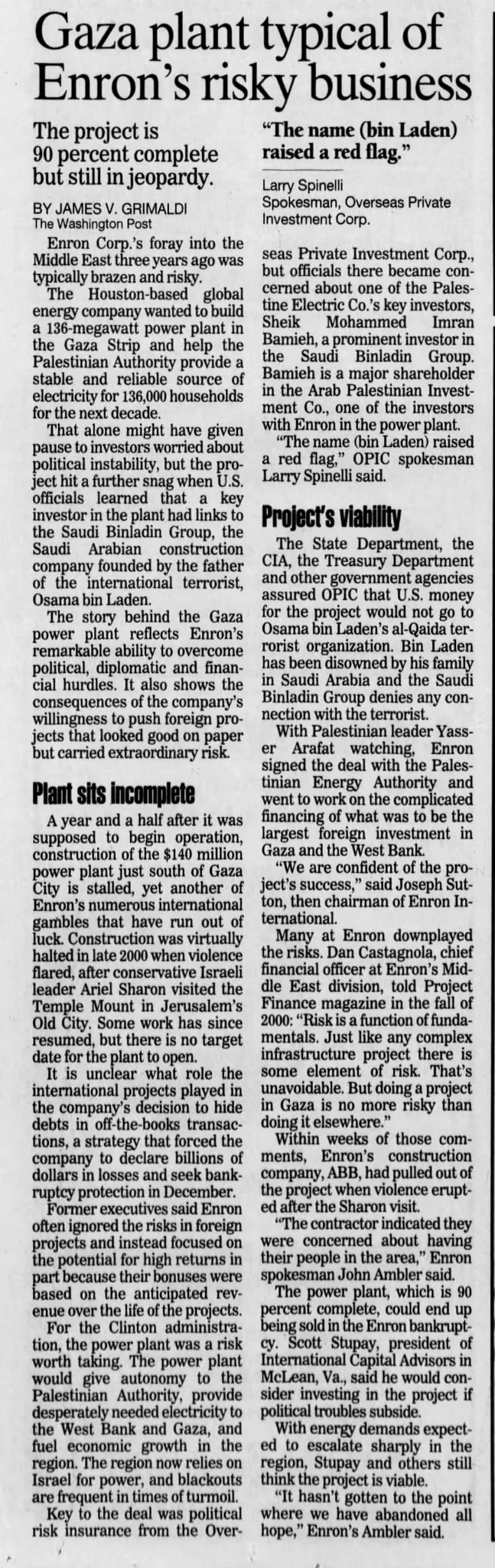
Shown from the top. The whole column — 3.2 times taller than it is wide — is in the enlargement.
Transcribed from the clipping
Enron Corp.’s foray into the Middle East three years ago was typically brazen and risky. The Houston-based global energy company wanted to build a 136-megawatt power plant in the Gaza Strip and help the Palestinian Authority provide a stable and reliable source of electricity for 136,000 households for the next decade.
That alone might have given pause to investors worried about political instability, but the project hit a further snag when U.S. officials learned that a key investor in the plant had links to the Saudi Binladin Group, the Saudi Arabian construction company founded by the father of the international terrorist, Osama bin Laden.
The story behind the Gaza power plant reflects Enron’s remarkable ability to overcome political, diplomatic and financial hurdles. It also shows the consequences of the company’s willingness to push foreign projects that looked good on paper but carried extraordinary risk.
Plant sits incomplete A year and a half after it was supposed to begin operation, construction of the $140 million power plant just south of Gaza City is stalled, yet another of Enron’s numerous international gambles that have run out of luck.
Construction was virtually halted in late 2000 when violence flared, after conservative Israeli leader Ariel Sharon visited the Temple Mount in Jerusalem’s Old City. Some work has since resumed, but there is no target date for the plant to open.
It is unclear what role the international projects played in the company’s decision to hide debts in off-the-books transactions, a strategy that forced the company to declare billions of dollars in losses and seek bankruptcy protection in December.
How this transcription was made
Read from the scan by a machine looking at the image of the page, not by optical character recognition and not by a person. The clipping carries no masthead or date line, so its date and newspaper rest on the record it arrived with, not on anything visible in the scan.
Cite this clipping
"Gaza plant typical of Enron's risky business," Statesman Journal, 3 March 2002. Covering Palestine archive, CP-2002-036. https://coveringpalestine.org/archive/cp-2002-036
More from the 2000s
- Don’t forget it’s an Israeli occupationThe Daily Press · 1 January 2002
- Soothing Israel’s FearsThe New York Times · 7 January 2002
- Israel, in Reprisal for Killings, Razes Gaza Refugee HomesThe New York Times · 11 January 2002
- Refugees and Reparations in the MideastThe New York Times · 13 January 2002
- Israeli missiles strike naval baseThe Greenville News · 13 January 2002
- Friendship of Palestinian, architect defies oddsThe Bismarck Tribune · 17 January 2002
- All 527 clippings from the 2000s →
Last updated 17 November 2026
This record is part of Covering Palestine, an archive of American newspaper clippings about Palestinians, 1724 to 2023. Researched and assembled by Maria Robles.
The clipping belongs to the newspaper that printed it, or to the news agency that supplied the copy. It is reproduced here for research, criticism and commentary. A city here is where the newspaper was published, not where the story came from, and on most records it was taken from the masthead.
Something wrong here, or something you know about this clipping? The archive is still being built and corrections are wanted: maria@rozumstudio.com, quoting CP-2002-036.
Everything printed in 2002 · Printed on this day · See it in the archive reel · Full text of every clipping · Dataset