The Redwood Coast Review · Gualala, California · 14 October 2011
CP-2011-002
Echoes of the Promised Land
Yehuda Amichai and Mahmoud Darwish · Poets & Poetry
Roberta Werdinger
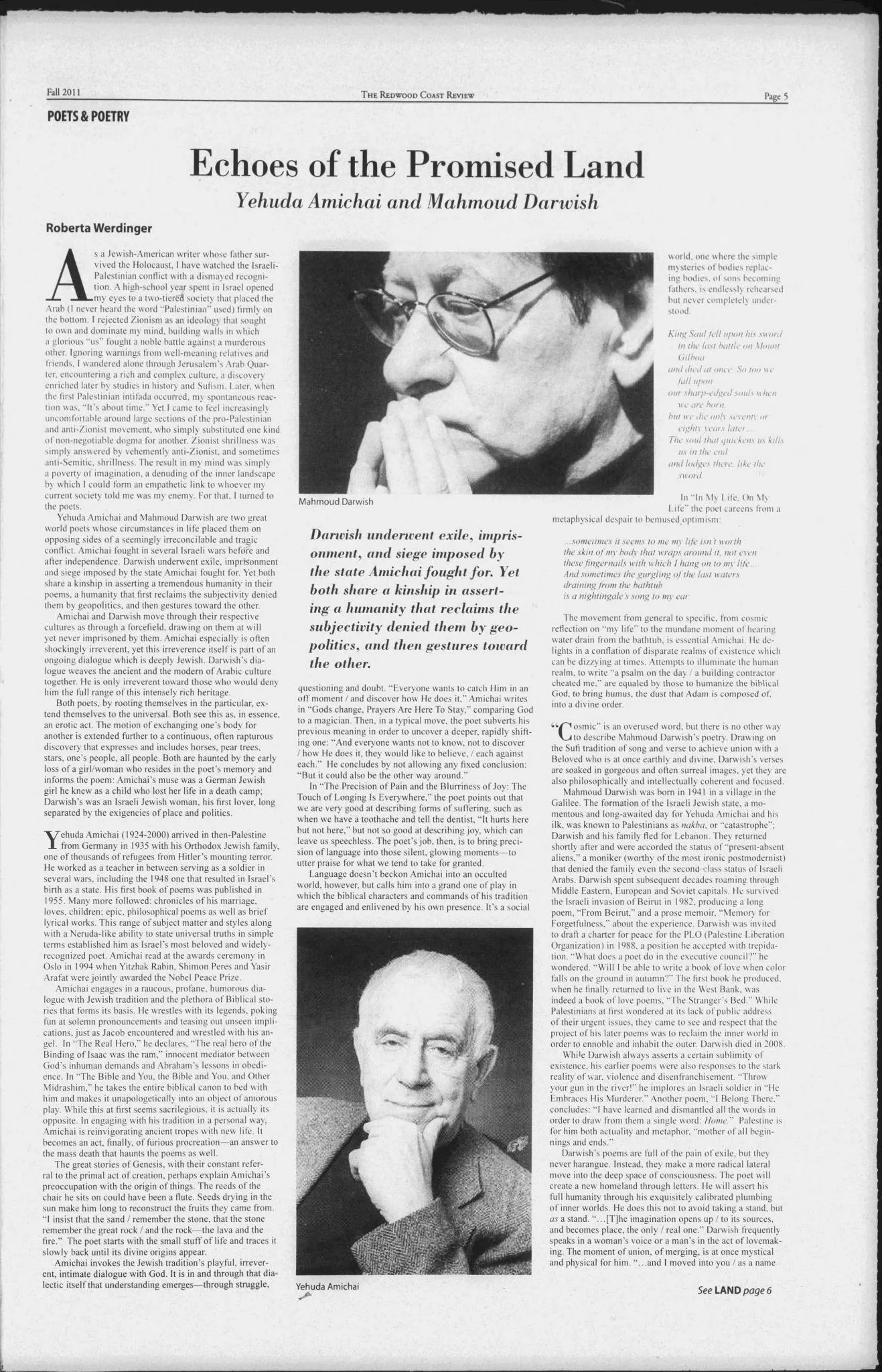
Transcribed from the clipping
“As a Jewish-American writer whose father survived the Holocaust, I have watched the Israeli-Palestinian conflict with a dismayed recognition.
A high-school year spent in Israel opened my eyes to a two-tiered society that placed the Arab (I never heard the word ‘Palestinian’ used) firmly on the bottom. I rejected Zionism as an ideology that sought to own and dominate my mind, building walls in which a glorious ‘us’ fought a noble battle against a murderous other… I wandered alone through Jerusalem’s Arab Quarter, encountering a rich and complex culture… Later, when the first Palestinian intifada occurred, my spontaneous reaction was, ‘It’s about time.’
Yet I came to feel increasingly uncomfortable around large sections of the pro-Palestinian and anti-Zionist movement, who simply substituted one kind of non-negotiable dogma for another… The result in my mind was simply a poverty of imagination, a denuding of the inner landscape by which I could form an empathetic link to whoever my current society told me was my enemy. For that, I turned to the poets.… Darwish underwent exile, imprisonment, and siege imposed by the state Amichai fought for.
Yet both share a kinship in asserting a humanity that reclaims the subjectivity denied them by geopolitics, and then gestures toward the other.… Mahmoud Darwish was born in 1941 in a village in the Galilee. The formation of the Israeli Jewish state, a momentous and long-awaited day for Yehuda Amichai and his ilk, was known to Palestinians as nakba, or ‘catastrophe’; Darwish and his family fled for Lebanon.
They returned shortly after and were accorded the status of ‘present-absent aliens,’ a moniker (worthy of the most ironic postmodernist) that denied the family even the second-class status of Israeli Arabs.… He survived the Israeli invasion of Beirut in 1982, producing a long poem, ‘From Beirut,’ and a prose memoir, ‘Memory for Forgetfulness,’ about the experience. Darwish was invited to draft a charter for peace for the PLO (Palestine Liberation Organization) in 1988, a position he accepted with trepidation.
‘What does a poet do in the executive council?’ he wondered. ‘Will I be able to write a book of love when color falls on the ground in autumn?’ The first book he produced, when he finally returned to live in the West Bank, was indeed a book of love poems, ‘The Stranger’s Bed.’
While Palestinians at first wondered at its lack of public address of their urgent issues, they came to see and respect that the project of his later poems was to reclaim the inner world in order to ennoble and inhabit the outer. Darwish died in 2008… ‘Throw your gun in the river!’ he implores an Israeli soldier in ‘He Embraces His Murderer.’
Another poem, ‘I Belong There,’ concludes: ‘I have learned and dismantled all the words in order to draw from them a single word: Home.’ Palestine is for him both actuality and metaphor, ‘mother of all beginnings and ends.’ Darwish’s poems are full of the pain of exile, but they never harangue.”
Context added by this archive
A small California literary review gives two pages to a Palestinian and an Israeli poet side by side, and the writer states her standpoint in her first line. Two things in it belong to this archive’s subject. The first is her account of a school year in Israel where she never once heard the word Palestinian.
The second is Darwish, asked in 1988 to help draft a charter for the PLO, asking what a poet is supposed to do on an executive council and whether he will still be allowed to write a book of love. He wrote one.
It is the same question the screenwriter Naim al-Khatib puts to an American reporter in Gaza twenty-six years later, and the same one the director Hany Abu-Assad answers in the Los Angeles Times seven months before that.
Cite this clipping
"Echoes of the Promised Land," The Redwood Coast Review, 14 October 2011, p. 1. Covering Palestine archive, CP-2011-002. https://coveringpalestine.org/archive/cp-2011-002
More from the 2010s
- IOC holds talks over Israel-Palestinian tiesTimes Record News · 21 January 2011
- This the Israel we want?The Times Argus · 15 May 2011
- Israeli leader cool on Obama’s Palestine requestThe Coeur d’Alene Press · 21 May 2011
- Palestinian statehoodDaily American · 27 May 2011
- Boxing BrothersMarshall News Messenger · 23 July 2011
- Israeli and Palestinian boxers train at the Maccabi Jerusalem Boxing ClubThe Tribune · 23 July 2011
- All 321 clippings from the 2010s →
In these collections
Last updated 2 November 2026
This record is part of Covering Palestine, an archive of American newspaper clippings about Palestinians, 1724 to 2023. Researched and assembled by Maria Robles.
The clipping belongs to the newspaper that printed it, or to the news agency that supplied the copy. It is reproduced here for research, criticism and commentary. A city here is where the newspaper was published, not where the story came from, and on most records it was taken from the masthead.
Something wrong here, or something you know about this clipping? The archive is still being built and corrections are wanted: maria@rozumstudio.com, quoting CP-2011-002.
Everything printed in 2011 · Printed on this day · See it in the archive reel · Full text of every clipping · Dataset