Rutland Daily Herald · Rutland, Vermont · 12 October 2011
CP-2011-007
2,000 Palestinian prisoners join hunger strike
By MOHAMMED DARAGHMEH, THE ASSOCIATED PRESS
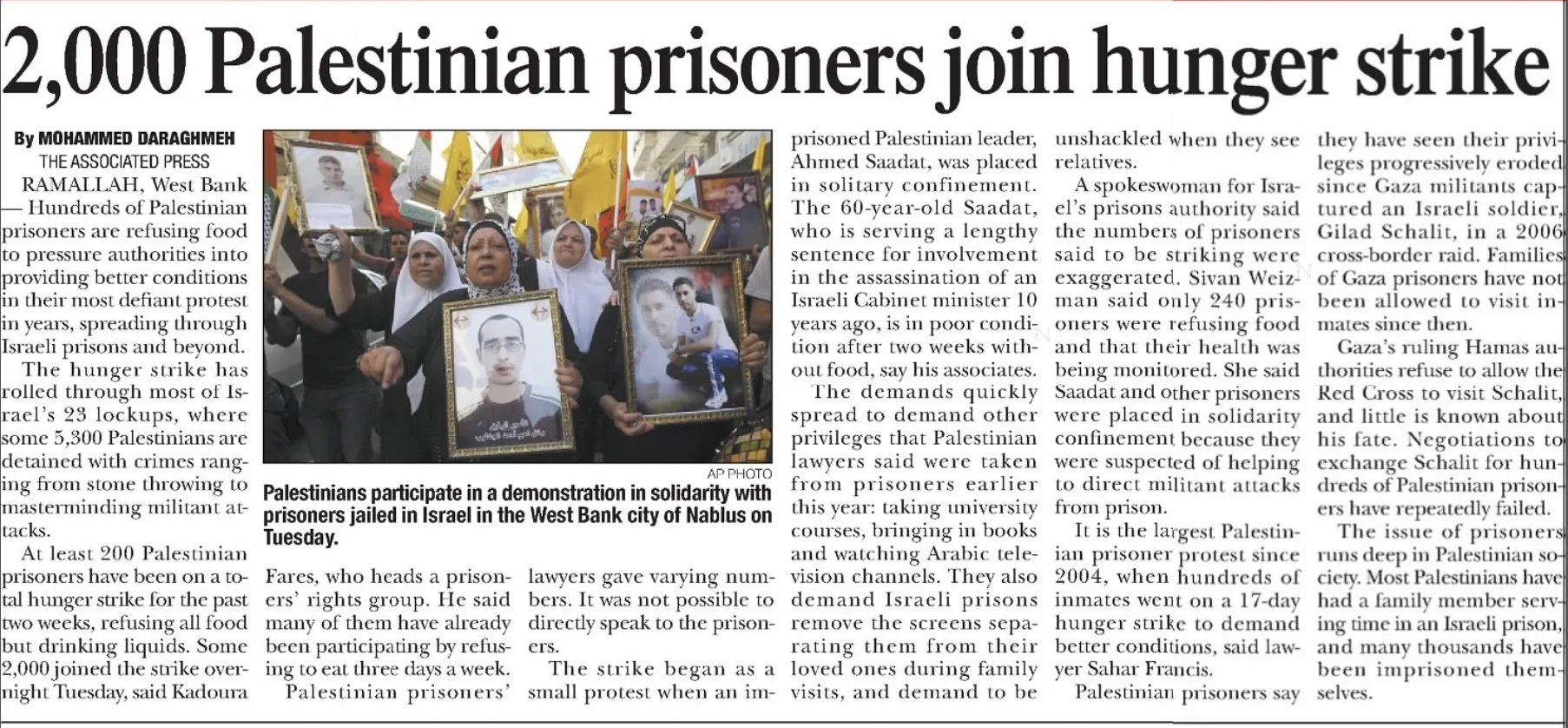
Transcribed from the clipping
RAMALLAH, West Bank — Hundreds of Palestinian prisoners are refusing food to pressure authorities into providing better conditions in their most defiant protest in years, spreading through Israeli prisons and beyond.
The hunger strike has rolled through most of Israel's 23 lockups, where some 5,300 Palestinians are detained with crimes ranging from stone throwing to masterminding militant attacks. At least 200 Palestinian prisoners have been on a total hunger strike for the past two weeks, refusing all food but drinking liquids.
Some 2,000 joined the strike overnight Tuesday, said Kadoura Fares, who heads a prisoners' rights group. He said many of them have already been participating by refusing to eat three days a week. Palestinian prisoners' lawyers gave varying numbers. It was not possible to directly speak to the prisoners.
The strike began as a small protest when an imprisoned Palestinian leader, Ahmed Saadat, was placed in solitary confinement. The 60-year-old Saadat, who is serving a lengthy sentence for involvement in the assassination of an Israeli Cabinet minister 10 years ago, is in poor condition after two weeks without food, say his associates.
The demands quickly spread to demand other privileges that Palestinian lawyers said were taken from prisoners earlier this year: taking university courses, bringing in books and watching Arabic television channels. They also demand Israeli prisons remove the screens separating them from their loved ones during family visits, and demand to be unshackled when they see relatives.
A spokeswoman for Israel's prisons authority said the numbers of prisoners said to be striking were exaggerated. Sivan Weizman said only 240 prisoners were refusing food and that their health was being monitored. She said Saadat and other prisoners were placed in solidarity confinement because they were suspected of helping to direct militant attacks from prison.
It is the largest Palestinian prisoner protest since 2004, when hundreds of inmates went on a 17-day hunger strike to demand better conditions, said lawyer Sahar Francis. Palestinian prisoners say they have seen their privileges progressively eroded since Gaza militants captured an Israeli soldier, Gilad Schalit, in a 2006 cross-border raid.
Families of Gaza prisoners have not been allowed to visit inmates since then. Gaza's ruling Hamas authorities refuse to allow the Red Cross to visit Schalit, and little is known about his fate. Negotiations to exchange Schalit for hundreds of Palestinian prisoners have repeatedly failed. The issue of prisoners runs deep in Palestinian society.
Most Palestinians have had a family member serving time in an Israeli prison, and many thousands have been imprisoned themselves.
Cite this item
"2,000 Palestinian prisoners join hunger strike," Rutland Daily Herald, 12 October 2011. Covering Palestine archive, CP-2011-007. https://coveringpalestine.org/archive/cp-2011-007
More from Rutland Daily Herald
- Despairing Arab Refugees Flee in Wake of Successes By Palestine Jewish ForcesRutland Daily Herald · 3 May 1948
- After Joy, What's Next In Middle East?Rutland Daily Herald · 8 May 1994
More from the 2010s
- IOC holds talks over Israel-Palestinian tiesTimes Record News · 21 January 2011
- Boxing BrothersMarshall News Messenger · 23 July 2011
- Israeli and Palestinian boxers train at the Maccabi Jerusalem Boxing ClubThe Tribune · 23 July 2011
- Will protests unite Jews, Arabs?The Republic · 20 August 2011
- Palestine should be recognized as a stateIowa City Press-Citizen · 15 September 2011
- Echoes of the Promised LandThe Redwood Coast Review · 14 October 2011
- All 110 clippings from the 2010s →
This record is part of Covering Palestine, an archive of American and Anglophone newspaper clippings about Palestinians, 1799 to 2023. Researched and assembled by Maria Robles.
The clipping belongs to the newspaper that printed it, or to the news agency that supplied the copy. It is reproduced here for research, criticism and commentary. The city is derived from the masthead, not read off the clipping.
Something wrong here, or something you know about this clipping? The archive is still being built and corrections are wanted: maria@rozumstudio.com, quoting CP-2011-007.
See it in the archive reel · Full text of every clipping · Dataset