Belleville News Democrat · Belleville, IL · 2 November 2015
CP-2015-025
Would Yitzhak Rabin recognize this Israel?
Israeli prime minister who made peace with Yasser Arafat was killed Nov. 4, 1995 | Most Israelis no longer believe in the peace process Rabin ushered in | Obama isn’t personally involved in trying to negotiate a deal
BY DANIELLA CHESLOW, McClatchy Foreign Staff
Transcribed from the clipping
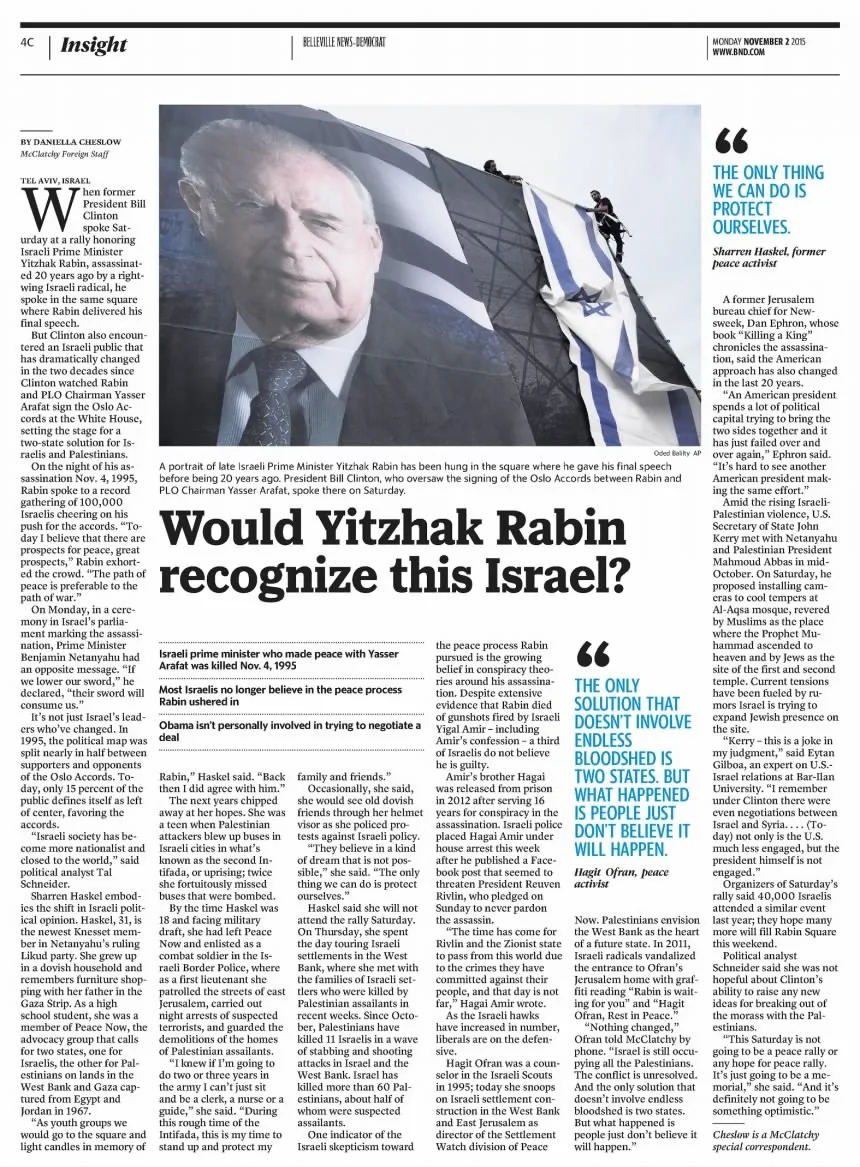
TEL AVIV, ISRAEL When former President Bill Clinton spoke Saturday at a rally honoring Israeli Prime Minister Yitzhak Rabin, assassinated 20 years ago by a right-wing Israeli radical, he spoke in the same square where Rabin delivered his final speech.
But Clinton also encountered an Israeli public that has dramatically changed in the two decades since Clinton watched Rabin and PLO Chairman Yasser Arafat sign the Oslo Accords at the White House, setting the stage for a two-state solution for Israelis and Palestinians. On the night of his assassination Nov.
4, 1995, Rabin spoke to a record gathering of 100,000 Israelis cheering on his push for the accords. “Today I believe that there are prospects for peace, great prospects,” Rabin exhorted the crowd. “The path of peace is preferable to the path of war.”
On Monday, in a ceremony in Israel’s parliament marking the assassination, Prime Minister Benjamin Netanyahu had an opposite message. “If we lower our sword,” he declared, “their sword will consume us.” It’s not just Israel’s leaders who’ve changed. In 1995, the political map was split nearly in half between supporters and opponents of the Oslo Accords.
Today, only 15 percent of the public defines itself as left of center, favoring the accords. “Israeli society has become more nationalist and closed to the world,” said political analyst Tal Schneider. Sharren Haskel embodies the shift in Israeli political opinion. Haskel, 31, is the newest Knesset member in Netanyahu’s ruling Likud party.
She grew up in a dovish household and remembers furniture shopping with her father in the Gaza Strip. As a high school student, she was a member of Peace Now, the advocacy group that calls for two states, one for Israelis, the other for Palestinians on lands in the West Bank and Gaza captured from Egypt and Jordan in 1967.
“As youth groups we would go to the square and light candles in memory of Rabin,” Haskel said. “Back then I did agree with him.” The next years chipped away at her hopes. She was a teen when Palestinian attackers blew up buses in Israeli cities in what’s known as the second Intifada, or uprising; twice she fortuitously missed buses that were bombed.
By the time Haskel was 18 and facing military draft, she had left Peace Now and enlisted as a combat soldier in the Israeli Border Police, where as a first lieutenant she patrolled the streets of east Jerusalem, carried out night arrests of suspected terrorists, and guarded the demolitions of the homes of Palestinian assailants.
“I knew if I’m going to do two or three years in the army I can’t just sit and be a clerk, a nurse or a guide,” she said. “During this rough time of the Intifada, this is my time to stand up and protect my family and friends.” Occasionally, she said, she would see old dovish friends through her helmet visor as she policed protests against Israeli policy.
“They believe in a kind of dream that is not possible,” she said. “The only thing we can do is protect ourselves.”
How this transcription was made
Date confirmed on the page (folio).
Context added by this archive
The fullest profile of Haskel in the batch and the one that shows the mechanism rather than the position: Peace Now at sixteen, Border Police at eighteen, east Jerusalem night arrests, guarding house demolitions, Knesset at thirty-one.
Palestinians appear in it only as ‘attackers’, ‘suspected terrorists’ and ‘assailants’ whose homes are demolished; no Palestinian is quoted anywhere on the page, and the only people who speak for a two-state outcome are Israeli Jews. Signed at the foot: ‘Cheslow is a McClatchy special correspondent.’
Cite this clipping
"Would Yitzhak Rabin recognize this Israel?," Belleville News Democrat, 2 November 2015, p. 4C. Covering Palestine archive, CP-2015-025. https://coveringpalestine.org/archive/cp-2015-025
More from the 2010s
- Palestinian move to court is a mistakeThe Daily Times · 8 January 2015
- Palestinian Official Says Fisherman Shot Dead By Israeli NavyPonca City Daily Courier · 8 March 2015
- Winds of war still blowing through Gaza's rubbleTri-City Herald · 10 March 2015
- A long way to go to make a differenceThe Press · 1 May 2015
- Push on to boot Israel in soccerLos Angeles Times · 24 May 2015
- Hamas entrenched; frustration growsDaily American Republic · 3 July 2015
- All 321 clippings from the 2010s →
Last updated 2 November 2026
This record is part of Covering Palestine, an archive of American newspaper clippings about Palestinians, 1724 to 2023. Researched and assembled by Maria Robles.
The clipping belongs to the newspaper that printed it, or to the news agency that supplied the copy. It is reproduced here for research, criticism and commentary. A city here is where the newspaper was published, not where the story came from, and on most records it was taken from the masthead.
Something wrong here, or something you know about this clipping? The archive is still being built and corrections are wanted: maria@rozumstudio.com, quoting CP-2015-025.
Everything printed in 2015 · Printed on this day · See it in the archive reel · Full text of every clipping · Dataset