Sun News · 11 February 2017
CP-2017-022
Trump might turn to Arab allies for help with Israeli-Palestinian relations
Transcribed from the clipping
WASHINGTON — President Donald Trump and his advisers, venturing for the first time into the fraught world of Middle East peacemaking, are developing a strategy on the Israeli-Palestinian conflict that would enlist Arab nations like Saudi Arabia and Egypt to break years of deadlock.
The emerging approach mirrors the thinking of Prime Minister Benjamin Netanyahu of Israel, who will visit the United States next week, and would build on his de facto alignment with Sunni Muslim countries in trying to counter the rise of Shiite-led Iran.
But Arab officials have warned Trump and his advisers that if they want cooperation, the United States cannot make life harder for them with provocative pro-Israel moves. The White House seems to be taking the advice. Trump delayed his plan to move the U.S.
Embassy to Jerusalem after Arab leaders told him that doing so would cause angry protests among Palestinians, who also claim the city as the capital of a future state. And after meeting with King Abdullah II of Jordan last week, Trump authorized a statement that, for the first time, cautioned Israel against building new West Bank settlements beyond existing lines.
“There are some quite interesting ideas circulating on the potential for U.S.-Israeli-Arab discussions on regional security in which Israeli-Palestinian issues would play a significant role,” said Robert Satloff, the executive director of the Washington Institute for Near East Policy.
The notion of recruiting Arab countries to help forge an agreement between Israelis and Palestinians – known as the “outside-in” approach – is not a new one. As secretary of state under President George H.W. Bush, James Baker organized the first regional conference in 1991 at which Arab leaders sat down with Israel’s prime minister.
President George W. Bush invited Arab leaders to a summit meeting with Israel in Maryland in 2007. And President Barack Obama’s first special envoy, George Mitchell, spent months in 2009 trying to enlist Arab partners in a joint effort.
The difference is that in the last eight years, Israel has grown closer to Sunni Arab nations because of their shared concern about Iranian hegemony in the region, opening the possibility that this newfound, if not always public, affiliation could change the dynamics.
“The logic of outside-in is that because the Palestinians are so weak and divided – and because there’s a new, tacit relationship between the Sunni Arabs and Israel – there’s the hope the Arabs would be prepared to do more,” said Dennis B. Ross, a Middle East peace negotiator under several presidents, including Obama.
That is a departure from the countervailing assumption that if Israel first made peace with the Palestinians, it would lead to peace with the larger Arab world – the “inside-out” approach.
That was at the core of President Bill Clinton’s attempts to bring the two sides together and was Obama’s fallback position after his efforts to find Arab partners failed. Netanyahu, who is due at the White House on Wednesday, has been talking about an outside-in approach for a while. His theory is that the inside-out approach has failed.
And so, he argues, if Israel can transform its relationship with Sunni Arab nations, they can ultimately lead the way toward a resolution with the Palestinians. Jared Kushner, the senior White House adviser whom Trump has assigned a major role in negotiations, has been intrigued by this logic, according to people who have spoken with him.
Kushner has grown close to Ron Dermer, the Israeli ambassador and a close confidant of Netanyahu’s. Trump and Kushner also had dinner at the White House on Thursday night with Sheldon Adelson, the casino magnate and key supporter of Netanyahu.
A series of telephone conversations and personal meetings with Arab and regional leaders in recent weeks have also shaped Kushner’s thinking and that of the president.
Trump has talked with President Abdel-Fattah el-Sissi of Egypt; King Salman of Saudi Arabia; Sheikh Mohammed bin Zayed al-Nahyan, the crown prince of Abu Dhabi; and President Recep Tayyip Erdogan of Turkey. Kushner has also met with Arab officials, including Yousef Al Otaiba, the ambassador from the United Arab Emirates.
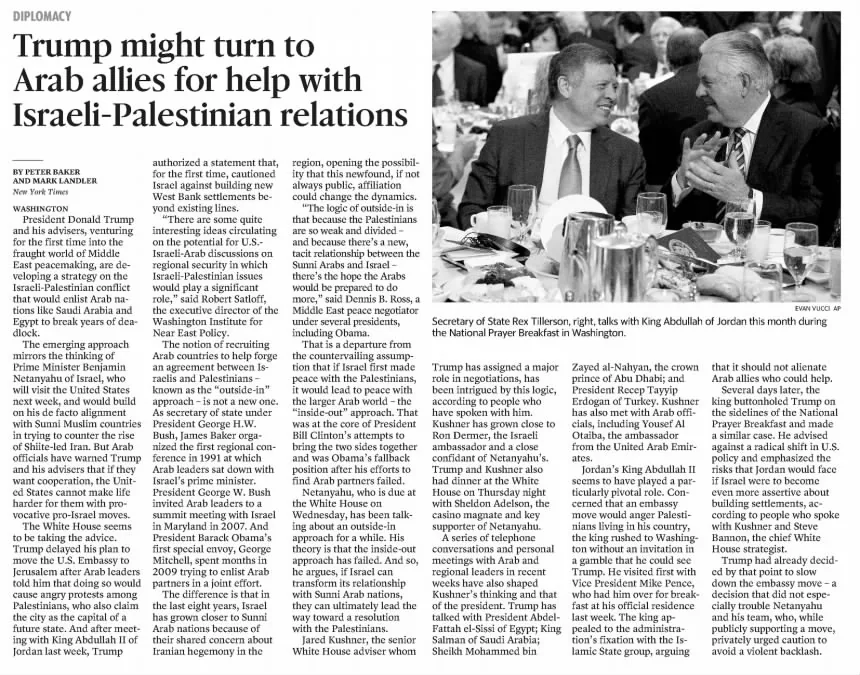
Jordan’s King Abdullah II seems to have played a particularly pivotal role. Concerned that an embassy move would anger Palestinians living in his country, the king rushed to Washington without an invitation in a gamble that he could see Trump. He visited first with Vice President Mike Pence, who had him over for breakfast at his official residence last week.
The king appealed to the administration’s fixation with the Islamic State group, arguing that it should not alienate Arab allies who could help. Several days later, the king buttonholed Trump on the sidelines of the National Prayer Breakfast and made a similar case.
He advised against a radical shift in U.S. policy and emphasized the risks that Jordan would face if Israel were to become even more assertive about building settlements, according to people who spoke with Kushner and Steve Bannon, the chief White House strategist.
Trump had already decided by that point to slow down the embassy move – a decision that did not especially trouble Netanyahu and his team, who, while publicly supporting a move, privately urged caution to avoid a violent backlash.
How this transcription was made
Read from the scan by a machine looking at the image of the page, not by optical character recognition and not by a person. The clipping carries no masthead or date line, so its date and newspaper rest on the record it arrived with, not on anything visible in the scan.
Cite this clipping
"Trump might turn to Arab allies for help with Israeli-Palestinian relations," Sun News, 11 February 2017. Covering Palestine archive, CP-2017-022. https://coveringpalestine.org/archive/cp-2017-022
More from Sun News
- Hamas’ election victory muddies Bush’s policiesSun News · 27 January 2006
More from the 2010s
- A two-faced policy cooked up with just one of the sidesJackson Citizen Patriot · 3 January 2017
- A two-state solution is the only oneTelegram & Gazette · 3 January 2017
- Keep Mideast peace option aliveClarion Ledger · 5 January 2017
- How about sticking with ally Israel?Omaha World-Herald · 5 January 2017
- Israeli military at odds with political classThe Register-Guard · 7 January 2017
- A Palestinian lightning rodLos Angeles Times · 11 January 2017
- All 343 clippings from the 2010s →
Last updated 17 November 2026
This record is part of Covering Palestine, an archive of American newspaper clippings about Palestinians, 1724 to 2023. Researched and assembled by Maria Robles.
The clipping belongs to the newspaper that printed it, or to the news agency that supplied the copy. It is reproduced here for research, criticism and commentary. A city here is where the newspaper was published, not where the story came from, and on most records it was taken from the masthead.
Something wrong here, or something you know about this clipping? The archive is still being built and corrections are wanted: maria@rozumstudio.com, quoting CP-2017-022.
Everything printed in 2017 · Printed on this day · See it in the archive reel · Full text of every clipping · Dataset