The New York Times · New York, New York · 21 May 1911
CP-1911-005
Palestine’s Transformation
Long Periods of Drought Responsible for the Aridity of the Holy Land
A review of Palestine and Its Transformation, by Ellsworth Huntington (Houghton Mifflin Co.)
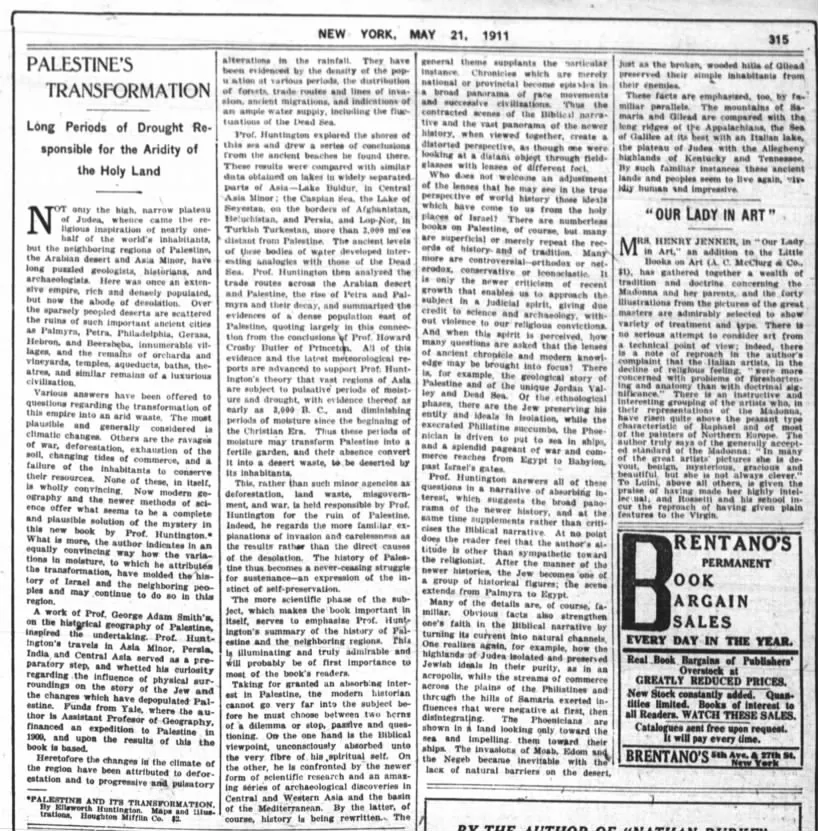
Transcribed from the clipping
“NOT only the high, narrow plateau of Judea, whence came the religious inspiration of nearly one-half of the world’s inhabitants, but the neighboring regions of Palestine, the Arabian desert and Asia Minor, have long puzzled geologists, historians, and archaeologists. Here was once an extensive empire, rich and densely populated, but now the abode of desolation.
Over the sparsely peopled deserts are scattered the ruins of such important ancient cities as Palmyra, Petra, Philadelphia, Gerasa, Hebron, and Beersheba, innumerable villages, and the remains of orchards and vineyards, temples, aqueducts, baths, theatres, and similar remains of a luxurious civilization.
Various answers have been offered to questions regarding the transformation of this empire into an arid waste. The most plausible and generally considered is climatic changes. Others are the ravages of war, deforestation, exhaustion of the soil, changing tides of commerce, and a failure of the inhabitants to conserve their resources.”
How this transcription was made
The headline, the two-line summary and the opening of the review have been read back against the scan. The rest runs to four agate columns and has not been transcribed.
Context added by this archive
The empty-land description in its scholarly form, in the New York Times of 1911, reviewing a Yale geographer. The land is now the abode of desolation and sparsely peopled; what is scattered over it is ruins. The list of possible causes ends on a failure of the inhabitants to conserve their resources, which is the only appearance the inhabitants make.
Four months earlier a syndicated correspondent had spent a page describing those inhabitants plowing, threshing and keeping sheep (CP-1911-002); six months later the News Herald opened a column with the flat statement that Palestine has a present population (CP-1911-007). All three ran in American papers in the same year.
Cite this clipping
"Palestine’s Transformation," The New York Times, 21 May 1911. Covering Palestine archive, CP-1911-005. https://coveringpalestine.org/archive/cp-1911-005
More from The New York Times
- The Maine Colony in PalestineThe New York Times · 12 November 1866
- Jewish Colonization in PalestineThe New York Times · 9 December 1883
- Jewish State in Palestine OpposedThe New York Times · 9 July 1897
- ZIONIST CONGRESS IN BASELThe New York Times · 31 August 1897
- ROME FEARS THE ZIONISTSThe New York Times · 12 September 1897
- PROGRESS OF ZIONISMThe New York Times · 16 December 1901
- 852 more from this paper in the full text →
More from the 1910s
- The Farms Of PalestineBirmingham Age-Herald · 8 January 1911
- Farms of PalestineRichmond Times-Dispatch · 8 January 1911
- Nebraskans Visit Old PalestineLincoln Journal Star · 22 January 1911
- Young Turks Would Drive Jews From PalestineCourier-Journal · 14 May 1911
- Zionists To Purchase LandThe Dispatch · 17 July 1911
- Palestine Is In Hands Of JewsHartford Courant · 31 July 1911
- All 77 clippings from the 1910s →
In these collections
Last updated 2 November 2026
This record is part of Covering Palestine, an archive of American newspaper clippings about Palestinians, 1724 to 2023. Researched and assembled by Maria Robles.
The clipping belongs to the newspaper that printed it, or to the news agency that supplied the copy. It is reproduced here for research, criticism and commentary. A city here is where the newspaper was published, not where the story came from, and on most records it was taken from the masthead.
Something wrong here, or something you know about this clipping? The archive is still being built and corrections are wanted: maria@rozumstudio.com, quoting CP-1911-005.
Everything printed in 1911 · Printed on this day · See it in the archive reel · Full text of every clipping · Dataset