The Times Record · 6 January 1915
CP-1915-008
Ancient Customs
Which Still Prevail in Villages of Palestine

Shown from the top. The whole column — 5.6 times taller than it is wide — is in the enlargement.
Transcribed from the clipping
The latest land to have been brought within the rapidly expanded war area is that thin strip upon the eastern coast of the Mediterranean Sea, the Holy Land, sacred to the believers of three world-religions, to Christians, Jews and Moslems, and ground wherein were cradled ideals which have made almost all civilization tributary.
It is a bridge between the Moslem power in Asia Minor and the Moslem power in Egypt, and so assumes strategic importance in the war of the nations. Yet the Holy Land is a land embalmed in the spirit and customs of 3,000 years ago, according to a description of village life there as prepared by John D.
Whiting for the National Geographic Society: “Manners and customs which prevailed in Palestine in Biblical days are still unchanged. While the townspeople are losing their ancient customs and quaint costumes, the villagers are, in these things, as they were 3,000 years ago.
Three distinct classes inhabit the land: the Bedouin, a nomadic, war-loving race; the Fellaheen, agriculturists, shepherds and village-dwellers; and the Madaniyeh, who live in the towns and cities and are artisans. “The present-day villages are located, as a rule, either on the tops of hills, originally for protection, or near some spring or source of water.
Many are built upon the foundations of buildings whose origin dates back thousands of years. There does not exist a single example of a peasant village that has been founded in modern times. “Village streets are crooked, narrow and unpaved. The farmers’ houses are crowded close together for protection. These houses consist of one large room, usually square.
About two-thirds of the space within is devoted to a raised, masonry platform, some 8 to 10 feet above the ground, and this is the kitchen, store room, bed room and living room of the family. Below this platform, the cattle and flocks are housed, goats and sheep, a few work cattle, and perhaps a donkey or camel.
How this transcription was made
Transcribed by optical character recognition and read back against the scan by hand.
Cite this clipping
"Ancient Customs," The Times Record, 6 January 1915. Covering Palestine archive, CP-1915-008. https://coveringpalestine.org/archive/cp-1915-008
More from The Times Record
- Palestine Partition Decision Incenses Arabs To ViolenceThe Times Record · 1 December 1947
- Arabs push UNESCO through resolution voteThe Times Record · 18 December 1975
- West Bank attack casts shadow over Israel-Palestinian talksThe Times Record · 20 March 2023
- Thousands take to streets in Gaza in display of discontent with HamasThe Times Record · 31 July 2023
- 3 Palestinian villages have emptied out; residents blame Israeli attacksThe Times Record · 25 August 2023
More from the 1910s
- Palestine a NationDetroit Free Press · 3 January 1915
- Holy Land Opens UpSedalia Capital · 3 January 1915
- LITTLE CHANGE IN HOLY LAND IN LAST 3000 YEARSThe Daily Item · 7 January 1915
- PALESTINE PEASANT LIVES IN HUTSRoanoke Times · 13 January 1915
- Welcome Kaiser to IslamWashington Post · 7 February 1915
- PALESTINE IN WASTEWashington Post · 7 February 1915
- All 77 clippings from the 1910s →
The same copy, in 3 other papers
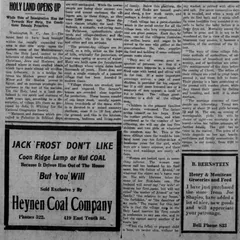 Holy Land Opens UpSedalia Capital3 January 1915CP-1915-007
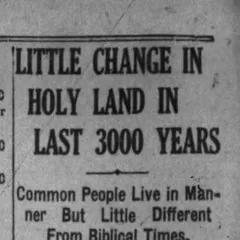 LITTLE CHANGE IN HOLY LAND IN LAST 3000 YEARSThe Daily Item7 January 1915CP-1915-003
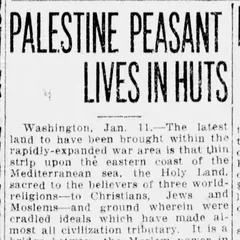 PALESTINE PEASANT LIVES IN HUTSRoanoke TimesRoanoke, Virginia13 January 1915CP-1915-006
Their text and this one are nearly identical. Found by comparing transcriptions, not by reading them side by side, so this establishes that the text overlaps and not that these papers ran the same dispatch. How this was done.
Last updated 17 November 2026
This record is part of Covering Palestine, an archive of American newspaper clippings about Palestinians, 1724 to 2023. Researched and assembled by Maria Robles.
The clipping belongs to the newspaper that printed it, or to the news agency that supplied the copy. It is reproduced here for research, criticism and commentary. A city here is where the newspaper was published, not where the story came from, and on most records it was taken from the masthead.
Something wrong here, or something you know about this clipping? The archive is still being built and corrections are wanted: maria@rozumstudio.com, quoting CP-1915-008.
Everything printed in 1915 · Printed on this day · See it in the archive reel · Full text of every clipping · Dataset