The New York Times · New York, New York · 14 March 1960
CP-1960-014
Israelis Bid Bedouins Cut Flocks
Sale or Slaughter of Drought-Menaced Sheep Is Urged
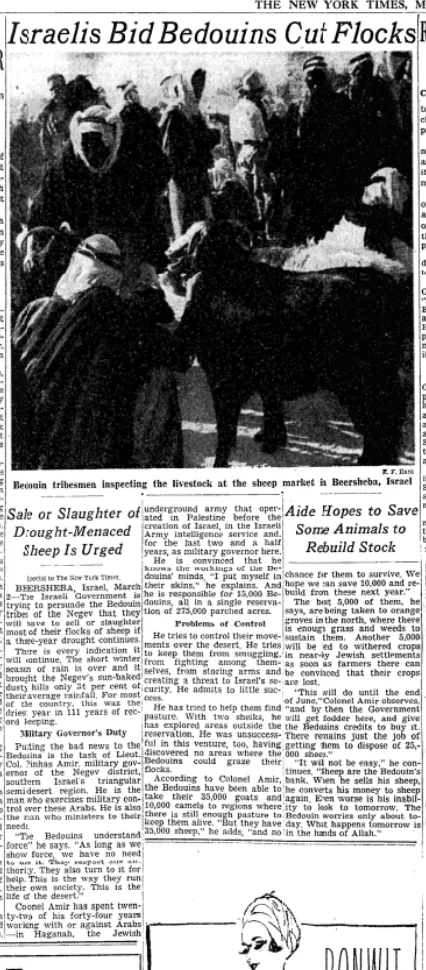
Transcribed from the clipping
BEERSHEBA, Israel, March 2—The Israeli Government is trying to persuade the Bedouin tribes of the Negev that they will have to sell or slaughter most of their flocks of sheep if a three-year drought continues. There is every indication it will continue.
The short winter season of rain is over and it brought the Negev’s sun-baked dusty hills only [illegible: two-digit figure] per cent of their average rainfall. For most of the country, this was the driest year in 111 years of record keeping. Putting the bad news to the Bedouins is the task of Lieut. Col.
Pinhas Amir, military governor of the Negev district, southern Israel’s triangular semidesert region. He is the man who exercises military control over these Arabs. He is also the man who ministers to their needs. “The Bedouins understand force” he says. “As long as we show force, we have no need to use it. They respect our authority.
They also turn to it for help. This is the way they run their own society. This is the life of the desert.”
Colonel Amir has spent twenty-two of his forty-four years working with or against Arabs—in Haganah, the Jewish underground army that operated in Palestine before the creation of Israel, in the Israeli Army intelligence service and, for the last two and a half years, as military governor here. He is convinced that he knows the workings of the Bedouins’ minds.
“I put myself in their skins,” he explains. And he is responsible for 15,000 Bedouins, all in a single reservation of 275,000 parched acres.
How this transcription was made
Read from the scan by a machine looking at the image of the page, not by optical character recognition and not by a person. The clipping carries no masthead or date line, so its date and newspaper rest on the record it arrived with, not on anything visible in the scan.
Context added by this archive
Date check: A running head along the very top of the page reads “THE NEW YORK TIMES, M” — the scan is cropped at the right edge mid-word, so the paper agrees with `pub` but the date that would follow is cut off. 1960-03-14 was a Monday, which fits the surviving “M”, but the date itself is not visible.
The dateline reads “BEERSHEBA, Israel, March 2”.
Cite this clipping
"Israelis Bid Bedouins Cut Flocks," The New York Times, 14 March 1960. Covering Palestine archive, CP-1960-014. https://coveringpalestine.org/archive/cp-1960-014
More from The New York Times
- The Maine Colony in PalestineThe New York Times · 12 November 1866
- Jewish Colonization in PalestineThe New York Times · 9 December 1883
- Jewish State in Palestine OpposedThe New York Times · 9 July 1897
- ZIONIST CONGRESS IN BASELThe New York Times · 31 August 1897
- ROME FEARS THE ZIONISTSThe New York Times · 12 September 1897
- PROGRESS OF ZIONISMThe New York Times · 16 December 1901
- 852 more from this paper in the full text →
More from the 1960s
- Gaza Strip Refugees Are Fed, Clothed, HousedHerald Statesman · 6 January 1960
- Marry, Wait to Die Lament of 240,000 Gaza RefugeesPress and Sun Bulletin · 6 January 1960
- Gaza Strip Refugee Says Young Merely Wed, Old DieThe Patriot Ledger · 7 January 1960
- An Arab Voice of ReasonThe New York Times · 19 January 1960
- Uncertainty, Fear Mark City's MoodMonroe Morning World · 5 February 1960
- Jordan Rejects Palestine BidThe New York Times · 8 March 1960
- All 227 clippings from the 1960s →
Last updated 2 November 2026
This record is part of Covering Palestine, an archive of American newspaper clippings about Palestinians, 1724 to 2023. Researched and assembled by Maria Robles.
The clipping belongs to the newspaper that printed it, or to the news agency that supplied the copy. It is reproduced here for research, criticism and commentary. A city here is where the newspaper was published, not where the story came from, and on most records it was taken from the masthead.
Something wrong here, or something you know about this clipping? The archive is still being built and corrections are wanted: maria@rozumstudio.com, quoting CP-1960-014.
Everything printed in 1960 · Printed on this day · See it in the archive reel · Full text of every clipping · Dataset