Chicago Tribune · Chicago, Illinois · 27 September 1965
CP-1965-001
Refugees Fare Poorly, Packed Into Gaza Strip
By Chesly Manly, Chicago Tribune Press Service
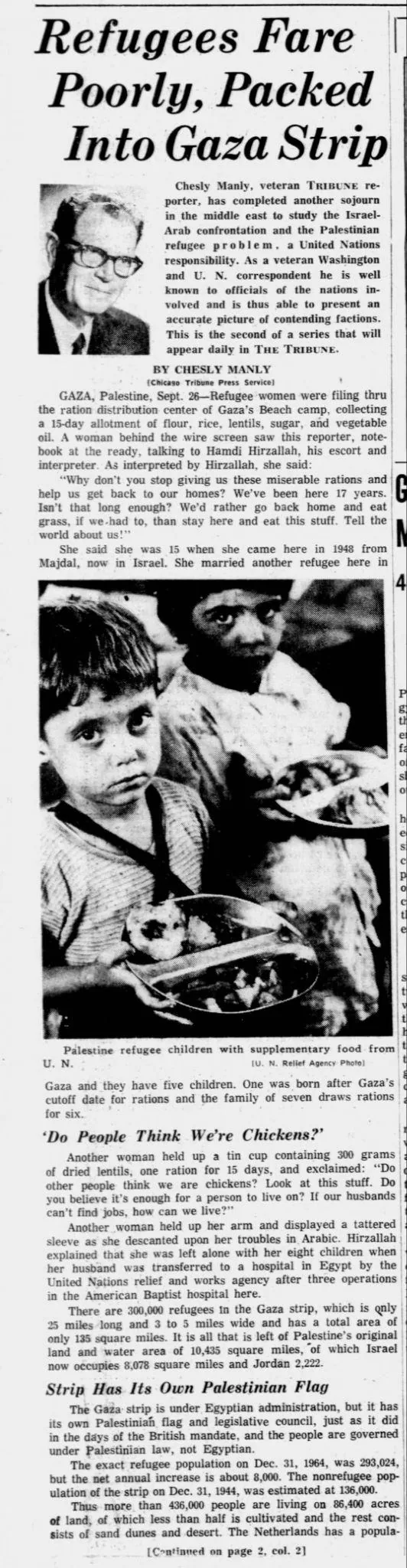
Transcribed from the clipping
“GAZA, Palestine, Sept. 26 — Refugee women were filing thru the ration distribution center of Gaza’s Beach camp, collecting a 15-day allotment of flour, rice, lentils, sugar, and vegetable oil. A woman behind the wire screen saw this reporter, notebook at the ready, talking to Hamdi Hirzallah, his escort and interpreter.
As interpreted by Hirzallah, she said: ‘Why don’t you stop giving us these miserable rations and help us get back to our homes? We’ve been here 17 years. Isn’t that long enough? We’d rather go back home and eat grass, if we had to, than stay here and eat this stuff. Tell the world about us!’
She said she was 15 when she came here in 1948 from Majdal, now in Israel. She married another refugee here in Gaza and they have five children. One was born after Gaza’s cutoff date for rations and the family of seven draws rations for six. ‘DO PEOPLE THINK WE’RE CHICKENS?’
Another woman held up a tin cup containing 300 grams of dried lentils, one ration for 15 days, and exclaimed: ‘Do other people think we are chickens? Look at this stuff. Do you believe it’s enough for a person to live on? If our husbands can’t find jobs, how can we live?’
Another woman held up her arm and displayed a tattered sleeve as she descanted upon her troubles in Arabic. Hirzallah explained that she was left alone with her eight children when her husband was transferred to a hospital in Egypt by the United Nations relief and works agency after three operations in the American Baptist hospital here.
There are 300,000 refugees in the Gaza strip, which is only 25 miles long and 3 to 5 miles wide and has a total area of only 135 square miles. It is all that is left of Palestine’s original land and water area of 10,435 square miles, of which Israel now occupies 8,078 square miles and Jordan 2,222. STRIP HAS ITS OWN PALESTINIAN FLAG.
The Gaza strip is under Egyptian administration, but it has its own Palestinian flag and legislative council, just as it did in the days of the British mandate, and the people are governed under Palestinian law, not Egyptian. The exact refugee population on Dec. 31, 1964, was 293,024, but the net annual increase is about 8,000. The nonrefugee population of the strip on Dec.
31, 1944, was estimated at 136,000. Thus more than 436,000 people are living on 86,400 acres of land, of which less than half is cultivated and the rest consists of sand dunes and desert.”
Context added by this archive
Three Palestinian women speak at length in an American newspaper in 1965, and not one of them is named. The reporter is standing at a ration window in Gaza’s Beach camp with an interpreter; the women see the notebook and come to it.
The first tells him she was fifteen when she left Majdal in 1948, that her family of seven draws rations for six, and then gives him an instruction:
‘Tell the world about us!’ The second holds up a tin cup of lentils and asks whether people think they are chickens. The third holds up a torn sleeve. Two other things this page settles. The dateline reads
GAZA, Palestine. And a subheading says the strip has its own Palestinian flag and legislative council, just as it did in the days of the British mandate, and the people are governed under Palestinian law, not Egyptian — printed thirty-seven years before an American column would call the Palestinian people an invention.
Cite this item
"Refugees Fare Poorly, Packed Into Gaza Strip," Chicago Tribune, 27 September 1965. Covering Palestine archive, CP-1965-001. https://coveringpalestine.org/archive/cp-1965-001
More from Chicago Tribune
- Chief Issue in ZionChicago Tribune · 16 August 1907
- Palestine and PatriotismChicago Tribune · 9 January 1916
- Move Palestine Arabs To Iraq, Hoover UrgesChicago Tribune · 20 November 1945
- CRISIS NEARS CLIMAXChicago Tribune · 9 February 1948
- ISRAEL CALLS FOR U.N. STEPS TO STOP ARABSChicago Tribune · 9 February 1948
- JEWISH FORCES SEIZE A MILE OF ARAB JAFFAChicago Tribune · 29 April 1948
- 17 more from this paper in the full text →
More from the 1960s
- Hogs Live Better Than 1,500,000Omaha World-Herald · 26 September 1965
- Palestinian Artists Depict Tragedy of Great ExodusValley News · 13 December 1964
- Rabbi ‘Warns’ U.S. Jews About FundThe Plain Dealer · 23 October 1963
- Refugee Crisis Forming On Jordan’s West BankCourier-Journal · 13 June 1967
- Imminent Tragedy Of The Refugees Constitutes Grim Legacy Of FightThe Anniston Star · 14 June 1967
- Victory Brings Israel Peacetime Problem of Occupying New TerritoryThe Idaho Daily Statesman · 16 June 1967
- All 56 clippings from the 1960s →
This record is part of Covering Palestine, an archive of American and Anglophone newspaper clippings about Palestinians, 1799 to 2023. Researched and assembled by Maria Robles.
The clipping belongs to the newspaper that printed it, or to the news agency that supplied the copy. It is reproduced here for research, criticism and commentary. The city is derived from the masthead, not read off the clipping.
Something wrong here, or something you know about this clipping? The archive is still being built and corrections are wanted: maria@rozumstudio.com, quoting CP-1965-001.
See it in the archive reel · Full text of every clipping · Dataset