Omaha World-Herald · Omaha, Nebraska · 26 September 1965
CP-1965-002
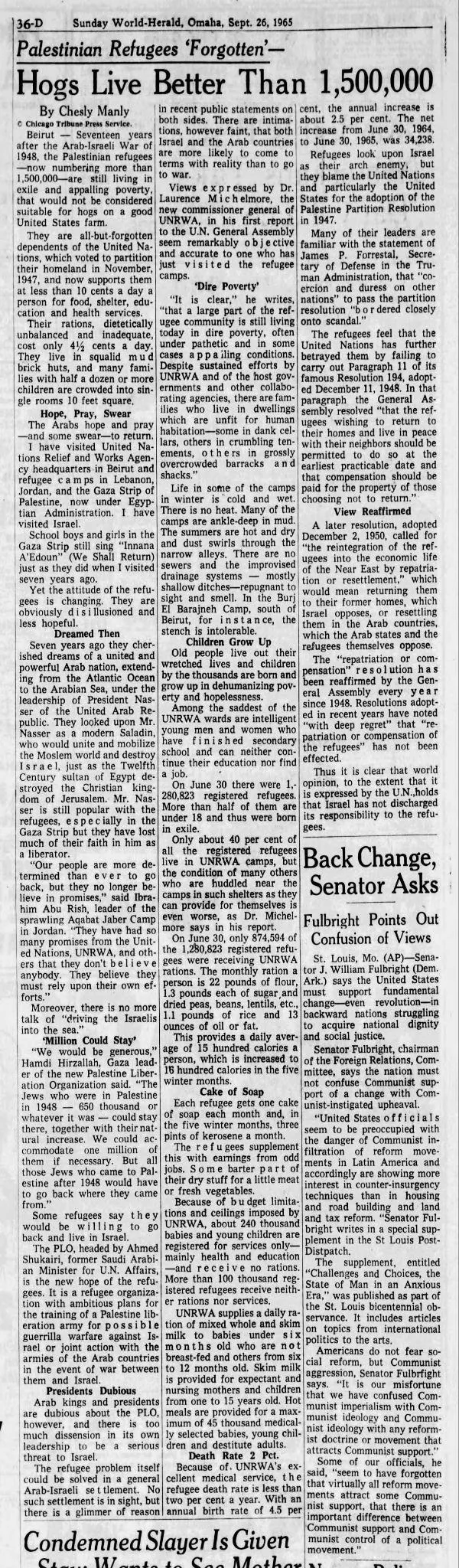
Hogs Live Better Than 1,500,000
Palestinian Refugees ‘Forgotten’
By Chesly Manly, Chicago Tribune Press Service
Transcribed from the clipping
“Beirut — Seventeen years after the Arab-Israeli War of 1948, the Palestinian refugees — now numbering more than 1,500,000 — are still living in exile and appalling poverty, that would not be considered suitable for hogs on a good United States farm.
They are all-but-forgotten dependents of the United Nations, which voted to partition their homeland in November, 1947, and now supports them at less than 10 cents a day a person for food, shelter, education and health services. Their rations, dietetically unbalanced and inadequate, cost only 4½ cents a day.
They live in squalid mud brick huts, and many families with half a dozen or more children are crowded into single rooms 10 feet square. HOPE, PRAY, SWEAR. The Arabs hope and pray — and some swear — to return. I have visited United Nations Relief and Works Agency headquarters in Lebanon, Jordan, and the Gaza Strip of Palestine, now under Egyptian Administration.
I have visited Israel. School boys and girls in the Gaza Strip still sing ‘Innana A’Edoun’ (We Shall Return) just as they did when I visited seven years ago. Yet the attitude of the refugees is changing. They are obviously disillusioned and less hopeful.
‘Our people are more determined than ever to go back, but they no longer believe in promises,’ said Ibrahim Abu Kish, leader of the sprawling Aqabat Jaber Camp in Jordan. ‘They have had so many promises from the United Nations, UNRWA, and others that they don’t believe anybody. They believe they must rely upon their own efforts.’
‘MILLION COULD STAY.’ ‘We would be generous,’ Hamdi Hirzallah, Gaza leader of the new Palestine Liberation Organization said. ‘The Jews who were in Palestine in 1948 — 650 thousand or whatever it was — could stay there, together with their natural increase. We could accommodate one million of them if necessary.
But all those Jews who came to Palestine after 1948 would have to go back where they came from.’ Some refugees say they would be willing to go back and live in Israel. ‘DIRE POVERTY.’
‘It is clear,’ he writes, ‘that a large part of the refugee community is still living today in dire poverty, often under pathetic and in some cases appalling conditions.’ Life in some of the camps in winter is cold and wet. There is no heat. Many of the camps are ankle-deep in mud. The summers are hot and dry and dust swirls through the narrow alleys.
There are no sewers and the improvised drainage systems — mostly shallow ditches — repugnant to sight and smell. In the Burj El Barajneh Camp, south of Beirut, for instance, the stench is intolerable. CHILDREN GROW UP. Old people live out their wretched lives and children by the thousands are born and grow up in dehumanizing poverty and hopelessness.
On June 30 there were 1,280,823 registered refugees. More than half of them are under 18 and thus were born in exile. The monthly ration a person is 22 pounds of flour, 1.3 pounds each of sugar and dried peas, beans, lentils, etc., 1.1 pounds of rice and 13 ounces of oil or fat.
This provides a daily average of 15 hundred calories a person, which is increased to 16 hundred calories in the five winter months. CAKE OF SOAP. Each refugee gets one cake of soap each month and, in the five winter months, three pints of kerosene a month.
Refugees look upon Israel as their arch enemy, but they blame the United Nations and particularly the United States for the adoption of the Palestine Partition Resolution in 1947. Many of their leaders are familiar with the statement of James P.
Forrestal, Secretary of Defense in the Truman Administration, that ‘coercion and duress on other nations’ to pass the partition resolution ‘bordered closely onto scandal.’ The refugees feel that the United Nations has further betrayed them by failing to carry out Paragraph 11 of its famous Resolution 194, adopted December 11, 1948.
In that paragraph the General Assembly resolved ‘that the refugees wishing to return to their homes and live in peace with their neighbors should be permitted to do so at the earliest practicable date and that compensation should be paid for the property of those choosing not to return.’
Thus it is clear that world opinion, to the extent that it is expressed by the U.N., holds that Israel has not discharged its responsibility to the refugees.”
Context added by this archive
The same reporter, the same week, and a headline that measures a million and a half people against American livestock in order to make them visible.
The comparison is the writer’s own and it is meant sympathetically, which is what makes it worth keeping: in 1965 the way to get an American reader to look at Palestinian refugees was to tell him they were housed worse than his hogs. The detail underneath is precise in a way the headline is not. Rations costing four and a half cents a day. One cake of soap a month.
Fifteen hundred calories, sixteen hundred in winter. 1,280,823 registered refugees, more than half of them under eighteen and therefore born in exile.
The man quoted at length as the new Palestine Liberation Organization’s leader in Gaza is Hamdi Hirzallah — the same man who served as this reporter’s escort and interpreter at the ration window in the companion piece.
Cite this item
"Hogs Live Better Than 1,500,000," Omaha World-Herald, 26 September 1965. Covering Palestine archive, CP-1965-002. https://coveringpalestine.org/archive/cp-1965-002
More from Omaha World-Herald
- Arabs Fear Zionists Menace in PalestineOmaha World-Herald · 17 March 1919
- Arabs Violently Opposed to ZionismOmaha World-Herald · 1 June 1919
- Palestine Is Listing Her Landless ArabsOmaha World-Herald · 15 February 1931
- KILL ARAB RIOTERS IN JAFFA, PALESTINEOmaha World-Herald · 28 October 1933
- BRITISH CONTINUE PALESTINE CURFEWOmaha World-Herald · 20 October 1937
- Bomb, Shots Jolt PalestineOmaha World-Herald · 20 October 1937
- 7 more from this paper in the full text →
More from the 1960s
- Refugees Fare Poorly, Packed Into Gaza StripChicago Tribune · 27 September 1965
- Palestinian Artists Depict Tragedy of Great ExodusValley News · 13 December 1964
- Rabbi ‘Warns’ U.S. Jews About FundThe Plain Dealer · 23 October 1963
- Refugee Crisis Forming On Jordan’s West BankCourier-Journal · 13 June 1967
- Imminent Tragedy Of The Refugees Constitutes Grim Legacy Of FightThe Anniston Star · 14 June 1967
- Victory Brings Israel Peacetime Problem of Occupying New TerritoryThe Idaho Daily Statesman · 16 June 1967
- All 56 clippings from the 1960s →
This record is part of Covering Palestine, an archive of American and Anglophone newspaper clippings about Palestinians, 1799 to 2023. Researched and assembled by Maria Robles.
The clipping belongs to the newspaper that printed it, or to the news agency that supplied the copy. It is reproduced here for research, criticism and commentary. The city is derived from the masthead, not read off the clipping.
Something wrong here, or something you know about this clipping? The archive is still being built and corrections are wanted: maria@rozumstudio.com, quoting CP-1965-002.
See it in the archive reel · Full text of every clipping · Dataset