Grand Forks Herald · Grand Forks, North Dakota · 6 February 1966
CP-1966-003
Palestinian Refugee Population Growing
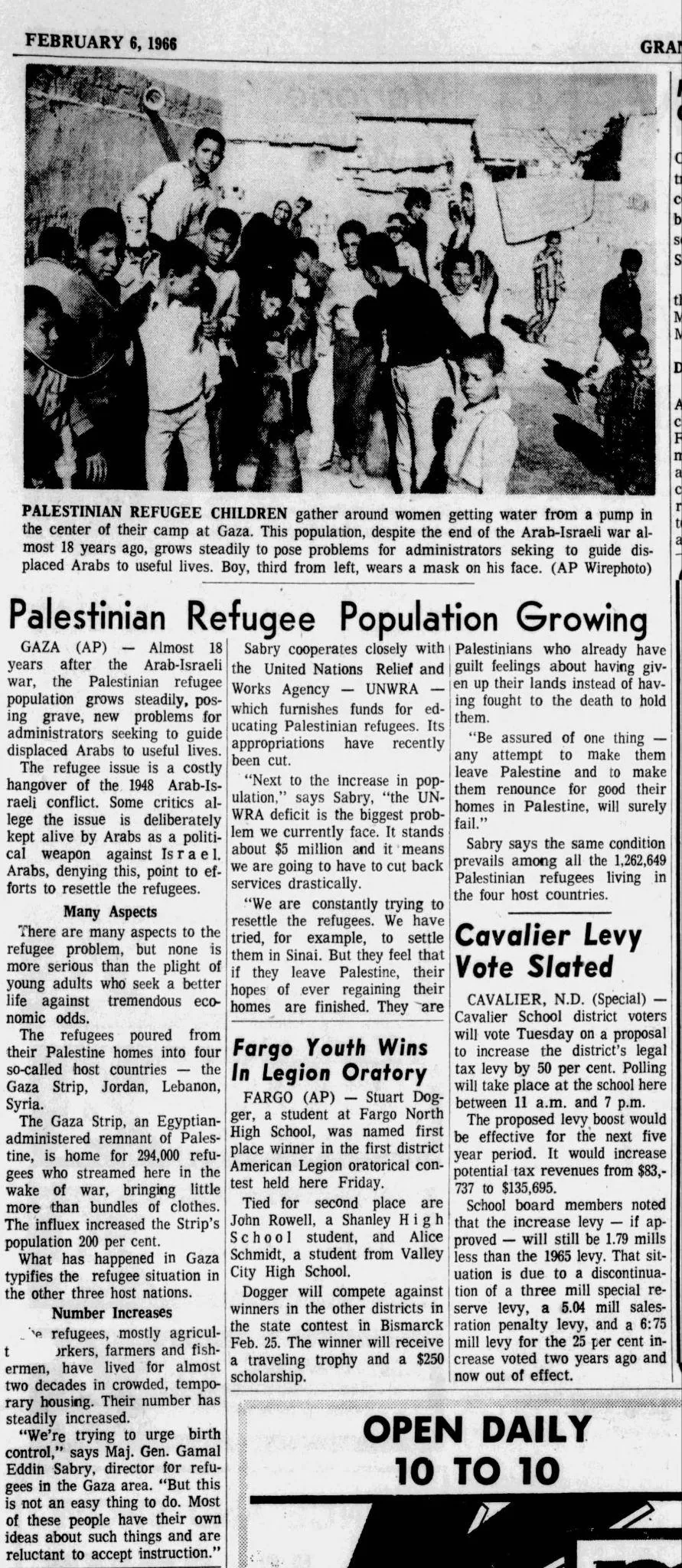
Transcribed from the clipping
GAZA (AP) — Almost 18 years after the Arab-Israeli war, the Palestinian refugee population grows steadily, posing grave, new problems for administrators seeking to guide displaced Arabs to useful lives. The refugee issue is a costly hangover of the 1948 Arab-Israeli conflict.
Some critics allege the issue is deliberately kept alive by Arabs as a political weapon against Israel. Arabs, denying this, point to efforts to resettle the refugees. There are many aspects to the refugee problem, but none is more serious than the plight of young adults who seek a better life against tremendous economic odds.
The refugees poured from their Palestine homes into four so-called host countries — the Gaza Strip, Jordan, Lebanon, Syria. The Gaza Strip, an Egyptian-administered remnant of Palestine, is home for 294,000 refugees who streamed here in the wake of war, bringing little more than bundles of clothes. The influx increased the Strip's population 200 per cent.
What has happened in Gaza typifies the refugee situation in the other three host nations. The refugees, mostly agricultural workers, farmers and fishermen, have lived for almost two decades in crowded, temporary housing. Their number has steadily increased. “We're trying to urge birth control,” says Maj. Gen. Gamal Eddin Sabry, director for refugees in the Gaza area.
“But this is not an easy thing to do. Most of these people have their own ideas about such things and are reluctant to accept instruction.” Sabry cooperates closely with the United Nations Relief and Works Agency — UNWRA — which furnishes funds for educating Palestinian refugees. Its appropriations have recently been cut.
“Next to the increase in population,” says Sabry, “the UNWRA deficit is the biggest problem we currently face. It stands about $5 million and it means we are going to have to cut back services drastically.” “We are constantly trying to resettle the refugees. We have tried, for example, to settle them in Sinai.
But they feel that if they leave Palestine, their hopes of ever regaining their homes are finished. They are Palestinians who already have guilt feelings about having given up their lands instead of having fought to the death to hold them.
“Be assured of one thing — any attempt to make them leave Palestine and to make them renounce for good their homes in Palestine, will surely fail.” Sabry says the same condition prevails among all the 1,262,649 Palestinian refugees living in the four host countries.
Context added by this archive
No byline. The same Associated Press dispatch ran in the Orange Leader, Texas, a month later, bylined Garven Hudgins and under a kicker reading Posing Grave Problems. The paper's own spelling of UNWRA and of seking is kept.
Cite this item
"Palestinian Refugee Population Growing," Grand Forks Herald, 6 February 1966. Covering Palestine archive, CP-1966-003. https://coveringpalestine.org/archive/cp-1966-003
More from Grand Forks Herald
- Palestinian children in deadly tug of warGrand Forks Herald · 22 July 1993
- Six killed in raids by Israeli forces, Palestinians sayGrand Forks Herald · 26 October 2022
More from the 1960s
- Palestinian Refugee Population Is GrowingThe Orange Leader · 8 March 1966
- Palestinians Riot for ArmsThe Daily Oklahoman · 25 November 1966
- Palestinian Refugees Hate Us For Helping IsraelGoldsboro News-Argus · 29 November 1966
- Palestinian Arabs Reportedly Engaged in Sabotage CampaignLincoln Journal Star · 2 April 1965
- Hogs Live Better Than 1,500,000Omaha World-Herald · 26 September 1965
- Refugees Fare Poorly, Packed Into Gaza StripChicago Tribune · 27 September 1965
- All 61 clippings from the 1960s →
This record is part of Covering Palestine, an archive of American and Anglophone newspaper clippings about Palestinians, 1799 to 2023. Researched and assembled by Maria Robles.
The clipping belongs to the newspaper that printed it, or to the news agency that supplied the copy. It is reproduced here for research, criticism and commentary. The city is derived from the masthead, not read off the clipping.
Something wrong here, or something you know about this clipping? The archive is still being built and corrections are wanted: maria@rozumstudio.com, quoting CP-1966-003.
See it in the archive reel · Full text of every clipping · Dataset