Santa Barbara News-Press · Santa Barbara, California · 18 June 1967
CP-1967-003
The Palestinian Refugees…
Our Readers’ Views
Sheldon T. Mills, a former United States ambassador to Jordan
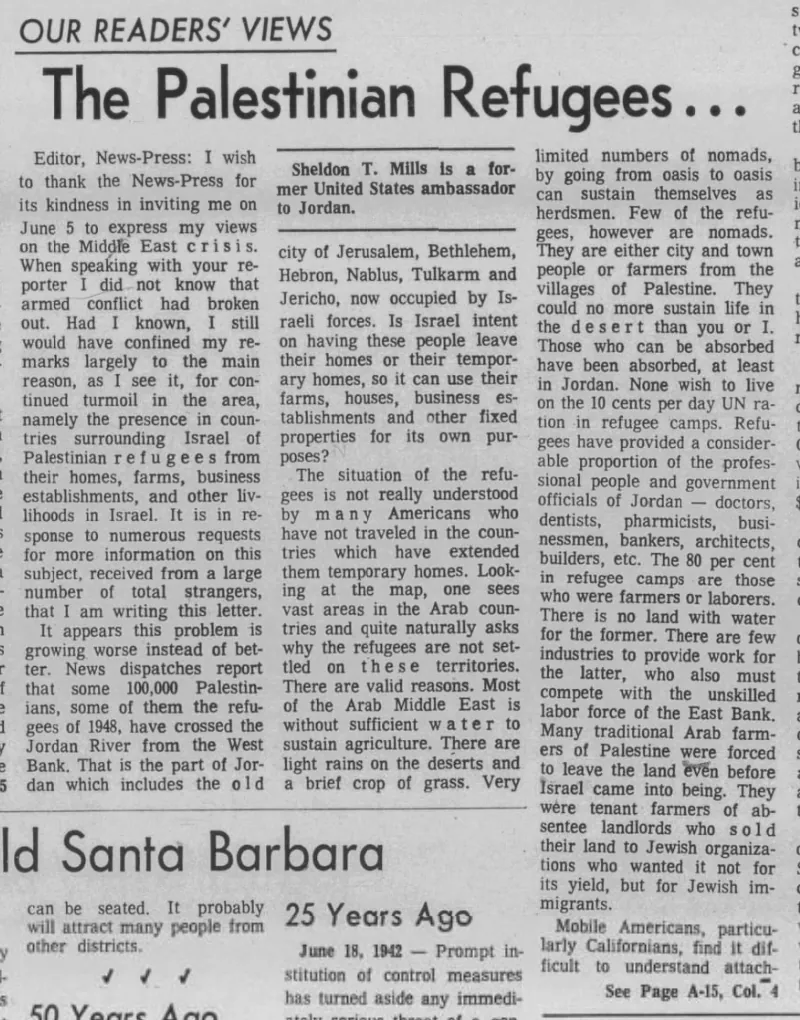
Transcribed from the clipping
“Editor, News-Press: I wish to thank the News-Press for its kindness in inviting me on June 5 to express my views on the Middle East crisis. When speaking with your reporter I did not know that armed conflict had broken out.
Had I known, I still would have confined my remarks largely to the main reason, as I see it, for continued turmoil in the area, namely the presence in countries surrounding Israel of Palestinian refugees from their homes, farms, business establishments, and other livelihoods in Israel.
It is in response to numerous requests for more information on this subject, received from a large number of total strangers, that I am writing this letter. It appears this problem is growing worse instead of better. News dispatches report that some 100,000 Palestinians, some of them the refugees of 1948, have crossed the Jordan River from the West Bank.
That is the part of Jordan which includes the old city of Jerusalem, Bethlehem, Hebron, Nablus, Tulkarm and Jericho, now occupied by Israeli forces. Is Israel intent on having these people leave their homes or their temporary homes, so it can use their farms, houses, business establishments and other fixed properties for its own purposes?
The situation of the refugees is not really understood by many Americans who have not traveled in the countries which have extended them temporary homes. Looking at the map, one sees vast areas in the Arab countries and quite naturally asks why the refugees are not settled on these territories. There are valid reasons.
Most of the Arab Middle East is without sufficient water to sustain agriculture. There are light rains on the deserts and a brief crop of grass. Very limited numbers of nomads, by going from oasis to oasis can sustain themselves as herdsmen. Few of the refugees, however are nomads. They are either city and town people or farmers from the villages of Palestine.
They could no more sustain life in the desert than you or I. Those who can be absorbed have been absorbed, at least in Jordan. None wish to live on the 10 cents per day UN ration in refugee camps.
Refugees have provided a considerable proportion of the professional people and government officials of Jordan — doctors, dentists, pharmicists, businessmen, bankers, architects, builders, etc. The 80 per cent in refugee camps are those who were farmers or laborers. There is no land with water for the former.
There are few industries to provide work for the latter, who also must compete with the unskilled labor force of the East Bank. Many traditional Arab farmers of Palestine were forced to leave the land even before Israel came into being.
They were tenant farmers of absentee landlords who sold their land to Jewish organizations who wanted it not for its yield, but for Jewish immigrants. Mobile Americans, particularly Californians, find it difficult to understand attach…”
Context added by this archive
A former American ambassador to Jordan writing to his local California paper to answer strangers who had asked him why the refugees were not simply settled elsewhere. He answers with water, soil and the tenant-farming system. The story continues on A-15.
Cite this clipping
"The Palestinian Refugees…," Santa Barbara News-Press, 18 June 1967, p. 1. Covering Palestine archive, CP-1967-003. https://coveringpalestine.org/archive/cp-1967-003
More from Santa Barbara News-Press
- Problem of Refugees in PalestineSanta Barbara News-Press · 12 June 1949
- Zionism, racism: Another viewpointSanta Barbara News-Press · 11 December 1975
- Gazans lose a rare pleasure: the zooSanta Barbara News-Press · 22 May 2004
- Israeli leader warns of 'iron fist'; Hamas remains defiantSanta Barbara News-Press · 13 January 2009
- Palestinian push for statehood jeopardizes U.S. aidSanta Barbara News-Press · 20 September 2011
- ‘Hamas is using the Gaza population as human shields’Santa Barbara News-Press · 19 November 2012
- 3 more from this paper in the full text →
More from the 1960s
- Arabs Call Unity Meeting For Israel OppositionThe Arizona Republic · 2 January 1967
- Middle East Pots Boiling on New Year'sTulsa World · 2 January 1967
- New Blow At Jordan ThreatenedThe Clarksdale Press Register · 3 January 1967
- PLO Plans To Strike At HusseinClovis News-Journal · 3 January 1967
- Even in War, Bethlehem Has Air of Tourist TownThe New York Times · 10 June 1967
- JERUSALEM ARABS DIVIDED ON FUTUREThe New York Times · 12 June 1967
- All 227 clippings from the 1960s →
In these collections
Last updated 2 November 2026
This record is part of Covering Palestine, an archive of American newspaper clippings about Palestinians, 1724 to 2023. Researched and assembled by Maria Robles.
The clipping belongs to the newspaper that printed it, or to the news agency that supplied the copy. It is reproduced here for research, criticism and commentary. A city here is where the newspaper was published, not where the story came from, and on most records it was taken from the masthead.
Something wrong here, or something you know about this clipping? The archive is still being built and corrections are wanted: maria@rozumstudio.com, quoting CP-1967-003.
Everything printed in 1967 · Printed on this day · See it in the archive reel · Full text of every clipping · Dataset