The New York Times · 10 June 1967
CP-1967-053
Even in War, Bethlehem Has Air of Tourist Town
By TERENCE SMITH, Special to The New York Times
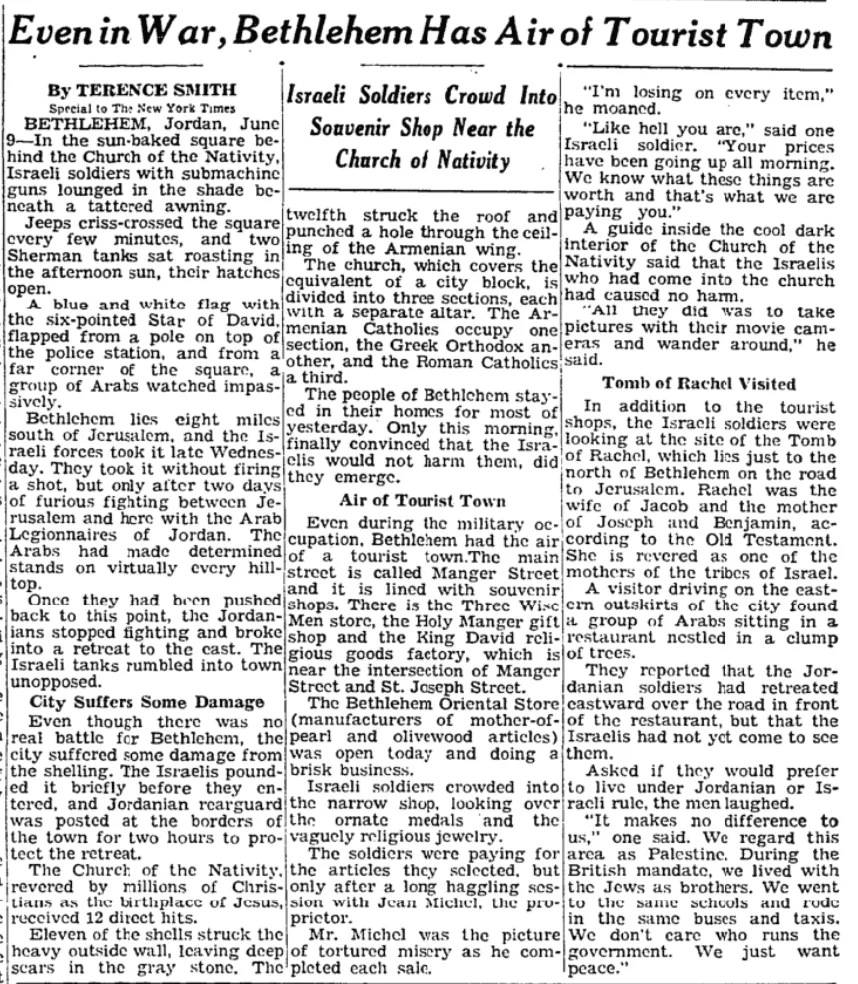
Transcribed from the clipping
BETHLEHEM, Jordan, June 9—In the sun-baked square behind the Church of the Nativity, Israeli soldiers with submachine guns lounged in the shade beneath a tattered awning. Jeeps criss-crossed the square every few minutes, and two Sherman tanks sat roasting in the afternoon sun, their hatches open.
A blue and white flag with the six-pointed Star of David, flapped from a pole on top of the police station, and from a far corner of the square, a group of Arabs watched impassively. Bethlehem lies eight miles south of Jerusalem, and the Israeli forces took it late Wednesday.
They took it without firing a shot, but only after two days of furious fighting between Jerusalem and here with the Arab Legionnaires of Jordan. The Arabs had made determined stands on virtually every hilltop. Once they had been pushed back to this point, the Jordanians stopped fighting and broke into a retreat to the east. The Israeli tanks rumbled into town unopposed.
City Suffers Some Damage Even though there was no real battle for Bethlehem, the city suffered some damage from the shelling. The Israelis pounded it briefly before they entered, and Jordanian rearguard was posted at the borders of the town for two hours to protect the retreat.
The Church of the Nativity, revered by millions of Christians as the birthplace of Jesus, received 12 direct hits. Eleven of the shells struck the heavy outside wall, leaving deep scars in the gray stone. The twelfth struck the roof and punched a hole through the ceiling of the Armenian wing.
The church, which covers the equivalent of a city block, is divided into three sections, each with a separate altar. The Armenian Catholics occupy one section, the Greek Orthodox another, and the Roman Catholics a third. The people of Bethlehem stayed in their homes for most of yesterday.
Only this morning, finally convinced that the Israelis would not harm them, did they emerge. Air of Tourist Town Even during the military occupation, Bethlehem had the air of a tourist town.The main street is called Manger Street and it is lined with souvenir shops.
There is the Three Wise Men store, the Holy Manger gift shop and the King David religious goods factory, which is near the intersection of Manger Street and St. Joseph Street. The Bethlehem Oriental Store (manufacturers of mother-of-pearl and olivewood articles) was open today and doing a brisk business.
Israeli soldiers crowded into the narrow shop, looking over the ornate medals and the vaguely religious jewelry. The soldiers were paying for the articles they selected, but only after a long haggling session with Jean Michel, the proprietor. Mr. Michel was the picture of tortured misery as he completed each sale. “I’m losing on every item,” he moaned.
“Like hell you are,” said one Israeli soldier. “Your prices have been going up all morning. We know what these things are worth and that’s what we are paying you.” A guide inside the cool dark interior of the Church of the Nativity said that the Israelis who had come into the church had caused no harm.
“All they did was to take pictures with their movie cameras and wander around,” he said. Tomb of Rachel Visited In addition to the tourist shops, the Israeli soldiers were looking at the site of the Tomb of Rachel, which lies just to the north of Bethlehem on the road to Jerusalem.
Rachel was the wife of Jacob and the mother of Joseph and Benjamin, according to the Old Testament. She is revered as one of the mothers of the tribes of Israel. A visitor driving on the eastern outskirts of the city found a group of Arabs sitting in a restaurant nestled in a clump of trees.
They reported that the Jordanian soldiers had retreated eastward over the road in front of the restaurant, but that the Israelis had not yet come to see them. Asked if they would prefer to live under Jordanian or Israeli rule, the men laughed. “It makes no difference to us,” one said. We regard this area as Palestine.
During the British mandate, we lived with the Jews as brothers. We went to the same schools and rode in the same buses and taxis. We don’t care who runs the government. We just want peace.”
How this transcription was made
Transcribed from the slide scan by a reader working off magnified crops, not by optical character recognition. The newspaper is printed on the clipping, in the credit line “Special to The New York Times” under the byline. There is no masthead and no folio. The date is derived from the printed dateline, “BETHLEHEM, Jordan, June 9”, and from the text, which says Israeli forces took the city “late Wednesday” — 7 June 1967 — and that its people stayed indoors “for most of yesterday”; the year is fixed beyond doubt by the war the article describes. The city is datelined “BETHLEHEM, Jordan”, which is the paper’s usage on 10 June 1967 and is kept. Two printed errors are kept as set: a quotation that opens, closes after four words and then runs on for five more sentences without a reopening mark, and a missing space in “tourist town.The main street”.
Cite this clipping
"Even in War, Bethlehem Has Air of Tourist Town," The New York Times, 10 June 1967. Covering Palestine archive, CP-1967-053. https://coveringpalestine.org/archive/cp-1967-053
More from The New York Times
- The Maine Colony in PalestineThe New York Times · 12 November 1866
- Jewish Colonization in PalestineThe New York Times · 9 December 1883
- Jewish State in Palestine OpposedThe New York Times · 9 July 1897
- ZIONIST CONGRESS IN BASELThe New York Times · 31 August 1897
- ROME FEARS THE ZIONISTSThe New York Times · 12 September 1897
- PROGRESS OF ZIONISMThe New York Times · 16 December 1901
- 852 more from this paper in the full text →
More from the 1960s
- Arabs Call Unity Meeting For Israel OppositionThe Arizona Republic · 2 January 1967
- Middle East Pots Boiling on New Year'sTulsa World · 2 January 1967
- New Blow At Jordan ThreatenedThe Clarksdale Press Register · 3 January 1967
- PLO Plans To Strike At HusseinClovis News-Journal · 3 January 1967
- JERUSALEM ARABS DIVIDED ON FUTUREThe New York Times · 12 June 1967
- Refugee Crisis Forming On Jordan’s West BankCourier-Journal · 13 June 1967
- All 227 clippings from the 1960s →
Last updated 2 November 2026
This record is part of Covering Palestine, an archive of American newspaper clippings about Palestinians, 1724 to 2023. Researched and assembled by Maria Robles.
The clipping belongs to the newspaper that printed it, or to the news agency that supplied the copy. It is reproduced here for research, criticism and commentary. A city here is where the newspaper was published, not where the story came from, and on most records it was taken from the masthead.
Something wrong here, or something you know about this clipping? The archive is still being built and corrections are wanted: maria@rozumstudio.com, quoting CP-1967-053.
Everything printed in 1967 · Printed on this day · See it in the archive reel · Full text of every clipping · Dataset