The Times Picayune · New Orleans, LA · 19 May 1969
CP-1969-031
U.N. Agency Suggests Ban of Arab Textbooks
Being Used in Refugee Schools of Unit
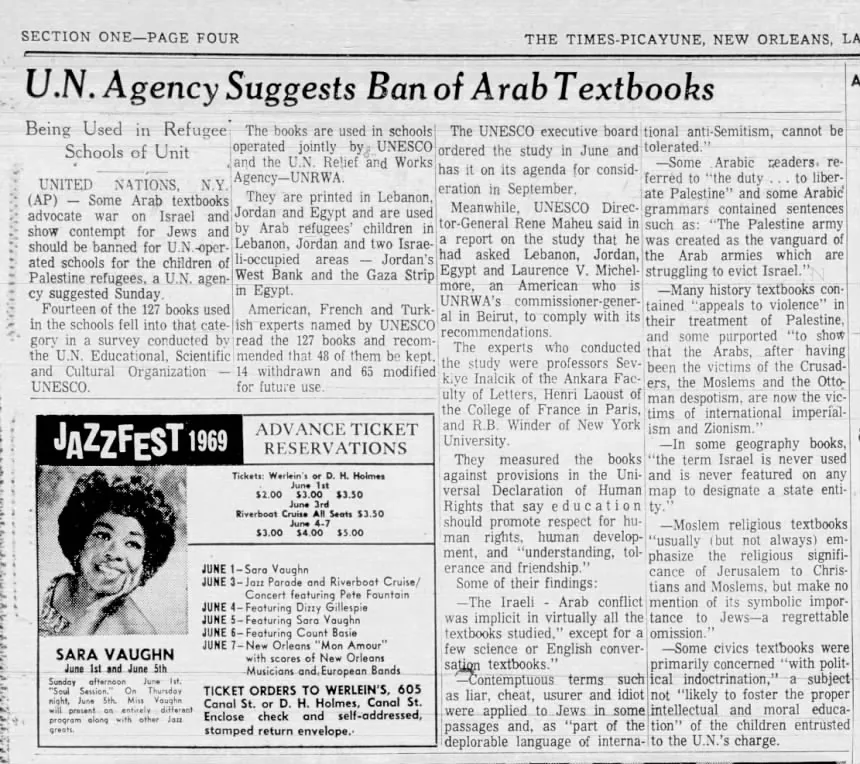
Transcribed from the clipping
UNITED NATIONS, N.Y. (AP) — Some Arab textbooks advocate war on Israel and show contempt for Jews and should be banned for U.N.-operated schools for the children of Palestine refugees, a U.N. agency suggested Sunday. Fourteen of the 127 books used in the schools fell into that category in a survey conducted by the U.N.
Educational, Scientific and Cultural Organization — UNESCO. The books are used in schools operated jointly by UNESCO and the U.N. Relief and Works Agency—UNRWA. They are printed in Lebanon, Jordan and Egypt and are used by Arab refugees' children in Lebanon, Jordan and two Israeli-occupied areas — Jordan's West Bank and the Gaza Strip in Egypt.
American, French and Turkish experts named by UNESCO read the 127 books and recommended that 48 of them be kept, 14 withdrawn and 65 modified for future use. The UNESCO executive board ordered the study in June and has it on its agenda for consideration in September.
Meanwhile, UNESCO Director-General Rene Maheu said in a report on the study that he had asked Lebanon, Jordan, Egypt and Laurence V. Michelmore, an American who is UNRWA's commissioner-general in Beirut, to comply with its recommendations.
The experts who conducted the study were professors Sevkiye Inalcik of the Ankara Faculty of Letters, Henri Laoust of the College of France in Paris, and R.B. Winder of New York University.
They measured the books against provisions in the Universal Declaration of Human Rights that say education should promote respect for human rights, human development, and "understanding, tolerance and friendship." Some of their findings: —The Iraeli - Arab conflict was implicit in virtually all the textbooks studied," except for a few science or English conversation textbooks." —Contemptuous terms such as liar, cheat, usurer and idiot were applied to Jews in some passages and, as "part of the deplorable language of international anti-Semitism, cannot be tolerated." —Some Arabic readers referred to "the duty . . . to liberate Palestine" and some Arabic grammars contained sentences such as: "The Palestine army was created as the vanguard of the Arab armies which are struggling to evict Israel." —Many history textbooks contained "appeals to violence" in their treatment of Palestine, and some purported "to show that the Arabs, after having been the victims of the Crusaders, the Moslems and the Ottoman despotism, are now the victims of international imperialism and Zionism." —In some geography books, "the term Israel is never used and is never featured on any map to designate a state entity." —Moslem religious textbooks "usually (but not always) emphasize the religious significance of Jerusalem to Christians and Moslems, but make no mention of its symbolic importance to Jews—a regrettable omission." —Some civics textbooks were primarily concerned "with political indoctrination," a subject not "likely to foster the proper intellectual and moral education" of the children entrusted to the U.N.'s charge.
How this transcription was made
Date confirmed on the page (masthead). Filed under the archive’s spelling; the page prints “The Times PIcayune”.
Context added by this archive
THE FOURTH HEADLINE, and the one that shows the others were choices. Same AP copy, four desks: s102_1 'U.N.
Agency Suggests Ban of Arab Textbooks' (+ deck: 'Being Used in Refugee Schools of Unit') <- this one s099_1 'Arab Textbooks Advocate Waging War with Israel' s099_2 'Arab Schoolbooks Advocate War, Anti-Semitism' s112_2 'UNESCO Would Withdraw 14 Anti-Jewish Textbooks' The Times-Picayune headline attributes ('U.N.
Agency Suggests'), names the actor, and makes no claim in the paper's own voice about what the books are. Three other desks, given the identical paragraphs, wrote headlines that asserted. That is the cleanest possible demonstration that the assertion was editorial and not in the wire: one of the four desks did not make it.
This printing is also the fullest text of the dispatch and should be the one the archive quotes from.
Note that even here, the structure of the bulleted list does the work Maria noticed: seven findings in a row, of which one concerns actual slurs against Jews ('liar, cheat, usurer and idiot'), one concerns an omission from Moslem religious textbooks, one concerns 'political indoctrination' in civics books, and one concerns Arabic readers that 'referred to "the duty . . . to liberate Palestine"'.
They are set as equivalent items. Nobody in the piece distinguishes between a slur and a political aspiration, and no Arab or Palestinian educator is given a line to make that distinction. The only named people are three European and American professors, a French director-general and an American commissioner-general.
Cite this clipping
"U.N. Agency Suggests Ban of Arab Textbooks," The Times Picayune, 19 May 1969, p. Section One, Page Four. Covering Palestine archive, CP-1969-031. https://coveringpalestine.org/archive/cp-1969-031
More from The Times Picayune
- GAZA HAS NEW CONSTITUTIONThe Times Picayune · 10 March 1962
- World Reaction Varied Toward Zionism VoteThe Times Picayune · 13 November 1975
More from the 1960s
- Israel Integrating Druze AreasThe Plain Dealer · 1969
- Arabs Create 'Schools of Hate' for YoungSan Francisco Examiner · 12 January 1969
- Arab textbooks carry message of hatredAlbany Democrat-Herald · 22 January 1969
- Dayan Tours Four Towns in West-Bank RegionThe New York Times · 12 February 1969
- Israelis Slaughter Palestine ArabsFlorida Today · 13 February 1969
- Another View On Justice, TruthWorcester Telegram · 19 February 1969
- All 227 clippings from the 1960s →
Last updated 2 November 2026
This record is part of Covering Palestine, an archive of American newspaper clippings about Palestinians, 1724 to 2023. Researched and assembled by Maria Robles.
The clipping belongs to the newspaper that printed it, or to the news agency that supplied the copy. It is reproduced here for research, criticism and commentary. A city here is where the newspaper was published, not where the story came from, and on most records it was taken from the masthead.
Something wrong here, or something you know about this clipping? The archive is still being built and corrections are wanted: maria@rozumstudio.com, quoting CP-1969-031.
Everything printed in 1969 · Printed on this day · See it in the archive reel · Full text of every clipping · Dataset