The New York Times · 2 November 1976
CP-1976-045
Unease Is Deepening in Israel Over the Arab Minority
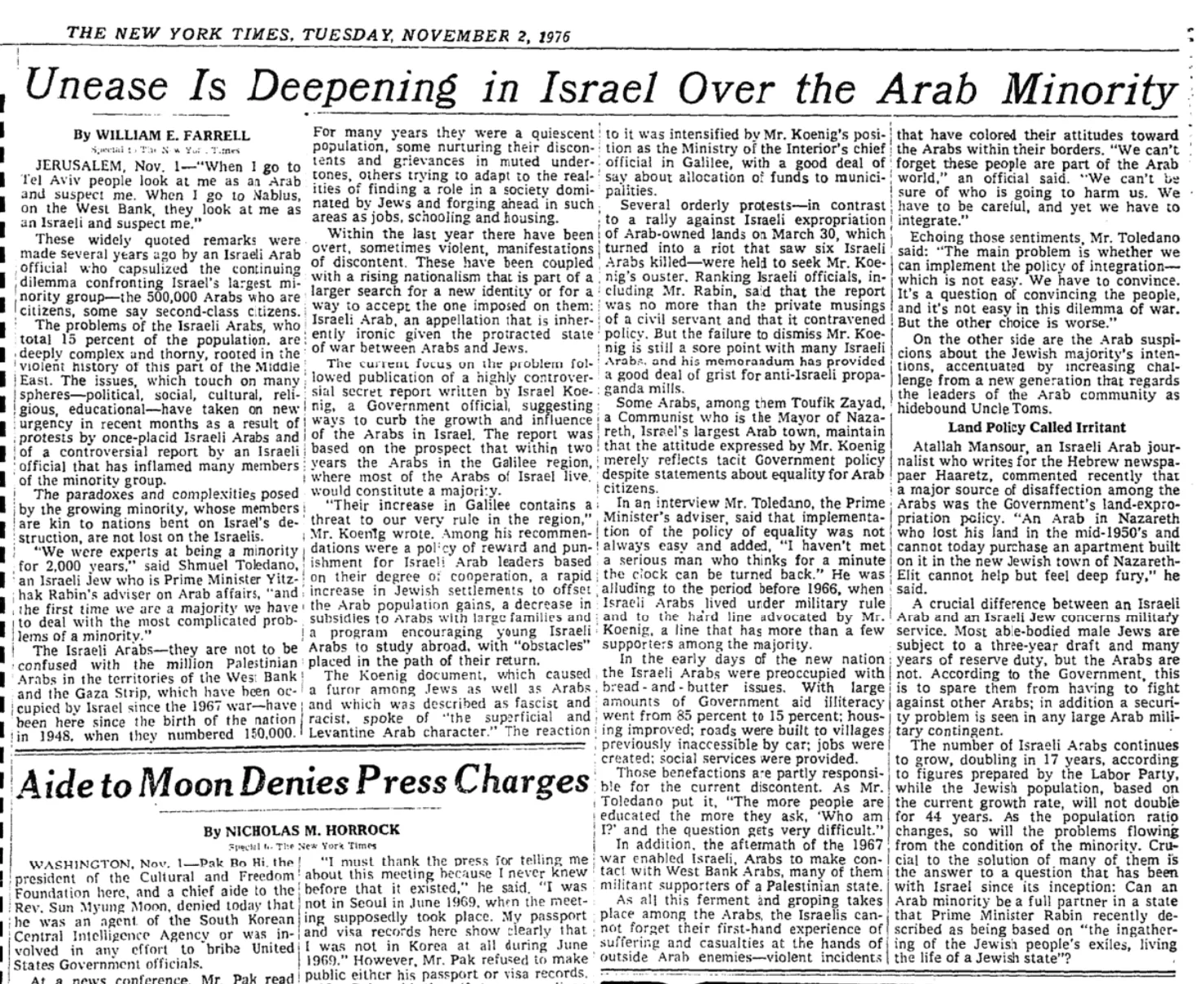
Transcribed from the clipping
JERUSALEM, Nov. 1 — “When I go to Tel Aviv people look at me as an Arab and suspect me. When I go to Nablus, on the West Bank, they look at me as an Israeli and suspect me.”
These widely quoted remarks were made several years ago by an Israeli Arab official who capsulized the continuing dilemma confronting Israel’s largest minority group — the 500,000 Arabs who are citizens, some say second-class citizens.
The problems of the Israeli Arabs, who total 15 percent of the population, are deeply complex and thorny, rooted in the violent history of this part of the Middle East.
The issues, which touch on many spheres — political, social, cultural, religious, educational — have taken on new urgency in recent months as a result of protests by once-placid Israeli Arabs and of a controversial report by an Israeli official that has inflamed many members of the minority group.
The paradoxes and complexities posed by the growing minority, whose members are kin to nations bent on Israel’s destruction, are not lost on the Israelis.
“We were experts at being a minority for 2,000 years,” said Shmuel Toledano, an Israeli Jew who is Prime Minister Yitzhak Rabin’s adviser on Arab affairs, “and the first time we are a majority we have to deal with the most complicated problems of a minority.”
The Israeli Arabs — they are not to be confused with the million Palestinian Arabs in the territories of the West Bank and the Gaza Strip, which have been occupied by Israel since the 1967 war — have been here since the birth of the nation in 1948, when they numbered 150,000.
For many years they were a quiescent population, some nurturing their discontents and grievances in muted undertones, others trying to adapt to the realities of finding a role in a society dominated by Jews and forging ahead in such areas as jobs, schooling and housing. Within the last year there have been overt, sometimes violent, manifestations of discontent.
These have been coupled with a rising nationalism that is part of a larger search for a new identity or for a way to accept the one imposed on them: Israeli Arab, an appellation that is inherently ironic given the protracted state of war between Arabs and Jews.
The current focus on the problem followed publication of a highly controversial secret report written by Israel Koenig, a Government official, suggesting ways to curb the growth and influence of the Arabs in Israel. The report was based on the prospect that within two years the Arabs in the Galilee region, where most of the Arabs of Israel live, would constitute a majority.
“Their increase in Galilee contains a threat to our very rule in the region,” Mr. Koenig wrote.
Among his recommendations were a policy of reward and punishment for Israeli Arab leaders based on their degree of cooperation, a rapid increase in Jewish settlements to offset the Arab population gains, a decrease in subsidies to Arabs with large families and a program encouraging young Israeli Arabs to study abroad, with “obstacles” placed in the path of their return.
The Koenig document, which caused a furor among Jews as well as Arabs and which was described as fascist and racist, spoke of “the superficial and Levantine Arab character.” The reaction to it was intensified by Mr.
Koenig’s position as the Ministry of the Interior’s chief official in Galilee, with a good deal of say about allocation of funds to municipalities. Several orderly protests — in contrast to a rally against Israeli expropriation of Arab-owned lands on March 30, which turned into a riot that saw six Israeli Arabs killed — were held to seek Mr.
Koenig’s ouster. Ranking Israeli officials, including Mr. Rabin, said that the report was no more than the private musings of a civil servant and that it contravened policy. But the failure to dismiss Mr. Koenig is still a sore point with many Israeli Arabs, and his memorandum has provided a good deal of grist for anti-Israeli propaganda mills.
Some Arabs, among them Toufik Zayad, a Communist who is the Mayor of Nazareth, Israel’s largest Arab town, maintain that the attitude expressed by Mr. Koenig merely reflects tacit Government policy despite statements about equality for Arab citizens. In an interview Mr.
Toledano, the Prime Minister’s adviser, said that implementation of the policy of equality was not always easy and added, “I haven’t met a serious man who thinks for a minute the clock can be turned back.” He was alluding to the period before 1966, when Israeli Arabs lived under military rule and to the hard line advocated by Mr.
Koenig, a line that has more than a few supporters among the majority. In the early days of the new nation the Israeli Arabs were preoccupied with bread-and-butter issues.
With large amounts of Government aid illiteracy went from 85 percent to 15 percent; housing improved; roads were built to villages previously inaccessible by car; jobs were created; social services were provided. Those benefactions are partly responsible for the current discontent. As Mr.
Toledano put it, “The more people are educated the more they ask, ‘Who am I?’ and the question gets very difficult.” In addition, the aftermath of the 1967 war enabled Israeli Arabs to make contact with West Bank Arabs, many of them militant supporters of a Palestinian state.
As all this ferment and groping takes place among the Arabs, the Israelis cannot forget their first-hand experience of suffering and casualties at the hands of outside Arab enemies — violent incidents that have colored their attitudes toward the Arabs within their borders. “We can’t forget these people are part of the Arab world,” an official said.
“We can’t be sure of who is going to harm us. We have to be careful, and yet we have to integrate.” Echoing those sentiments, Mr. Toledano said: “The main problem is whether we can implement the policy of integration — which is not easy. We have to convince.
It’s a question of convincing the people, and it’s not easy in this dilemma of war. But the other choice is worse.” On the other side are the Arab suspicions about the Jewish majority’s intentions, accentuated by increasing challenge from a new generation that regards the leaders of the Arab community as hidebound Uncle Toms.
Land Policy Called Irritant Atallah Mansour, an Israeli Arab journalist who writes for the Hebrew newspapaer Haaretz, commented recently that a major source of disaffection among the Arabs was the Government’s land-expropriation policy.
“An Arab in Nazareth who lost his land in the mid-1950’s and cannot today purchase an apartment built on it in the new Jewish town of Nazareth-Elit cannot help but feel deep fury,” he said. A crucial difference between an Israeli Arab and an Israeli Jew concerns military service.
Most able-bodied male Jews are subject to a three-year draft and many years of reserve duty, but the Arabs are not. According to the Government, this is to spare them from having to fight against other Arabs; in addition a security problem is seen in any large Arab military contingent.
The number of Israeli Arabs continues to grow, doubling in 17 years, according to figures prepared by the Labor Party, while the Jewish population, based on the current growth rate, will not double for 44 years. As the population ratio changes, so will the problems flowing from the condition of the minority.
Crucial to the solution of many of them is the answer to a question that has been with Israel since its inception: Can an Arab minority be a full partner in a state that Prime Minister Rabin recently described as being based on “the ingathering of the Jewish people’s exiles, living the life of a Jewish state”?
Cite this clipping
"Unease Is Deepening in Israel Over the Arab Minority," The New York Times, 2 November 1976. Covering Palestine archive, CP-1976-045. https://coveringpalestine.org/archive/cp-1976-045
More from The New York Times
- The Maine Colony in PalestineThe New York Times · 12 November 1866
- Jewish Colonization in PalestineThe New York Times · 9 December 1883
- Jewish State in Palestine OpposedThe New York Times · 9 July 1897
- ZIONIST CONGRESS IN BASELThe New York Times · 31 August 1897
- ROME FEARS THE ZIONISTSThe New York Times · 12 September 1897
- PROGRESS OF ZIONISMThe New York Times · 16 December 1901
- 852 more from this paper in the full text →
More from the 1970s
- Palestinians and Leftist Factions Open an Offensive in BeirutThe New York Times · 8 January 1976
- Equation Of Zionism With Racism Shocked CleaverPaducah Sun · 13 January 1976
- Arab prisoner manages to retain political attitudesMidland Reporter Telegram · 29 January 1976
- Drive to liberate Palestine intensifiesChicago Tribune · 29 February 1976
- Zionism and RacismHonolulu Star-Bulletin · 12 March 1976
- Plight of four schoolgirls illustrates frustration of West Bank occupationBellingham Herald · 17 March 1976
- All 338 clippings from the 1970s →
Last updated 2 November 2026
This record is part of Covering Palestine, an archive of American newspaper clippings about Palestinians, 1724 to 2023. Researched and assembled by Maria Robles.
The clipping belongs to the newspaper that printed it, or to the news agency that supplied the copy. It is reproduced here for research, criticism and commentary. A city here is where the newspaper was published, not where the story came from, and on most records it was taken from the masthead.
Something wrong here, or something you know about this clipping? The archive is still being built and corrections are wanted: maria@rozumstudio.com, quoting CP-1976-045.
Everything printed in 1976 · Printed on this day · See it in the archive reel · Full text of every clipping · Dataset