Johnson City Press-Chronicle · Johnson City, Tennessee · 8 October 1978
CP-1978-013
Students from Middle East discuss problems of peace
By BILLIE FARTHING, P-C Staff Writer
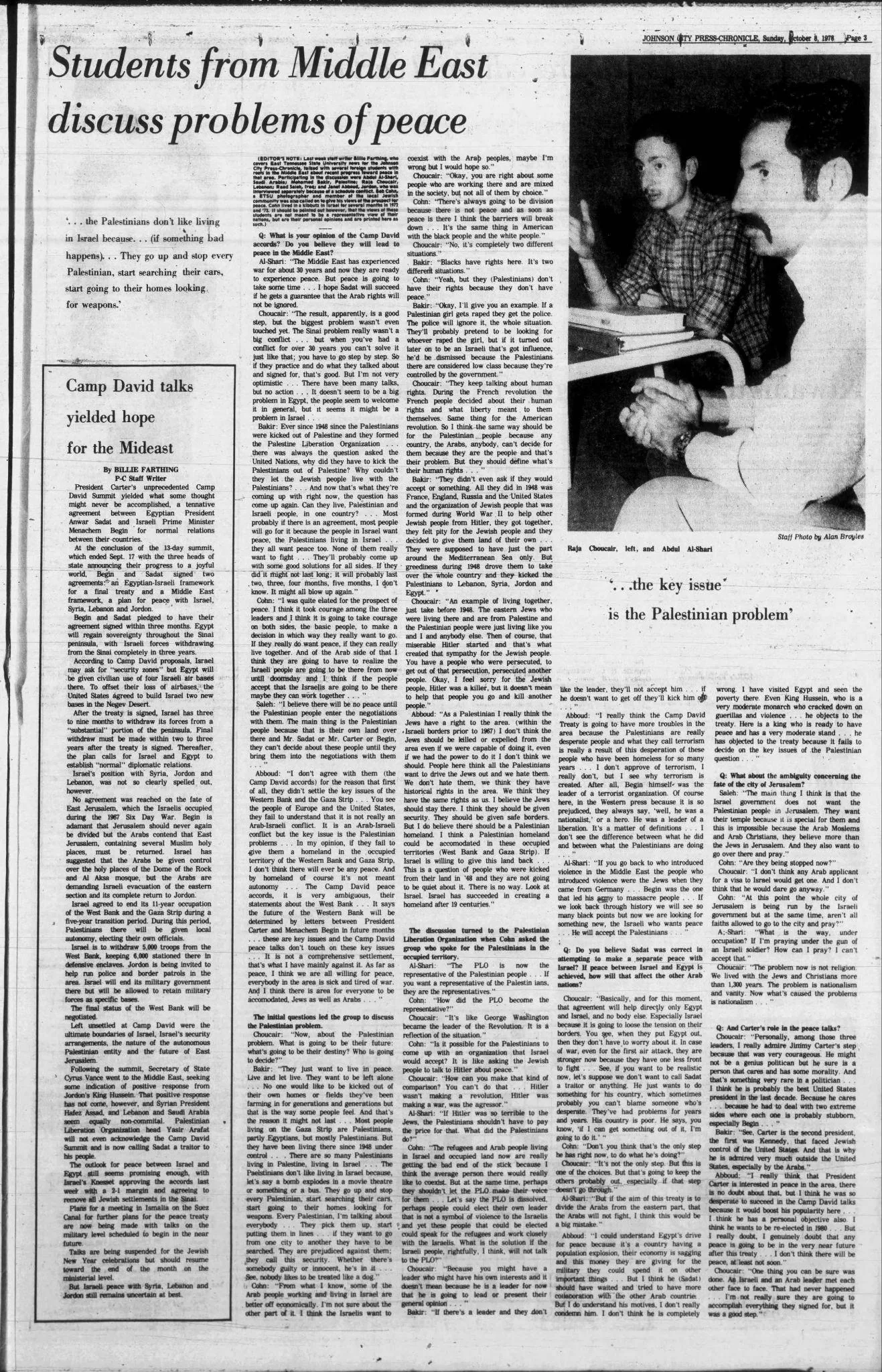
Transcribed from the clipping
(EDITOR'S NOTE: Last week staff writer Billie Farthing, who covers East Tennessee State University news for the Johnson City Press-Chronicle, talked with several foreign students with roots in the Middle East about recent progress toward peace in that area.
Participating in the discussion were Abdul Al-Shari, Saudi Arabia; Mohamed Bakir, Palestine; Raja Choucair, Lebanon; Raad Saleh, Iraq; and Janet Abboud, Jordon, who was interviewed separately because of a schedule conflict. Bob Cohn, a ETSU photographer and member of the local Jewish community was also called on to give his views of the prospect for peace.
Cohn lived in a kibbutz in Israel for several months in 1972 and '73. It should be pointed out however, that the views of these students are not meant to be a representative view of their nations, but are their personal opinions and are printed here as such.) Q: What is your opinion of the Camp David accords? Do you believe they will lead to peace in the Middle East?
Al-Shari: “The Middle East has experienced war for about 30 years and now they are ready to experience peace. But peace is going to take some time . . . I hope Sadat will succeed if he gets a guarantee that the Arab rights will not be ignored.” Choucair: “The result, apparently, is a good step, but the biggest problem wasn't even touched yet.
The Sinai problem really wasn't a big conflict . . . but when you've had a conflict for over 30 years you can't solve it just like that; you have to go step by step. So if they practice and do what they talked about and signed for, that's good. But I'm not very optimistic . . . There have been many talks, but no action . . .
It doesn't seem to be a big problem in Egypt, the people seem to welcome it in general, but it seems it might be a problem in Israel . . .”
Bakir: “Ever since 1948 since the Palestinians were kicked out of Palestine and they formed the Palestine Liberation Organization . . . there was always the question asked the United Nations, why did they have to kick the Palestinians out of Palestine? Why couldn't they let the Jewish people live with the Palestinians? . . .
And now that's what they're coming up with right now, the question has come up again. Can they live, Palestinian and Israeli people, in one country? . . . Most probably if there is an agreement, most people will go for it because the people in Israel want peace, the Palestinians living in Israel . . . they all want peace too. None of them really want to fight . . .
They'll probably come up with some good solutions for all sides. If they did it might not last long; it will probably last two, three, four months, five months, I don't know. It might all blow up again.” Cohn: “I was quite elated for the prospect of peace.
I think it took courage among the three leaders and I think it is going to take courage on both sides, the basic people, to make a decision in which way they really want to go. If they really do want peace, if they can really live together.
And of the Arab side of that I think they are going to have to realize the Israeli people are going to be there from now until doomsday and I think if the people accept that the Israelis are going to be there maybe they can work together . . .” Saleh: “I believe there will be no peace until the Palestinian people enter the negotiations with them.
The main thing is the Palestinian people because that is their own land over there and Mr. Sadat or Mr. Carter or Begin, they can't decide about these people until they bring them into the negotiations with them . . .”
Abboud: “I don't agree with them (the Camp David accords) for the reason that first of all, they didn't settle the key issues of the Western Bank and the Gaza Strip . . . You see the people of Europe and the United States, they fail to understand that it is not really an Arab-Israeli conflict. It is an Arab-Israeli conflict but the key issue is the Palestinian problems . . .
In my opinion, if they fail to give them a homeland in the occupied territory of the Western Bank and Gaza Strip, I don't think there will ever be any peace. And by homeland of course it's not meant to give them autonomy . . . The Camp David peace accords, it is very ambiguous, their statements about the West Bank . . .
It says the future of the Western Bank will be determined by letters between President Carter and Menachem Begin in future months . . . these are key issues and the Camp David peace talks don't touch on these key issues . . . It is not a comprehensive settlement, that's what I have mainly against it.
As far as peace, I think we are all willing for peace, everybody in the area is sick and tired of war. And I think there is area for everyone to be accomodated, Jews as well as Arabs . . .” The initial questions led the group to discuss the Palestinian problem. Choucair: “Now, about the Palestinian problem. What is going to be their future: what's going to be their destiny?
Who is going to decide?” Bakir: “They just want to live in peace. Live and let live. They want to be left alone . . . No one would like to be kicked out of their own homes or fields they've been farming for generations and generations but that is the way some people feel. And that's the reason it might not last . . .
Most people living on the Gaza Strip are Palestinians, partly Egyptians, but mostly Palestinians. But they have been living there since 1948 under control . . . There are so many Palestinians living in Palestine, living in Israel . . . The Palestinians don't like living in Israel because, let's say a bomb explodes in a movie theatre or something or a bus.
They go up and stop every Palestinian, start searching their cars, start going to their homes looking for weapons. Every Palestinian, I'm talking about everybody . . . They pick them up, start putting them in lines . . . if they want to go from one city to another they have to be searched. They are prejudiced against them; they call this security.
Whether there's somebody guilty or innocent, he's in it . . . See, nobody likes to be treated like a dog.” Cohn: “From what I know, some of the Arab people working and living in Israel are better off economically. I'm not sure about the other part of it. I think the Israelis want to coexist with the Arab peoples, maybe I'm wrong but I would hope so.”
Choucair: “Okay, you are right about some people who are working there and are mixed in the society, but not all of them by choice.” Cohn: “There's always going to be division because there is not peace and as soon as peace is there I think the barriers will break down . . . It's the same thing in American with the black people and the white people.”
Choucair: “No, it's completely two different situations.” Bakir: “Blacks have rights here. It's two different situations.” Cohn: “Yeah, but they (Palestinians) don't have their rights because they don't have peace.” Bakir: “Okay, I'll give you an example. If a Palestinian girl gets raped they get the police. The police will ignore it, the whole situation.
They'll probably pretend to be looking for whoever raped the girl, but if it turned out later on to be an Israeli that's got influence, he'd be dismissed because the Palestinians there are considered low class because they're controlled by the government.” Choucair: “They keep talking about human rights.
During the French revolution the French people decided about their human rights and what liberty meant to them themselves. Same thing for the American revolution. So I think the same way should be for the Palestinian people because any country, the Arabs, anybody, can't decide for them because they are the people and that's their problem.
But they should define what's their human rights . . .” Bakir: “They didn't even ask if they would accept or something.
All they did in 1948 was France, England, Russia and the United States and the organization of Jewish people that was formed during World War II to help other Jewish people from Hitler, they got together, they felt pity for the Jewish people and they decided to give them land of their own . . . They were supposed to have just the part around the Mediterranean Sea only.
But greediness during 1948 drove them to take over the whole country and they kicked the Palestinians to Lebanon, Syria, Jordon and Egypt.” Choucair: “An example of a living together, just take before 1948. The eastern Jews who were living there and are from Palestine and the Palestinian people were just living like you and I and anybody else.
Then of course, that miserable Hitler started and that's what created that sympathy for the Jewish people. You have a people who were persecuted, to get out of that persecution, persecuted another people. Okay, I feel sorry for the Jewish people, Hitler was a killer, but it doesn't mean to help that people you go and kill another people.”
Abboud: “As a Palestinian I really think the Jews have a right to the area. (within the Israeli borders prior to 1967) I don't think the Jews should be killed or expelled from the area even if we were capable of doing it, even if we had the power to do it I don't think we should. People here think all the Palestinians want to drive the Jews out and we hate them.
We don't hate them, we think they have historical rights in the area. We think they have the same rights as us. I believe the Jews should be given security. They should be given safe borders. But I do believe there should be a Palestinian homeland. I think a Palestinian homeland could be accomodated in these occupied territories (West Bank and Gaza Strip).
If Israel is willing to give this land back . . . This is a question of people who were kicked from their land in '48 and they are not going to be quiet about it. There is no way. Look at Israel. Israel has succeeded in creating a homeland after 19 centuries.”
The discussion turned to the Palestine Liberation Organization when Cohn asked the group who spoke for the Palestinians in the occupied territory. Al-Shari: “The PLO is now the representative of the Palestinian people . . . If you want a representative of the Palestinian people, they are the representatives.” Cohn: “How did the PLO become the representative?”
Choucair: “It's like George Washington became the leader of the Revolution. It is a reflection of the situation.” Cohn: “Is it possible for the Palestinians to come up with an organization that Israel would accept? It is like asking the Jewish people to talk to Hitler about peace.” Choucair: “How can you make that kind of comparison? You can't do that . . .
Hitler wasn't making a revolution. Hitler was making a war, was the agressor.” Al-Shari: “If Hitler was so terrible to the Jews, the Palestinians shouldn't have to pay the price for that. What did the Palestinians do?”
Cohn: “The refugees and Arab people living in Israel and occupied land now are really getting the bad end of the stick because I think the average person there would really like to coexist. But at the same time, perhaps they shouldn't let the PLO make their voice for them . . .
Let's say the PLO is dissolved, perhaps people could elect their own leader that is not a symbol of violence to the Israelis and yet these people that could be elected could speak for the refugees and work closely with the Israelis. What is the solution if the Israeli people, rightfully, I think, will not talk to the PLO?”
Choucair: “Because you might have a leader who might have his own interests and it doesn't mean because he is a leader for now that he is going to lead or present their general opinion . . .” Bakir: “If there's a leader and they don't like the leader, they'll not accept him . . . if he doesn't want to get off they'll kick him off.”
Abboud: “I really think the Camp David Treaty is going to have more troubles in the area because the Palestinians are really desperate people and what they call terrorism is really a result of this desperation of these people who have been homeless for so many years . . . I don't approve of terrorism. I really don't, but I see why terrorism is created.
After all, Begin himself was the leader of a terrorist organization. Of course here, in the Western press because it is so prejudiced, they always say, 'well, he was a nationalist,' or a hero. He was a leader of a liberation. It's a matter of definitions . . . I don't see the difference between what he did and between what the Palestinians are doing now.”
Al-Shari: “If you go back to who introduced violence in the Middle East the people who introduced violence were the Jews when they came from Germany . . . Begin was the one that led his army to massacre people . . . If we look back through history we will see so many black points but now we are looking for something new, the Israeli who wants peace . . .
He will accept the Palestinians . . .” Q: Do you believe Sadat was correct in attempting to make a separate peace with Israel? If peace between Israel and Egypt is achieved, how will that affect the other Arab nations? Choucair: “Basically, and for this moment, that agreement will help directly only Egypt and Israel, and no body else.
Especially Israel because it is going to loose the tension on their borders. You see, when they put Egypt out, then they don't have to worry about it. In case of war, even for the first air attack, they are stronger now because they have one less front to fight . . . See, if you want to be realistic now, let's suppose we don't want to call Sadat a traitor or anything.
He just wants to do something for his country, which sometimes probably you can't blame someone who's desperate. They've had problems for years and years. His country is poor. He says, you know, 'if I can get something out of it, I'm going to do it.'” Cohn: “Don't you think that's the only step he has right now, to do what he's doing?” Choucair: “It's not the only step.
But this is one of the choices. But that's going to keep the others probably out, especially if that step doesn't go through.” Al-Shari: “But if the aim of this treaty is to divide the Arabs from the eastern part, that the Arabs will not fight, I think this would be a big mistake.”
Abboud: “I could understand Egypt's drive for peace because it's a country having a population explosion, their economy is sagging and this money they are giving for the military they could spend it on other important things . . . But I think he (Sadat) should have waited and tried to have more collaboration with the other Arab countries.
But I do understand his motives, I don't really condemn him. I don't think he is completely wrong. I have visited Egypt and seen the poverty there. Even King Hussein, who is a very moderate monarch who cracked down on guerrillas and violence . . . he objects to the treaty.
Here is a king who is ready to have peace and has a very moderate stand . . . he has objected to the treaty because it fails to decide on the key issues of the Palestinian question . . .” Q: What about the ambiguity concerning the fate of the city of Jerusalem? Saleh: “The main thing I think is that the Israel government does not want the Palestinian people in Jerusalem.
They want their temple because it is special for them and this is impossible because the Arab Moslems and Arab Christians, they believe more than the Jews in Jerusalem. And they also want to go over there and pray.” Cohn: “Are they being stopped now?” Choucair: “I don't think any Arab applicant for a visa to Israel would get one.
And I don't think that he would dare go anyway.” Cohn: “At this point the whole city of Jerusalem is being run by the Israeli government but at the same time, aren't all faiths allowed to go to the city and pray?” Al-Shari: “What is the way, under occupation? If I'm praying under the gun of an Israeli soldier? How can I pray? I can't accept that.”
Choucair: “The problem now is not religion. We lived with the Jews and Christians more than 1,300 years. The problem is nationalism and vanity. Now what's caused the problems is nationalism . . .” Q: And Carter's role in the peace talks? Choucair: “Personally, among those three leaders, I really admire Jimmy Carter's step because that was very courageous.
He might not be a genius politican but he sure is a person that cares and has some morality. And that's something very rare in a politician . . . I think he is probably the best United States president in the last decade. Because he cares . . . because he had to deal with two extreme sides where each one is probably stubborn, especially Begin . . .”
Bakir: “See, Carter is the second president, the first was Kennedy, that faced Jewish control of the United States. And that is why he is admired very much outside the United States, especially by the Arabs.”
Abboud: “I really think that President Carter is interested in peace in the area, there is no doubt about that, but I think he was so desperate to succeed in the Camp David talks because it would boost his popularity here . . . I think he has a personal objective also. I think he wants to be re-elected in 1980 . . .
But I really doubt, I genuinely doubt that any peace is going to be in the very near future after this treaty . . . I don't think there will be peace, at least not soon.” Choucair: “One thing you can be sure was done. An Israeli and an Arab leader met each other face to face. That had never happened . . .
I'm not really sure they are going to accomplish everything they signed for, but it was a good step.”
Context added by this archive
A transcript of a discussion at East Tennessee State University three weeks after the Camp David summit, printed with the students' names attached to their words. Of the six people at the table one, Mohamed Bakir, is identified as Palestinian; Janet Abboud, listed as Jordanian, speaks of herself as a Palestinian and was interviewed separately.
The page also carries a separate staff report on the summit itself. The paper's spelling of Jordon is kept.
Cite this item
"Students from Middle East discuss problems of peace," Johnson City Press-Chronicle, 8 October 1978. Covering Palestine archive, CP-1978-013. https://coveringpalestine.org/archive/cp-1978-013
More from the 1970s
- 3 Israeli Settlements On West Bank ApprovedLos Angeles Herald Examiner · 11 January 1978
- A land so sacred to all who have held itThe Philadelphia Inquirer · 5 February 1978
- Israeli SettlementsThe Times · 13 February 1978
- Guerrilla gestures excitedly during interview near former Palestinian strongholdDaily News · 20 March 1978
- E. Jerusalem Guides Probed For PLO PropagandaSt. Louis Jewish Light · 30 August 1978
- Four Million Palestinian Refugees ‘Alienated, Dispossessed, Amputated’Omaha World-Herald · 22 October 1978
- All 122 clippings from the 1970s →
This record is part of Covering Palestine, an archive of American and Anglophone newspaper clippings about Palestinians, 1799 to 2023. Researched and assembled by Maria Robles.
The clipping belongs to the newspaper that printed it, or to the news agency that supplied the copy. It is reproduced here for research, criticism and commentary. The city is derived from the masthead, not read off the clipping.
Something wrong here, or something you know about this clipping? The archive is still being built and corrections are wanted: maria@rozumstudio.com, quoting CP-1978-013.
See it in the archive reel · Full text of every clipping · Dataset