The New York Times · New York, New York · 2 March 1980
CP-1980-023
Israeli Censorship Strikes A Discordant, Insistent Note
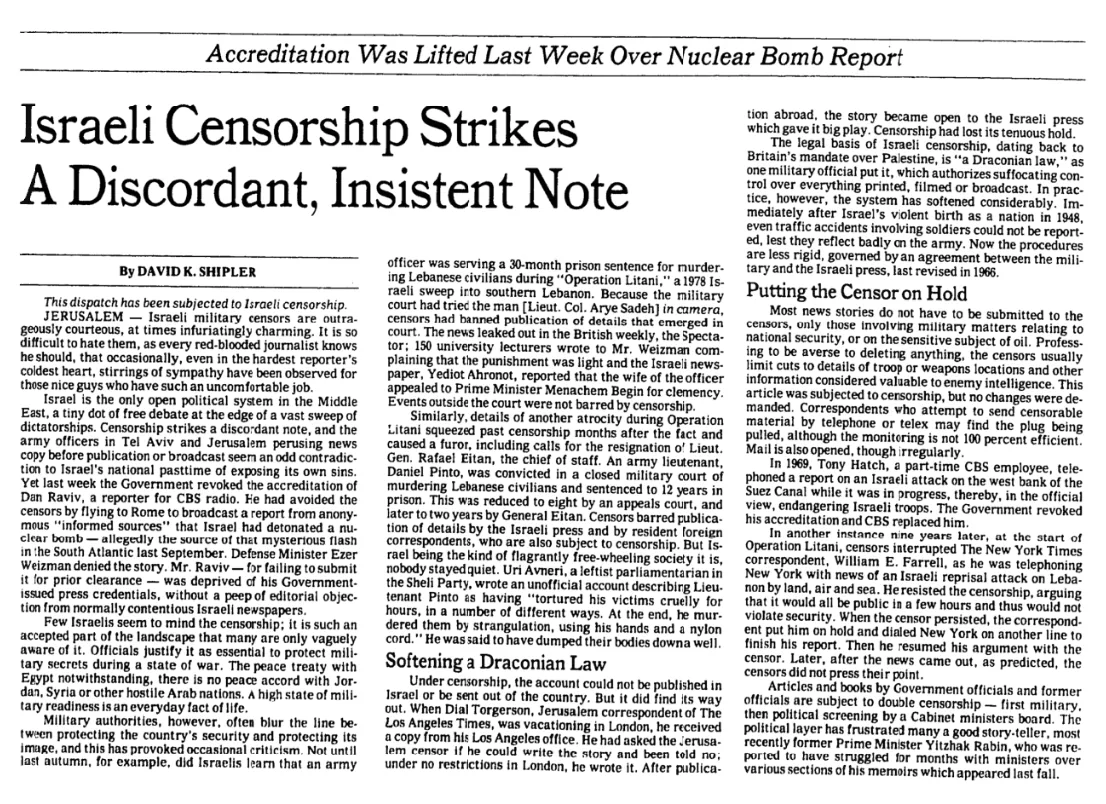
Transcribed from the clipping
JERUSALEM — Israeli military censors are outrageously courteous, at times infuriatingly charming. It is so difficult to hate them, as every red-blooded journalist knows he should, that occasionally, even in the hardest reporter’s coldest heart, stirrings of sympathy have been observed for those nice guys who have such an uncomfortable job.
Israel is the only open political system in the Middle East, a tiny dot of free debate at the edge of a vast sweep of dictatorships. Censorship strikes a discordant note, and the army officers in Tel Aviv and Jerusalem perusing news copy before publication or broadcast seem an odd contradiction to Israel’s national pasttime of exposing its own sins.
Yet last week the Government revoked the accreditation of Dan Raviv, a reporter for CBS radio. He had avoided the censors by flying to Rome to broadcast a report from anonymous “informed sources” that Israel had detonated a nuclear bomb — allegedly the source of that mysterious flash in the South Atlantic last September. Defense Minister Ezer Weizman denied the story. Mr.
Raviv — for failing to submit it for prior clearance — was deprived of his Government-issued press credentials, without a peep of editorial objection from normally contentious Israeli newspapers. Few Israelis seem to mind the censorship; it is such an accepted part of the landscape that many are only vaguely aware of it.
Officials justify it as essential to protect military secrets during a state of war. The peace treaty with Egypt notwithstanding, there is no peace accord with Jordan, Syria or other hostile Arab nations. A high state of military readiness is an everyday fact of life.
Military authorities, however, often blur the line between protecting the country’s security and protecting its image, and this has provoked occasional criticism.
Not until last autumn, for example, did Israelis learn that an army officer was serving a 30-month prison sentence for murdering Lebanese civilians during “Operation Litani,” a 1978 Israeli sweep into southern Lebanon. Because the military court had tried the man [Lieut. Col. Arye Sadeh] in camera, censors had banned publication of details that emerged in court.
The news leaked out in the British weekly, the Spectator; 150 university lecturers wrote to Mr. Weizman complaining that the punishment was light and the Israeli newspaper, Yediot Ahronot, reported that the wife of the officer appealed to Prime Minister Menachem Begin for clemency. Events outside the court were not barred by censorship.
Similarly, details of another atrocity during Operation Litani squeezed past censorship months after the fact and caused a furor, including calls for the resignation of Lieut. Gen. Rafael Eitan, the chief of staff. An army lieutenant, Daniel Pinto, was convicted in a closed military court of murdering Lebanese civilians and sentenced to 12 years in prison.
This was reduced to eight by an appeals court, and later to two years by General Eitan. Censors barred publication of details by the Israeli press and by resident foreign correspondents, who are also subject to censorship. But Israel being the kind of flagrantly free-wheeling society it is, nobody stayed quiet.
Uri Avneri, a leftist parliamentarian in the Sheli Party, wrote an unofficial account describing Lieutenant Pinto as having “tortured his victims cruelly for hours, in a number of different ways. At the end, he murdered them by strangulation, using his hands and a nylon cord.” He was said to have dumped their bodies downa well.
Softening a Draconian Law Under censorship, the account could not be published in Israel or be sent out of the country. But it did find its way out. When Dial Torgerson, Jerusalem correspondent of The Los Angeles Times, was vacationing in London, he received a copy from his Los Angeles office.
He had asked the Jerusalem censor if he could write the story and been told no; under no restrictions in London, he wrote it. After publication abroad, the story became open to the Israeli press which gave it big play. Censorship had lost its tenuous hold.
The legal basis of Israeli censorship, dating back to Britain’s mandate over Palestine, is “a Draconian law,” as one military official put it, which authorizes suffocating control over everything printed, filmed or broadcast.
How this transcription was made
Read from the scan by a machine looking at the image of the page, not by optical character recognition and not by a person. The clipping carries no masthead and no dated folio line, so the date recorded here could not be checked against anything printed on the page. Nothing on the page contradicts it.
Cite this clipping
"Israeli Censorship Strikes A Discordant, Insistent Note," The New York Times, 2 March 1980. Covering Palestine archive, CP-1980-023. https://coveringpalestine.org/archive/cp-1980-023
More from The New York Times
- The Maine Colony in PalestineThe New York Times · 12 November 1866
- Jewish Colonization in PalestineThe New York Times · 9 December 1883
- Jewish State in Palestine OpposedThe New York Times · 9 July 1897
- ZIONIST CONGRESS IN BASELThe New York Times · 31 August 1897
- ROME FEARS THE ZIONISTSThe New York Times · 12 September 1897
- PROGRESS OF ZIONISMThe New York Times · 16 December 1901
- 852 more from this paper in the full text →
More from the 1980s
- The View From the West BankThe New York Times · 20 January 1980
- Is Zionism Racism?Wichita Eagle · 27 January 1980
- UN papers on Zionism challenge Israel itselfMiami News · 29 January 1980
- No Compromise At Kiryat ArbaSarasota Herald-Tribune · 12 February 1980
- Palestinians in Gaza: Hostages to a DreamThe New York Times · 19 February 1980
- Arabs Living In Israel Complain Of DiscriminationTyler Morning Telegraph · 27 March 1980
- All 527 clippings from the 1980s →
Last updated 2 November 2026
This record is part of Covering Palestine, an archive of American newspaper clippings about Palestinians, 1724 to 2023. Researched and assembled by Maria Robles.
The clipping belongs to the newspaper that printed it, or to the news agency that supplied the copy. It is reproduced here for research, criticism and commentary. A city here is where the newspaper was published, not where the story came from, and on most records it was taken from the masthead.
Something wrong here, or something you know about this clipping? The archive is still being built and corrections are wanted: maria@rozumstudio.com, quoting CP-1980-023.
Everything printed in 1980 · Printed on this day · See it in the archive reel · Full text of every clipping · Dataset