The Anniston Star · 3 September 1982
CP-1982-037
Reagan's Palestine plan has Arabs' amber light
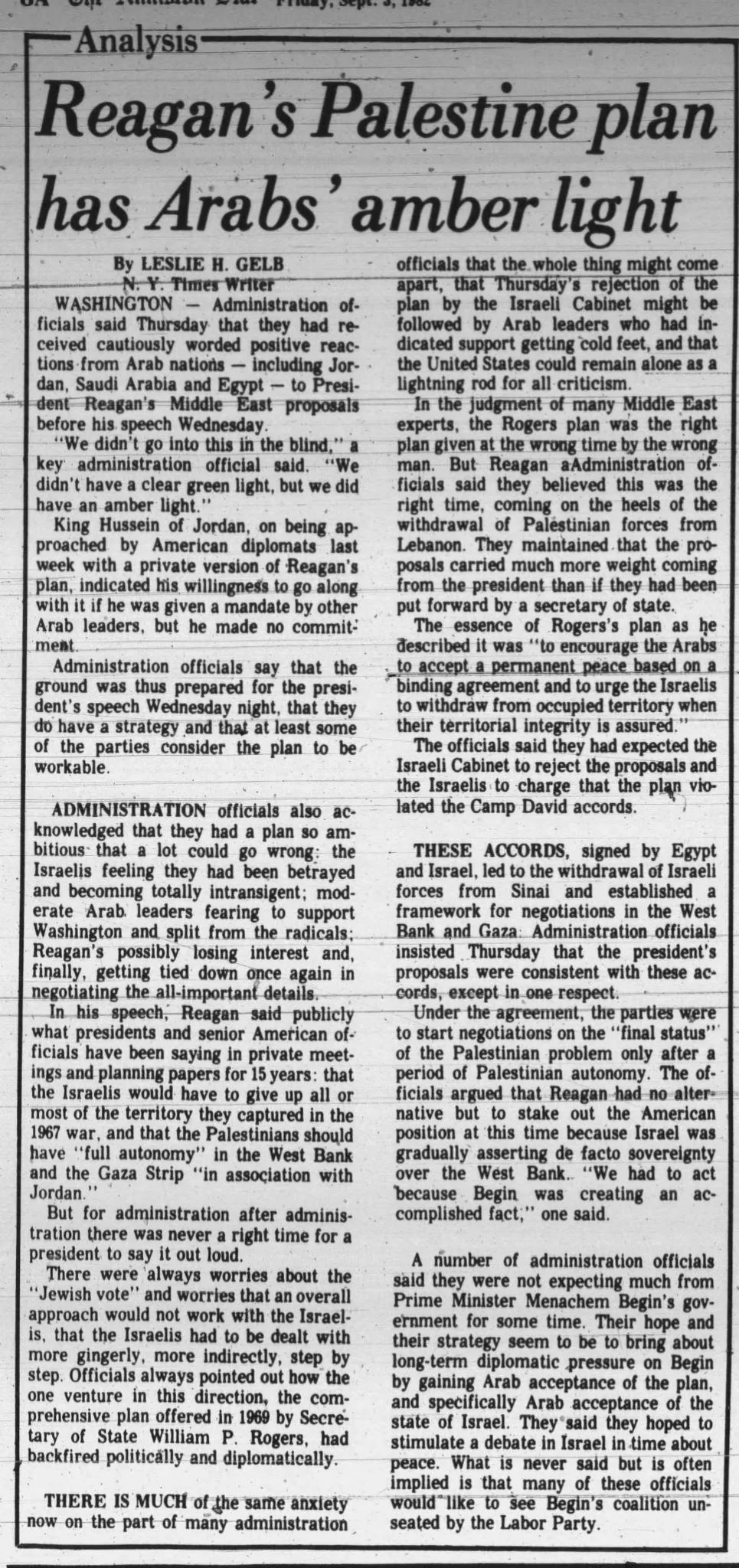
Transcribed from the clipping
ray, sops. 4006 Analysis- Reagan's Palestine plan has Arabs' amber light By LESLIE H. GELB officials that the whole thing might come N. Y.
Times Writer apart, that Thursday's rejection of the WASHINGTON - Administration of- plan by the Israell Cabinet might be ficials said Thursday that they had re- followed by Arab leaders who had in- ceived cautiously worded positive reac- dicated support getting cold feet, and that tions from Arab nations - including Jor- the United States could remain alone as a dan, Saudi Arabia and Egypt - to Presi- lightning rod for all criticism. dent Reagan's Middle East proposals In the judgment of many Middle East before his speech Wednesday. experts, the Rogers plan was the right "We didn't go into this in the blind," a plan given at the wrong time by the wrong key administration official said. •We man.
But Reagan Administration of- didn't have a clear green light, but we did ficials said they believed this was the have an amber light." right time, coming on the heels of the withdrawal of Palestinian forces from Lebanon.
They maintained that the pro- week with a private version of Reagan's plan, indicated his willingness to go along with it if he was given a mandate by other Arab leaders, but he made no commit- ment.
Administration officials say that the ground was thus prepared for the presi- dent's speech Wednesday night, that they do have a strategy and that at least some of the parties consider the plan to be workable. posals carried much more weight coming from the president than if they had been put forward by a secretary of state.
The essence of Rogers's plan as he described it was "to encourage the Arabs to accept a permanent peace based on a binding agreement and to urge the Israelis to withdraw from occupied territory when their territorial integrity is assured." The officials said they had expected the Israeli Cabinet to reject the proposals and the Israelis to charge that the plan vio lated the Camp David accords.
ADMINISTRATION officials also ac- knowledged that they had a plan so am- bitious that a lot could go wrong: the Israelis feeling they had been betrayed and becoming totally intransigent; mod- erate Arab. leaders fearing to support Washington and split from the radicals; Reagan's possibly losing interest and, finally, getting tied down once again in negotiating the all-important details. ins speech, Reagan said publicly what presidents and senior American of- ficials have been saying in private meet- ings and planning papers for 15 years: that the Israelis would have to give up all or most of the territory they captured in the 1967 war, and that the Palestinians should have "full autonomy" in the West Bank and the Gaza Strip "in association with Jordan." But for administration after adminis- tration there was never a right time for a president to say it out loud.
There were always worries about the "Jewish vote" and worries that an overall approach would not work with the Israel- is, that the Israelis had to be dealt with more gingerly, more indirectly, step by step. Officials always pointed out how the one venture in this direction, the com- prehensive plan offered in 1969 by Secre- tary of State William P.
Rogers, had backfired politically and diplomatically.
THERE IS MUCH of the same anxiety now on the part of many administration THESE ACCORDS, signed by Egypt and Israel, led to the withdrawal of Israeli forces from Sinai and established a framework for negotiations in the West Bank and Gaza: Administration officials insisted Thursday that the president's proposals were consistent with these ac- cords, except in one respect.
Under the agreement, the parties were to start negotiations on the "final status" of the Palestinian problem only after a period of Palestinian autonomy. The of- ficials argued that Reagan had no alter- native but to stake out the American position at this time because Israel was gradually asserting de facto sovereignty over the West Bank.
"We had to act because Begin was creating an ac- complished fact," one said A number of administration officials said they were not expecting much from Prime Minister Menachem Begin's gov- ernment for some time.
Their hope and their strategy seem to be to bring about long-term diplomatic pressure on Begin by gaining Arab acceptance of the plan, and specifically Arab acceptance of the state of Israel. They said they hoped to stimulate a debate in Israel in time about peace.
What is never said but is often implied is that many of these officials would like to see Begin's coalition un- seated by the Labor Party.
Cite this item
"Reagan's Palestine plan has Arabs' amber light," The Anniston Star, 3 September 1982. Covering Palestine archive, CP-1982-037. https://coveringpalestine.org/archive/cp-1982-037
More from The Anniston Star
- Imminent Tragedy Of The Refugees Constitutes Grim Legacy Of FightThe Anniston Star · 14 June 1967
- Israeli settlements remain obstacle to peaceThe Anniston Star · 28 July 1991
- Palestinian leader asks UN for end to Israeli occupationThe Anniston Star · 27 September 2014
More from the 1980s
- Even Israelis protest West Bank university shutdownThe Evening Sun · 11 January 1982
- art review/Childhood reflectionsNewsday · 12 March 1982
- Begin will stay on despite voteStamford Advocate · 24 March 1982
- Three more Palestinians killedMontana Standard · 25 March 1982
- Israeli troops kill boy, hurt 17 in Arab unrestThe Star-Ledger · 14 April 1982
- Israeli troops fire into protesters, killing boyBryan College Station Eagle · 14 April 1982
- All 180 clippings from the 1980s →
This record is part of Covering Palestine, an archive of American and Anglophone newspaper clippings about Palestinians, 1799 to 2023. Researched and assembled by Maria Robles.
The clipping belongs to the newspaper that printed it, or to the news agency that supplied the copy. It is reproduced here for research, criticism and commentary. The city is derived from the masthead, not read off the clipping.
Something wrong here, or something you know about this clipping? The archive is still being built and corrections are wanted: maria@rozumstudio.com, quoting CP-1982-037.
See it in the archive reel · Full text of every clipping · Dataset