The Anniston Star · 18 April 1973
CP-1973-028
Beirut: Night of bombs, machine guns
By GAVIN YOUNG
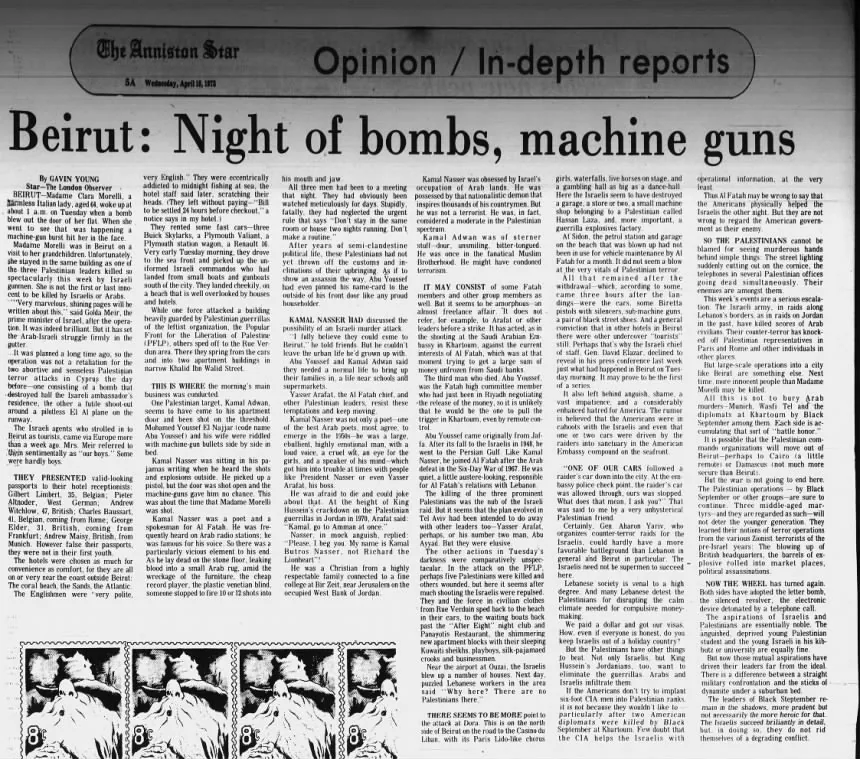
Transcribed from the clipping
BEIRUT—Madame Clara Morelli, a harmless Italian lady, aged 64, woke up at about 1 a.m. on Tuesday when a bomb blew out the door of her flat. When she went to see that was happening a machine-gun burst hit her in the face. Madame Morelli was in Beirut on a visit to her grandchildren.
Unfortunately, she stayed in the same building as one of the three Palestinian leaders killed so spectacularly this week by Israeli gunmen. She is not the first or last innocent to be killed by Israelis or Arabs. “Very marvelous, shining pages will be written about this,” said Golda Meir, the prime minister of Israel, after the operation. It was indeed brilliant.
But it has set the Arab-Israeli struggle firmly in the gutter. It was planned a long time ago, so the operation was not a retaliation for the two abortive and senseless Palestinian terror attacks in Cyprus the day before—one consisting of a bomb that destroyed half the Israeli ambassador's residence, the other a futile shoot-out around a pilotless El Al plane on the runway.
The Israeli agents who strolled in to Beirut as tourists came via Europe more than a week ago. Mrs. Meir referred to them sentimentally as “our boys.” Some were hardly boys.
THEY PRESENTED valid-looking passports to their hotel receptionists: Gilbert Limbert, 35, Belgian; Pieter Althofer, West German; Andrew Witchlow, 47, British; Charles Haussart, 41, Belgian, coming from Rome; George Elder, 31, British, coming from Frankfurt; Andrew Maisy, British, from Munich. However false their passports, they were not in their first youth.
The hotels were chosen as much for convenience as comfort, for they are all on or very near the coast outside Beirut: The coral beach, the Sands, the Atlantic. The Englishmen were “very polite, very English.” They were eccentrically addicted to midnight fishing at sea, the hotel staff said later, scratching their heads.
(They left without paying—“Bill to be settled 24 hours before checkout,” a notice says in my hotel.) They rented some fast cars—three Buick Skylarks, a Plymouth Valiant, a Plymouth station wagon, a Renault 16. Very early Tuesday morning, they drove to the sea front and picked up the uniformed Israeli commandos who had landed from small boats and gunboats south of the city.
They landed cheekily, on a beach that is well overlooked by houses and hotels. While one force attacked a building heavily guarded by Palestinian guerrillas of the leftist organization, the Popular Front for the Liberation of Palestine (PFLP), others sped off to the Rue Verdun area.
There they spring from the cars and into two apartment buildings in narrow Khalid Ibn Walid Street. THIS IS WHERE the morning's main business was conducted. One Palestinian target, Kamal Adwan, seems to have come to his apartment door and been shot on the threshold.
Mohamed Youssef El Najjar (code name Abu Youssef) and his wife were riddled with machine-gun bullets side by side in bed. Kamal Nasser was sitting in his pajamas writing when he heard the shots and explosions outside. He picked up a pistol, but the door was shot open and the machine-guns gave him no chance. This was about the time that Madame Morelli was shot.
Kamal Nasser was a poet and a spokesman for Al Fatah. He was frequently heard on Arab radio stations; he was famous for his voice. So there was a particularly vicious element to his end.
As he lay dead on the stone floor, leaking blood into a small Arab rug, amid the wreckage of the furniture, the cheap record player, the plastic venetian blind, someone stopped to fire 10 or 12 shots into his mouth and jaw. All three men had been to a meeting that night. They had obviously been watched meticulously for days.
Stupidly, fatally, they had neglected the urgent rule that says “Don't stay in the same room or house two nights running. Don't make a routine.” After years of semi-clandestine political life, these Palestinians had not yet thrown off the customs and inclinations of their upbringing.
As if to show an assassin the way, Abu Youssef had even pinned his name-card to the outside of his front door like any proud householder. KAMAL NASSER HAD discussed the possibility of an Israeli murder attack. “I fully believe they could come to Beirut,” he told friends. But he couldn't leave the urban life he'd grown up with.
Abu Youssef and Kamal Adwan said they needed a normal life to bring up their families in, a life near schools and supermarkets. Yasser Arafat, the Al Fatah chief, and other Palestinian leaders, resist these temptations and keep moving.
Kamal Nasser was not only a poet—one of the best Arab poets, most agree, to emerge in the 1960s—he was a large, ebullient, highly emotional man, with a loud voice, a cruel wit, an eye for the girls, and a speaker of his mind—which got him into trouble at times with people like President Nasser or even Yasser Arafat, his boss. He was afraid to die and could joke about that.
At the height of King Hussein's crackdown on the Palestinian guerrillas in Jordan in 1970, Arafat said: “Kamal, go to Amman at once.” Nasser, in mock anguish, replied: “Please I beg you. My name is Kamal Butros Nasser, not Richard the Lionheart”!
He was a Christian from a highly respectable family connected to a fine college at Bir Zeit, near Jerusalem on the occupied West Bank of Jordan. Kamal Nasser was obsessed by Israel's occupation of Arab lands. He was possessed by that nationalistic demon that inspires thousands of his countrymen. But he was not a terrorist.
He was, in fact, considered a moderate in the Palestinian spectrum. Kamal Adwan was of sterner stuff—dour, unsmiling, bitter-tongued. He was once in the fanatical Muslim Brotherhood. He might have condoned terrorism. IT MAY CONSIST of some Fatah members and other group members as well. But it seems to be amorphous—an almost freelance affair.
It does not refer, for example, to Arafat or other leaders before a strike. It has acted, as in the shooting at the Saudi Arabian Embassy in Khartoum, against the current interests of Al Fatah, which was at that moment trying to get a large sum of money unfrozen from Saudi banks.
The third man who died, Abu Youssef, was the Fatah high committee member who had just been in Riyadh negotiating the release of the money, so it is unlikely that he would be the one to pull the trigger in Khartoum, even by remote control. Abu Youssef came originally from Jaffa. After its fall to the Israelis in 1948, he went to the Persian Gulf.
Like Kamal Nasser, he joined Al Fatah after the Arab defeat in the Six-Day War of 1967. He was quiet, a little austere-looking, responsible for Al Fatah's relations with Lebanon. The killing of the three prominent Palestinians was the nub of the Israeli raid.
But it seems that the plan evolved in Tel Aviv had been intended to do away with other leaders too—Yasser Arafat, perhaps, or his number two man, Abu Ayyad. But they were elusive. The other actions in Tuesday's darkness were comparatively unspectacular.
In the attack on the PFLP, perhaps five Palestinians were killed and others wounded, but here it seems after much shooting the Israelis were repulsed.
They and the force in civilian clothes from Rue Verdain sped back to the beach in their cars, to the waiting boats back past the “After Eight” night club and Panayotis Restaurant, the shimmering new apartment blocks with their sleeping Kuwaiti sheikhs, playboys, silk-pajamaed crooks and businessmen. Near the airport at Ouzai, the Israelis blew up a number of houses.
Next day, puzzled Lebanese workers in the area said “Why here? There are no Palestinians there.” THERE SEEMS TO BE MORE point to the attack at Dora. This is on the north side of Beirut on the road to the Casino du Liban, with its Paris Lido-like chorus girls, waterfalls, live horses on stage, and a gambling hall as big as a dance-hall.
Here the Israelis seem to have destroyed a garage, a store or two, a small machine shop belonging to a Palestinian called Hassan Laza, and, more important, a guerrilla explosives factory. At Sidon, the petrol station and garage on the beach that was blown up had not been in use for vehicle maintenance by Al Fatah for a month.
It did not seem a blow at the very vitals of Palestinian terror. All that remained after the withdrawal—which, according to some, came three hours after the landings—were the cars, some Biretta pistols with silencers, sub-machine guns, a pair of black street shoes. And a general conviction that in other hotels in Beirut there were other undercover “tourists” still.
Perhaps that's why the Israeli chief of staff Gen. David Elazar declined to reveal in his press conference last week just what had happened in Beirut on Tuesday morning. It may prove to be the first of a series. It also left behind anguish, shame, a vast impatience, and a considerably enhanced hatred for America.
The rumor is believed that the Americans were in cahoots with the Israelis and even that one or two cars were driven by the raiders into sanctuary in the American Embassy compound on the seafront. “ONE OF OUR CARS followed a raider's car down into the city. At the embassy police check point, the raider's car was allowed through, ours was stopped.
What does that mean, I ask you?” That was said to me by a very unhysterical Palestinian friend. Certainly, Gen. Aharon Yariv, who organizes counter-terror raids for the Israelis, could hardly have a more favourable battleground than Lebanon in general and Beirut in particular. The Israelis need not be supermen to succeed here. Lebanese society is venal to a high degree.
And many Lebanese detest the Palestinians for disrupting the calm climate needed for compulsive money-making. We paid a dollar and got our visas. How, even if everyone is honest, do you keep Israelis out of a holiday country? But the Palestinians have other things to beat. Not only Israelis but King Hussein's Jordanians, too, want to eliminate the guerrillas.
Arabs and Israelis infiltrate them. If the Americans don't try to implant six-foot CIA men into Palestinian ranks it is not because they wouldn't like to, particularly after two American diplomats were killed by Black September at Khartoum. Few doubt that the CIA helps the Israelis with operational information, at the very least.
Thus Al Fatah may be wrong to say that the Americans physically helped the Israelis the other night. But they are not wrong to regard the American government as their enemy. SO THE PALESTINIANS cannot be blamed for seeing murderous hands behind simple things.
The street lighting suddenly cutting out on the cornice, the telephones in several Palestinian offices going dead simultaneously. Their enemies are amongst them. This week's events are a serious escalation. The Israeli army, in raids along Lebanon's borders, as in raids on Jordan in the past, have killed scores of Arab civilians.
Their counter-terror has knocked off Palestinian representatives in Paris and Rome and other individuals in other places. But large-scale operations into a city like Beirut are something else. Next time, more innocent people than Madame Morelli may be killed. All this is not to bury Arab murders—Munich, Wasfi Tel and the diplomats at Khartoum by Black September among them.
Each side is accumulating that sort of “battle honor.” It is possible that the Palestinian commando organizations will move out of Beirut—perhaps to Cairo (a little remote) or Damascus (not much more secure than Beirut). But the war is not going to end here. The Palestinian operations — by Black September or other groups—are sure to continue.
Three middle-aged martyrs—and they are regarded as such—will not deter the younger generation. They learned their notions of terror operations from the various Zionist terrorists of the pre-Israel years: The blowing up of British headquarters, the barrels of explosive rolled into market places, political assassinations. NOW THE WHEEL has turned again.
Both sides have adopted the letter bomb, the silenced revolver, the electronic device detonated by a telephone call. The aspirations of Israelis and Palestinians are essentially noble. The anguished, deprived young Palestinian student and the young Israeli in his kibbutz or university are equally fine.
But now those mutual aspirations have driven their leaders far from the ideal. There is a difference between a straight military confrontation and the sticks of dynamite under a suburban bed. The leaders of Black September remain in the shadows, more prudent but not necessarily the more heroic for that.
The Israelis succeed brilliantly in detail, but in doing so, they do not rid themselves of a degrading conflict.
How this transcription was made
Single clipping, one full opinion page. The page also carries unrelated material (a postage-stamp item at the foot). The second image on this slide, s013_2.jpg, is a different paper and is recorded separately. — Masthead read directly from the page, set in blackletter inside a rounded rule at the top left: The Anniston Star. Matches Maria's label apart from the definite article, which she omitted and the page prints. — The page carries a folio line reading "5A Wednesday, April [day], [year]". At this scan's compression I can read "5A", "Wednesday" and "April" with confidence; the day number and the year are below the resolution of the JPEG and I will not claim to have read them. The day number is consistent with "18" and the year with "1973", and 18 April 1973 did fall on a Wednesday, which agrees with the printed weekday. The body also places the raid on "Tuesday" of "this week" — the Israeli raid on Beirut was the night of 9-10 April 1973, a Monday night into Tuesday morning — which fits a Wednesday 18 April publication of a weekly Observer piece. So Maria's label is corroborated but not confirmed from the page. — Transcribed in full from magnified crops of all six text columns. Printed as set, including: "When she went to see that was happening" (for "what was happening"); "Rue Verdun" in one paragraph and "Rue Verdain" in another; "Biretta pistols" (for Beretta); "favourable" (British spelling, carried over from the Observer); "Abu Ayyad"; and the closing quotation mark placed before the exclamation point in "not Richard the Lionheart"!. The paragraph beginning "IT MAY CONSIST of some Fatah members" has no antecedent on the page — the pronoun "It" refers to Black September, which is not introduced until much later in the piece. This looks like a paragraph the paper dropped in layout rather than anything I failed to read; I checked the full width of the column above and below it. — No deck. "Opinion / In-depth reports" is the section flag running across the top of the page beside the masthead, not a deck.
Cite this clipping
"Beirut: Night of bombs, machine guns," The Anniston Star, 18 April 1973, p. 5A. Covering Palestine archive, CP-1973-028. https://coveringpalestine.org/archive/cp-1973-028
More from The Anniston Star
- Imminent Tragedy Of The Refugees Constitutes Grim Legacy Of FightThe Anniston Star · 14 June 1967
- Will avenge Tal Zaatar, Palestinians warn foesThe Anniston Star · 13 August 1976
- Reagan's Palestine plan has Arabs' amber lightThe Anniston Star · 3 September 1982
- Israel to begin military trials for protestorsThe Anniston Star · 27 December 1987
- Israeli settlements remain obstacle to peaceThe Anniston Star · 28 July 1991
- Palestinian news agency criticized U.S. envoy; warned Arab leaders of being overthrownThe Anniston Star · 31 March 2002
- 3 more from this paper in the full text →
More from the 1970s
- French Plan Protection For Israeli(newspaper unidentified) · 10 January 1973
- Paris Police Plan Special Security Measures for Meir(newspaper unidentified) · 10 January 1973
- Mrs. Meir's Safety StudiedLos Angeles Times · 11 January 1973
- Cases of senseless murder and wanton destructionWisconsin Jewish Chronicle · 19 January 1973
- Palestinian Runs : Arab Newspaper In E. JerusalemDuluth News-Tribune · 4 February 1973
- Israeli Arabs and Jews unite for right of villagers to returnDaily World · 23 February 1973
- All 338 clippings from the 1970s →
Last updated 2 November 2026
This record is part of Covering Palestine, an archive of American newspaper clippings about Palestinians, 1724 to 2023. Researched and assembled by Maria Robles.
The clipping belongs to the newspaper that printed it, or to the news agency that supplied the copy. It is reproduced here for research, criticism and commentary. A city here is where the newspaper was published, not where the story came from, and on most records it was taken from the masthead.
Something wrong here, or something you know about this clipping? The archive is still being built and corrections are wanted: maria@rozumstudio.com, quoting CP-1973-028.
Everything printed in 1973 · Printed on this day · See it in the archive reel · Full text of every clipping · Dataset