The New York Times · New York, New York · 17 April 1973
CP-1973-017
Israel Holds Arab Editors On a Censorship Charge
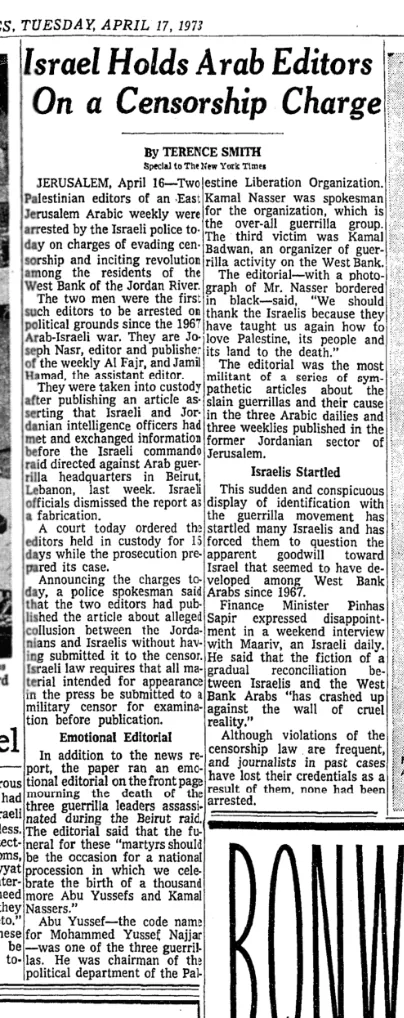
Transcribed from the clipping
JERUSALEM, April 16—Two Palestinian editors of an East Jerusalem Arabic weekly were arrested by the Israeli police today on charges of evading censorship and inciting revolution among the residents of the West Bank of the Jordan River. The two men were the first such editors to be arrested on political grounds since the 1967 Arab-Israeli war.
They are Joseph Nasr, editor and publisher of the weekly Al Fajr, and Jamil Hamad, the assistant editor. They were taken into custody after publishing an article asserting that Israeli and Jordanian intelligence officers had met and exchanged information before the Israeli commando raid directed against Arab guerrilla headquarters in Beirut, Lebanon, last week.
Israeli officials dismissed the report as a fabrication. A court today ordered the editors held in custody for 15 days while the prosecution prepared its case. Announcing the charges today, a police spokesman said that the two editors had published the article about alleged collusion between the Jordanians and Israelis without having submitted it to the censor.
Israeli law requires that all material intended for appearance in the press be submitted to a military censor for examination before publication. Emotional Editorial In addition to the news report, the paper ran an emotional editorial on the front page mourning the death of the three guerrilla leaders assassinated during the Beirut raid.
The editorial said that the funeral for these “martyrs should be the occasion for a national procession in which we celebrate the birth of a thousand more Abu Yussefs and Kamal Nassers.” Abu Yussef—the code name for Mohammed Yussef Najjar—was one of the three guerrillas. He was chairman of the political department of the Palestine Liberation Organization.
Kamal Nasser was spokesman for the organization, which is the over-all guerrilla group. The third victim was Kamal Badwan, an organizer of guerrilla activity on the West Bank. The editorial—with a photograph of Mr. Nasser bordered in black—said, “We should thank the Israelis because they have taught us again how to love Palestine, its people and its land to the death.”
The editorial was the most militant of a series of sympathetic articles about the slain guerrillas and their cause in the three Arabic dailies and three weeklies published in the former Jordanian sector of Jerusalem.
Israelis Startled This sudden and conspicuous display of identification with the guerrilla movement has startled many Israelis and has forced them to question the apparent goodwill toward Israel that seemed to have developed among West Bank Arabs since 1967. Finance Minister Pinhas Sapir expressed disappointment in a weekend interview with Maariv, an Israeli daily.
He said that the fiction of a gradual reconciliation between Israelis and the West Bank Arabs “has crashed up against the wall of cruel reality.” Although violations of the censorship law are frequent, and journalists in past cases have lost their credentials as a result of them, none had been arrested.
How this transcription was made
Read from the scan by a machine looking at the image of the page, not by optical character recognition and not by a person. The printed date on the page agrees with the date recorded here.
Cite this clipping
"Israel Holds Arab Editors On a Censorship Charge," The New York Times, 17 April 1973. Covering Palestine archive, CP-1973-017. https://coveringpalestine.org/archive/cp-1973-017
More from The New York Times
- The Maine Colony in PalestineThe New York Times · 12 November 1866
- Jewish Colonization in PalestineThe New York Times · 9 December 1883
- Jewish State in Palestine OpposedThe New York Times · 9 July 1897
- ZIONIST CONGRESS IN BASELThe New York Times · 31 August 1897
- ROME FEARS THE ZIONISTSThe New York Times · 12 September 1897
- PROGRESS OF ZIONISMThe New York Times · 16 December 1901
- 852 more from this paper in the full text →
More from the 1970s
- French Plan Protection For Israeli(newspaper unidentified) · 10 January 1973
- Paris Police Plan Special Security Measures for Meir(newspaper unidentified) · 10 January 1973
- Mrs. Meir's Safety StudiedLos Angeles Times · 11 January 1973
- Cases of senseless murder and wanton destructionWisconsin Jewish Chronicle · 19 January 1973
- Palestinian Runs : Arab Newspaper In E. JerusalemDuluth News-Tribune · 4 February 1973
- Israeli Arabs and Jews unite for right of villagers to returnDaily World · 23 February 1973
- All 338 clippings from the 1970s →
Last updated 2 November 2026
This record is part of Covering Palestine, an archive of American newspaper clippings about Palestinians, 1724 to 2023. Researched and assembled by Maria Robles.
The clipping belongs to the newspaper that printed it, or to the news agency that supplied the copy. It is reproduced here for research, criticism and commentary. A city here is where the newspaper was published, not where the story came from, and on most records it was taken from the masthead.
Something wrong here, or something you know about this clipping? The archive is still being built and corrections are wanted: maria@rozumstudio.com, quoting CP-1973-017.
Everything printed in 1973 · Printed on this day · See it in the archive reel · Full text of every clipping · Dataset