Broken Arrow Ledger · Broken Arrow, Oklahoma · 20 March 1985
CP-1985-006
U.S. says murdered Palestinian symbolizes peace dangers
By R. Gregory Nokes, AP Diplomatic Writer
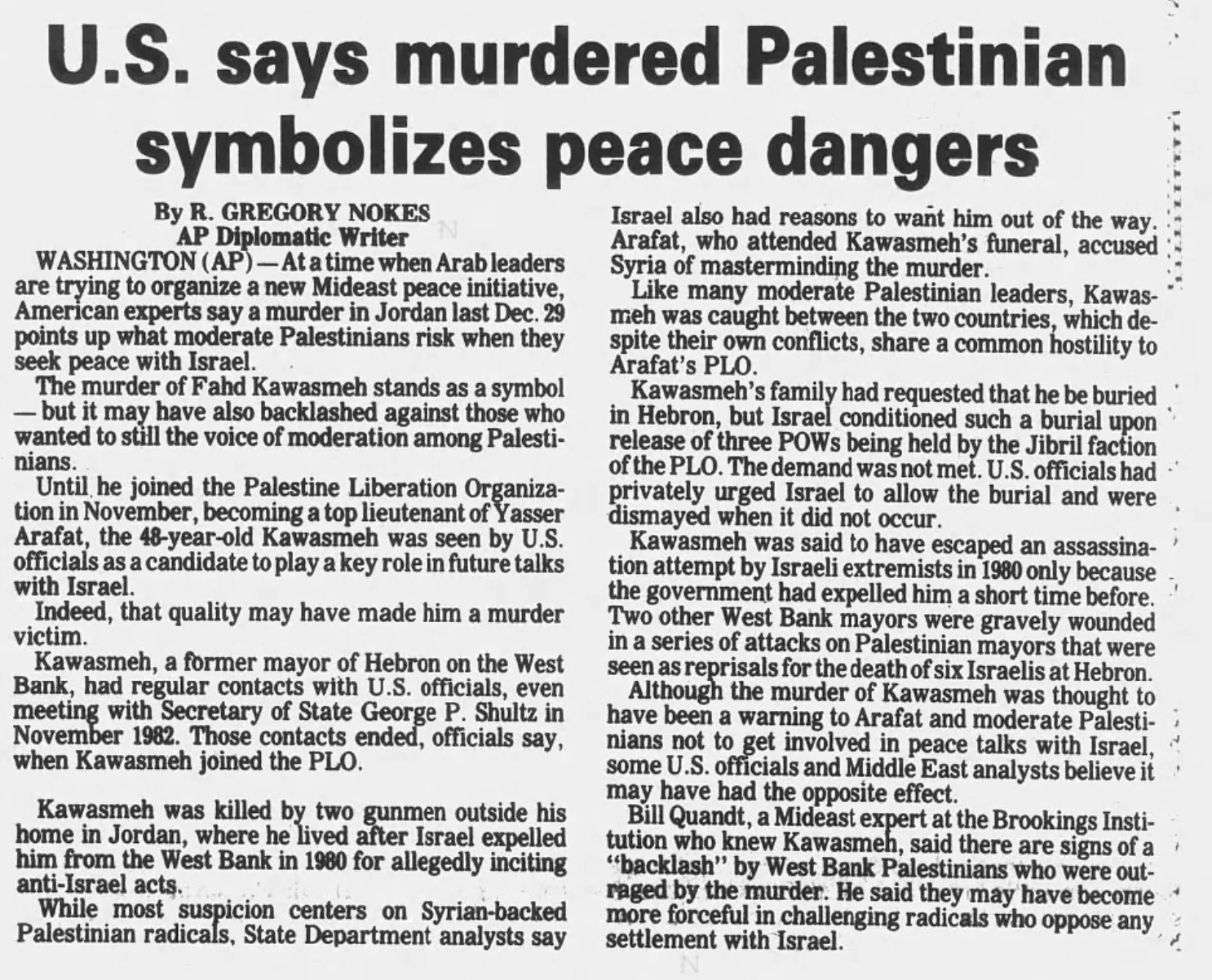
Transcribed from the clipping
“WASHINGTON (AP) — At a time when Arab leaders are trying to organize a new Mideast peace initiative, American experts say a murder in Jordan last Dec. 29 points up what moderate Palestinians risk when they seek peace with Israel.
The murder of Fahd Kawasmeh stands as a symbol — but it may have also backlashed against those who wanted to still the voice of moderation among Palestinians.
Until he joined the Palestine Liberation Organization in November, becoming a top lieutenant of Yasser Arafat, the 48-year-old Kawasmeh was seen by U.S. officials as a candidate to play a key role in future talks with Israel. Indeed, that quality may have made him a murder victim.
Kawasmeh, a former mayor of Hebron on the West Bank, had regular contacts with U.S. officials, even meeting with Secretary of State George P. Shultz in November 1982. Those contacts ended, officials say, when Kawasmeh joined the PLO.
Kawasmeh was killed by two gunmen outside his home in Jordan, where he lived after Israel expelled him from the West Bank in 1980 for allegedly inciting anti-Israel acts. While most suspicion centers on Syrian-backed Palestinian radicals, State Department analysts say Israel also had reasons to want him out of the way.
Arafat, who attended Kawasmeh’s funeral, accused Syria of masterminding the murder. Like many moderate Palestinian leaders, Kawasmeh was caught between the two countries, which despite their own conflicts, share a common hostility to Arafat’s PLO.
Kawasmeh’s family had requested that he be buried in Hebron, but Israel conditioned such a burial upon release of three POWs being held by the Jibril faction of the PLO. The demand was not met. U.S. officials had privately urged Israel to allow the burial and were dismayed when it did not occur.
Kawasmeh was said to have escaped an assassination attempt by Israeli extremists in 1980 only because the government had expelled him a short time before. Two other West Bank mayors were gravely wounded in a series of attacks on Palestinian mayors that were seen as reprisals for the death of six Israelis at Hebron.
Although the murder of Kawasmeh was thought to have been a warning to Arafat and moderate Palestinians not to get involved in peace talks with Israel, some U.S. officials and Middle East analysts believe it may have had the opposite effect.
Bill Quandt, a Mideast expert at the Brookings Institution who knew Kawasmeh, said there are signs of a ‘backlash’ by West Bank Palestinians who were outraged by the murder. He said they may have become more forceful in challenging radicals who oppose any settlement with Israel.”
Context added by this archive
The verb in the headline is murdered, of a Palestinian, in 1985. The man is named in the second paragraph: Fahd Kawasmeh, 48, former mayor of Hebron, expelled by Israel in 1980 and shot outside his home in Jordan. The copy records that his family asked to bury him in Hebron and that Israel made the burial conditional on a prisoner release that did not happen.
Cite this item
"U.S. says murdered Palestinian symbolizes peace dangers," Broken Arrow Ledger, 20 March 1985. Covering Palestine archive, CP-1985-006. https://coveringpalestine.org/archive/cp-1985-006
More from the 1980s
- Northern Border Secured, Says Israeli EnvoyThe Arizona Republic · 3 February 1985
- No Travel Permits to U.N. ConferenceTelegram & Gazette · 10 July 1985
- Kenyan resolution saves women’s conferenceTimes-News · 28 July 1985
- Israeli soldiers force four squatters to leaveThe Flint Journal · 20 August 1985
- ‘Zionism is racism’: Death of U.N. dreamThe Macon Telegraph · 12 November 1985
- Cultural-hatred roots run deep in West BankThe Oregonian · 5 January 1984
- All 148 clippings from the 1980s →
This record is part of Covering Palestine, an archive of American and Anglophone newspaper clippings about Palestinians, 1799 to 2023. Researched and assembled by Maria Robles.
The clipping belongs to the newspaper that printed it, or to the news agency that supplied the copy. It is reproduced here for research, criticism and commentary. The city is derived from the masthead, not read off the clipping.
Something wrong here, or something you know about this clipping? The archive is still being built and corrections are wanted: maria@rozumstudio.com, quoting CP-1985-006.
See it in the archive reel · Full text of every clipping · Dataset