Chicago Tribune · 11 October 1988
CP-1988-105
Trapped for life
Transcribed from the clipping
CAUGHT IN THE MIDDLE Trapped for life After 40 years, the Palestinian camps remain breeding grounds of frustration and violence [STANDFIRST, set in italic at the head of the first column] Sunday magazine writer William Mullen spent nine months touring the world’s refugee camps to discover why they have become seemingly permanent fixtures around the globe.
The longer refugee camps exist, the greater the probability of violence erupting as it has in the Gaza Strip. Second in a series. By William Mullen This year marks the 40th anniversary of the creation of the State of Israel.
It has not been celebrated even in Israel with much pomp and pageantry, for there is a corollary 40-year anniversary to be marked: the creation of Palestinian refugee camps. Palestinians hold the dubious honor of having stayed the longest in post-World War II refugee camps, but other refugee groups are not far behind.
In Uganda, 120,000 Rwandans have languished in camps since 1959. In Sudan, half a million Eritrean Ethiopians have been piling up in camps since 1962. The camps for half a million refugees in Somalia opened in 1978, the same year refugees began trickling out of Afghanistan, soon to become a torrent of 5 million.
Most of the camps housing Central American refugees were built in 1980 and 1981. For the most recent outpouring of people from Mozambique, the United Nations is preparing camps to hold them for five years. But receiving countries such as Malawi, which soon will have 750,000 Mozambicans to care for, are girding for at least a 10-year problem.
The UN High Commission for Refugees, the agency charged with caring for most of the world’s refugees, designates anybody who has been out of his country for more than three years as a “long-staying” refugee. Perhaps 75 percent of today’s refugees have been in camps for five or more years.
After 40 years, the expelled Palestinians and their 2.2 million descendants remain trapped in fetid camps across the Middle East. They have been there so long that two generations of Palestinians have been born and reared in camps, and much of the rest of the world tries not to think of them as refugees any longer.
The world has paid a high price for trying to ignore the Palestinians. Already it has meant the virtual destruction of one country, Lebanon. It has spawned an insidious new form of warfare, worldwide terrorism. The Palestinians, of course, will not let the rest of the world forget their plight.
They were largely abandoned to their fate in the camps by the rest of the Arab world after the original Arab-Israeli War in 1948, when the new Jewish state forced 700,000 Palestinians out of their homes. The rest of the Arabs did not want the Palestinians to leave the camps because that would have meant permanent resettlement elsewhere in the Arab world.
So the Palestinians have been left to their own seething discontent for 40 years. It is a discontent that is particularly galling to the 800,000 Palestinians who, since the Six-Day War of 1967, have lived in the Israeli occupied territories of Gaza, Golan Heights and the West Bank, where their status is less than second-class citizenship.
The Israelis, themselves descendants of Jewish refugees who managed to survive Hitler’s Holocaust and had nowhere else to go at the end of World War II, persuasively justify their treatment of the Palestinians. They point to 100 million Arabs surrounding them, to the Arab leaders who for 40 years have proclaimed their intentions of driving the Jewish state into the sea.
The Israelis say they are fighting for their very right to exist as a nation, and they are right. The Palestinians also persuasively justify their struggle against Israel. They are a nation of people without a land to call their own, a people denied the right to determine their own destiny.
The Palestinians say they are fighting for their very existence as a nation, and they, too, are right. With each passing year, the self-righteousness and intransigent attitudes of the Israelis, the Palestinians and the Arab world seem to harden. With each passing year, the violence and potential for violence ratchet upward.
Refugee officials around the world increasingly worry about the potential for more Palestinian-style refugee problems. They fear See Caught, pg.
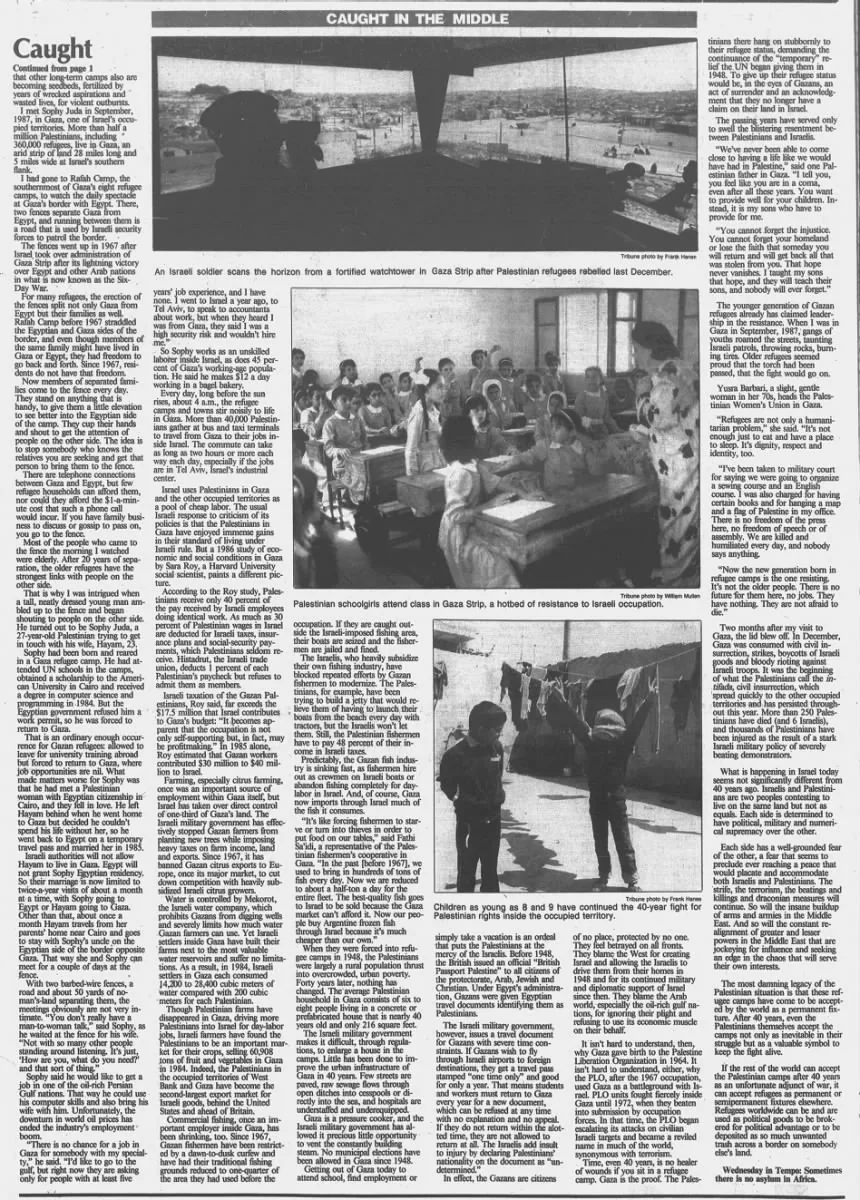
2 [THREE PHOTOGRAPH CAPTIONS, none of them the one the record already holds] Palestinian refugee housing in Israel’s Gaza Strip, where the camps turned 40 years old earlier this year. [credit] Tribune photo by Frank Hanes Israeli soldiers patrol camps in Gaza Strip shortly after Palestinians rose up in violent protest of Israeli occupation. [credit] Tribune photo by Frank Hanes Sophy Juda shouts across the buffer between Gaza and Egypt, hoping to talk to his wife, who must stay on the other side. [credit] Tribune photo by William Mullen … Continued from page 1 that other long-term camps also are becoming seedbeds, fertilized by years of wrecked aspirations and wasted lives, for violent outbursts.
I met Sophy Juda in September, 1987, in Gaza, one of Israel’s occupied territories. More than half a million Palestinians, including 360,000 refugees, live in Gaza, an arid strip of land 28 miles long and 5 miles wide at Israel’s southern flank. I had gone to Rafah Camp, the southernmost of Gaza’s eight refugee camps, to watch the daily spectacle at Gaza’s border with Egypt.
There, two fences separate Gaza from Egypt, and running between them is a road that is used by Israeli security forces to patrol the border. The fences went up in 1967 after Israel took over administration of Gaza Strip after its lightning victory over Egypt and other Arab nations in what is now known as the Six-Day War.
For many refugees, the erection of the fences split not only Gaza from Egypt but their families as well. Rafah Camp before 1967 straddled the Egyptian and Gaza sides of the border, and even though members of the same family might have lived in Gaza or Egypt, they had freedom to go back and forth. Since 1967, residents do not have that freedom.
Now members of separated families come to the fence every day. They stand on anything that is handy, to give them a little elevation to see better into the Egyptian side of the camp. They cup their hands and shout to get the attention of people on the other side.
The idea is to stop somebody who knows the relatives you are seeking and get that person to bring them to the fence. There are telephone connections between Gaza and Egypt, but few refugee households can afford them, nor could they afford the $1-a-minute cost that such a phone call would incur. If you have family business to discuss or gossip to pass on, you go to the fence.
How this transcription was made
The other part of this article was added on 2 November 2026 from a second clipping (m016_2.png). Headline corrected on 2 November 2026 from the opening of the article, which the archive did not hold until now: the record read “Caught”, which is the jump slug, not the headline the paper set.
Cite this clipping
"Trapped for life," Chicago Tribune, 11 October 1988. Covering Palestine archive, CP-1988-105. https://coveringpalestine.org/archive/cp-1988-105
More from Chicago Tribune
- FINDS the ROCK MOSES STRUCKChicago Tribune · 26 May 1901
- Chief Issue in ZionChicago Tribune · 16 August 1907
- Palestine and PatriotismChicago Tribune · 9 January 1916
- Move Palestine Arabs To Iraq, Hoover UrgesChicago Tribune · 20 November 1945
- Manhunt Is On For Palestine Jail FugitivesChicago Tribune · 6 May 1947
- CRISIS NEARS CLIMAXChicago Tribune · 9 February 1948
- 39 more from this paper in the full text →
More from the 1980s
- Moderation Silenced by Israel RiotsThe Buffalo News · 3 January 1988
- Gaza Strip: the forgotten stepchildNorthwest Herald · 4 January 1988
- 'Iron Fist' Enslaves Gazans In Their LandThe Herald Sun · 6 January 1988
- Israel condemns U.N. vote on deportationsThe Birmingham News · 6 January 1988
- Israeli soldiers fire on protestersCarroll County Times · 6 January 1988
- Undaunted Palestinians resume violenceThe News & Observer · 6 January 1988
- All 527 clippings from the 1980s →
Last updated 2 November 2026
This record is part of Covering Palestine, an archive of American newspaper clippings about Palestinians, 1724 to 2023. Researched and assembled by Maria Robles.
The clipping belongs to the newspaper that printed it, or to the news agency that supplied the copy. It is reproduced here for research, criticism and commentary. A city here is where the newspaper was published, not where the story came from, and on most records it was taken from the masthead.
Something wrong here, or something you know about this clipping? The archive is still being built and corrections are wanted: maria@rozumstudio.com, quoting CP-1988-105.
Everything printed in 1988 · Printed on this day · See it in the archive reel · Full text of every clipping · Dataset