The New York Times · New York, New York · 27 October 1991
CP-1991-033
Getting To ‘Yes’ In Madrid
By Roger Fisher
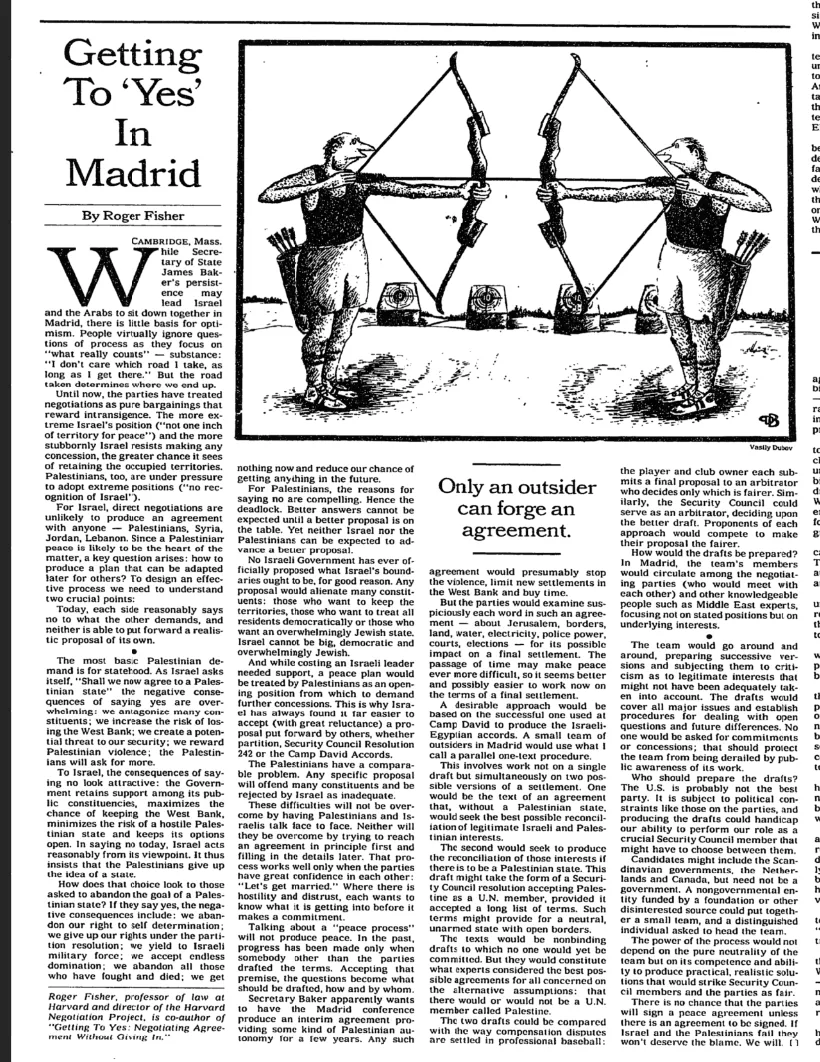
Transcribed from the clipping
CAMBRIDGE, Mass. — While Secretary of State James Baker’s persistence may lead Israel and the Arabs to sit down together in Madrid, there is little basis for optimism. People virtually ignore questions of process as they focus on “what really counts” — substance: “I don’t care which road I take, as long as I get there.” But the road taken determines where we end up.
Until now, the parties have treated negotiations as pure bargainings that reward intransigence. The more extreme Israel’s position (“not one inch of territory for peace”) and the more stubbornly Israel resists making any concession, the greater chance it sees of retaining the occupied territories.
Palestinians, too, are under pressure to adopt extreme positions (“no recognition of Israel”). For Israel, direct negotiations are unlikely to produce an agreement with anyone — Palestinians, Syria, Jordan, Lebanon. Since a Palestinian peace is likely to be the heart of the matter, a key question arises: how to produce a plan that can be adapted later for others?
To design an effective process we need to understand two crucial points: Today, each side reasonably says no to what the other demands, and neither is able to put forward a realistic proposal of its own. The most basic Palestinian demand is for statehood.
As Israel asks itself, “Shall we now agree to a Palestinian state” the negative consequences of saying yes are overwhelming: we antagonize many constituents; we increase the risk of losing the West Bank; we create a potential threat to our security; we reward Palestinian violence; the Palestinians will ask for more.
To Israel, the consequences of saying no look attractive: the Government retains support among its public constituencies, maximizes the chance of keeping the West Bank, minimizes the risk of a hostile Palestinian state and keeps its options open. In saying no today, Israel acts reasonably from its viewpoint. It thus insists that the Palestinians give up the idea of a state.
For Palestinians, the reasons for saying no are compelling. Hence the deadlock.
How this transcription was made
Read from the scan by a machine looking at the image of the page, not by optical character recognition and not by a person. The clipping carries no masthead and no dated folio line, so the date recorded here could not be checked against anything printed on the page. Nothing on the page contradicts it.
Cite this clipping
"Getting To ‘Yes’ In Madrid," The New York Times, 27 October 1991. Covering Palestine archive, CP-1991-033. https://coveringpalestine.org/archive/cp-1991-033
More from The New York Times
- The Maine Colony in PalestineThe New York Times · 12 November 1866
- Jewish Colonization in PalestineThe New York Times · 9 December 1883
- Jewish State in Palestine OpposedThe New York Times · 9 July 1897
- ZIONIST CONGRESS IN BASELThe New York Times · 31 August 1897
- ROME FEARS THE ZIONISTSThe New York Times · 12 September 1897
- PROGRESS OF ZIONISMThe New York Times · 16 December 1901
- 852 more from this paper in the full text →
More from the 1990s
- 2 killed in West Bank protestsThe Kansas City Star · 2 January 1991
- Two top men in PLO assassinatedTimes Record News · 17 January 1991
- Both Saddam Hussein, Israel blamed for PLO slayingsLa Crosse Tribune · 18 January 1991
- Palestinians Are Buoyed By the Attacks on Israel(newspaper unidentified) · 21 January 1991
- ‘Administrative detention’: Israelis skip due processThe Baltimore Sun · 6 February 1991
- Books About the Arab WorldSyracuse Herald Journal · 24 February 1991
- All 374 clippings from the 1990s →
Last updated 2 November 2026
This record is part of Covering Palestine, an archive of American newspaper clippings about Palestinians, 1724 to 2023. Researched and assembled by Maria Robles.
The clipping belongs to the newspaper that printed it, or to the news agency that supplied the copy. It is reproduced here for research, criticism and commentary. A city here is where the newspaper was published, not where the story came from, and on most records it was taken from the masthead.
Something wrong here, or something you know about this clipping? The archive is still being built and corrections are wanted: maria@rozumstudio.com, quoting CP-1991-033.
Everything printed in 1991 · Printed on this day · See it in the archive reel · Full text of every clipping · Dataset