The New York Times · New York, New York · 28 November 1991
CP-1991-045
Israel’s Coffee Spoons
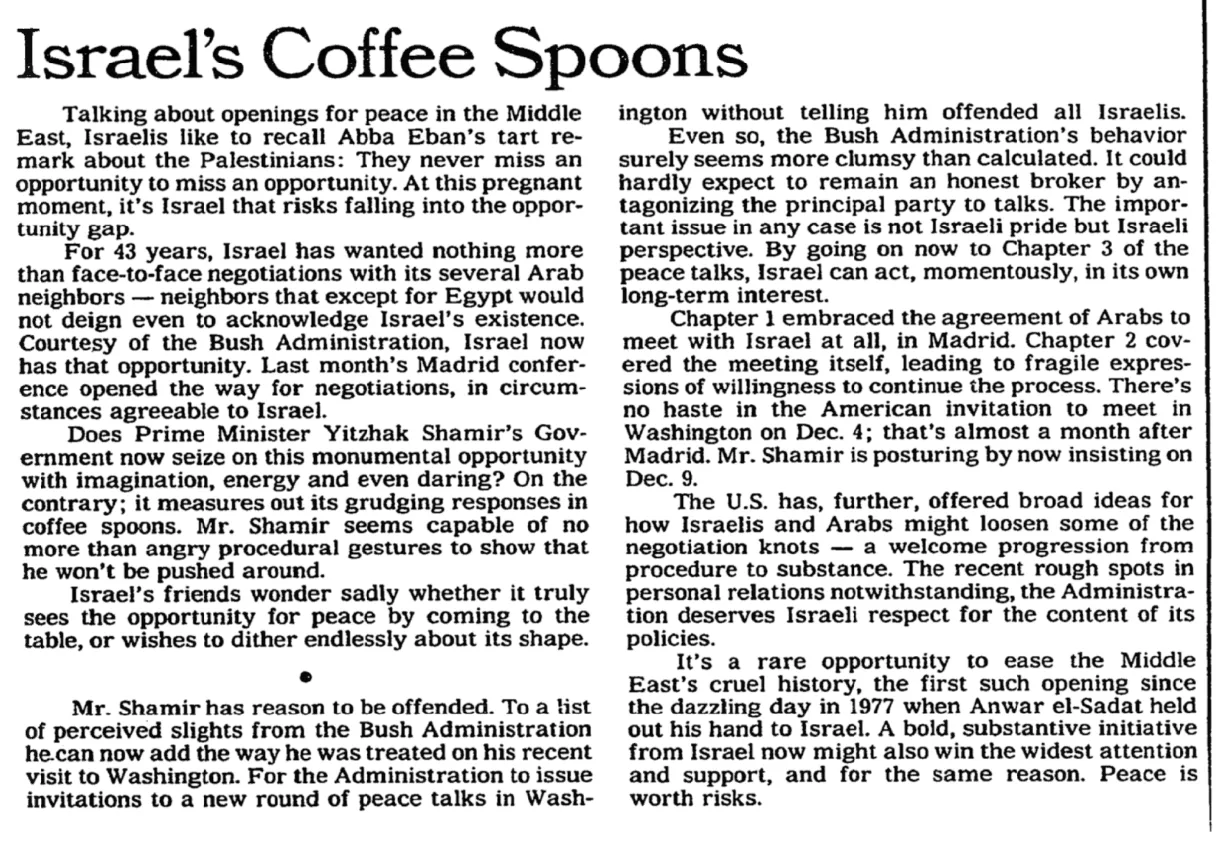
Transcribed from the clipping
Talking about openings for peace in the Middle East, Israelis like to recall Abba Eban’s tart remark about the Palestinians: They never miss an opportunity to miss an opportunity. At this pregnant moment, it’s Israel that risks falling into the opportunity gap.
For 43 years, Israel has wanted nothing more than face-to-face negotiations with its several Arab neighbors — neighbors that except for Egypt would not deign even to acknowledge Israel’s existence. Courtesy of the Bush Administration, Israel now has that opportunity. Last month’s Madrid conference opened the way for negotiations, in circumstances agreeable to Israel.
Does Prime Minister Yitzhak Shamir’s Government now seize on this monumental opportunity with imagination, energy and even daring? On the contrary; it measures out its grudging responses in coffee spoons. Mr. Shamir seems capable of no more than angry procedural gestures to show that he won’t be pushed around.
Israel’s friends wonder sadly whether it truly sees the opportunity for peace by coming to the table, or wishes to dither endlessly about its shape. Mr. Shamir has reason to be offended. To a list of perceived slights from the Bush Administration he can now add the way he was treated on his recent visit to Washington.
For the Administration to issue invitations to a new round of peace talks in Washington without telling him offended all Israelis. Even so, the Bush Administration’s behavior surely seems more clumsy than calculated. It could hardly expect to remain an honest broker by antagonizing the principal party to talks.
The important issue in any case is not Israeli pride but Israeli perspective. By going on now to Chapter 3 of the peace talks, Israel can act, momentously, in its own long-term interest. Chapter 1 embraced the agreement of Arabs to meet with Israel at all, in Madrid. Chapter 2 covered the meeting itself, leading to fragile expressions of willingness to continue the process.
There’s no haste in the American invitation to meet in Washington on Dec. 4; that’s almost a month after Madrid. Mr. Shamir is posturing by now insisting on Dec. 9. The U.S. has, further, offered broad ideas for how Israelis and Arabs might loosen some of the negotiation knots — a welcome progression from procedure to substance.
The recent rough spots in personal relations notwithstanding, the Administration deserves Israeli respect for the content of its policies. It’s a rare opportunity to ease the Middle East’s cruel history, the first such opening since the dazzling day in 1977 when Anwar el-Sadat held out his hand to Israel.
A bold, substantive initiative from Israel now might also win the widest attention and support, and for the same reason. Peace is worth risks.
How this transcription was made
Read from the scan by a machine looking at the image of the page, not by optical character recognition and not by a person. The clipping carries no masthead and no dated folio line, so the date recorded here could not be checked against anything printed on the page. Nothing on the page contradicts it.
Context added by this archive
In the same month of 1991 two American papers printed the same sentence about Palestinians. The Blade (CP-1991-044) set it with no source, in its own voice: “It is said of the Palestinians that they never miss an opportunity to miss an opportunity.”
The New York Times (CP-1991-045) set it with one: “Israelis like to recall Abba Eban’s tart remark about the Palestinians: They never miss an opportunity to miss an opportunity.” Neither clipping carries a masthead or a dated folio, so which came first is not established and neither date is confirmed from the page.
Both papers raise the sentence in order to put it down: The Blade goes on to say “But all that changed in Madrid,” and the Times goes on to say it is Israel that risks falling into the opportunity gap.
These are the only two instances in this archive, and a search of the other records found the phrase nowhere else — a search of transcribed excerpts, which are a portion of each clipping and not the whole of it.
Cite this clipping
"Israel’s Coffee Spoons," The New York Times, 28 November 1991. Covering Palestine archive, CP-1991-045. https://coveringpalestine.org/archive/cp-1991-045
More from The New York Times
- The Maine Colony in PalestineThe New York Times · 12 November 1866
- Jewish Colonization in PalestineThe New York Times · 9 December 1883
- Jewish State in Palestine OpposedThe New York Times · 9 July 1897
- ZIONIST CONGRESS IN BASELThe New York Times · 31 August 1897
- ROME FEARS THE ZIONISTSThe New York Times · 12 September 1897
- PROGRESS OF ZIONISMThe New York Times · 16 December 1901
- 852 more from this paper in the full text →
More from the 1990s
- 2 killed in West Bank protestsThe Kansas City Star · 2 January 1991
- Two top men in PLO assassinatedTimes Record News · 17 January 1991
- Both Saddam Hussein, Israel blamed for PLO slayingsLa Crosse Tribune · 18 January 1991
- Palestinians Are Buoyed By the Attacks on Israel(newspaper unidentified) · 21 January 1991
- ‘Administrative detention’: Israelis skip due processThe Baltimore Sun · 6 February 1991
- Books About the Arab WorldSyracuse Herald Journal · 24 February 1991
- All 374 clippings from the 1990s →
Last updated 2 November 2026
This record is part of Covering Palestine, an archive of American newspaper clippings about Palestinians, 1724 to 2023. Researched and assembled by Maria Robles.
The clipping belongs to the newspaper that printed it, or to the news agency that supplied the copy. It is reproduced here for research, criticism and commentary. A city here is where the newspaper was published, not where the story came from, and on most records it was taken from the masthead.
Something wrong here, or something you know about this clipping? The archive is still being built and corrections are wanted: maria@rozumstudio.com, quoting CP-1991-045.
Everything printed in 1991 · Printed on this day · See it in the archive reel · Full text of every clipping · Dataset