The Atlanta Journal · 4 April 1991
CP-1991-052
For Kuwait’s many Palestinians, future looks as grim as the past
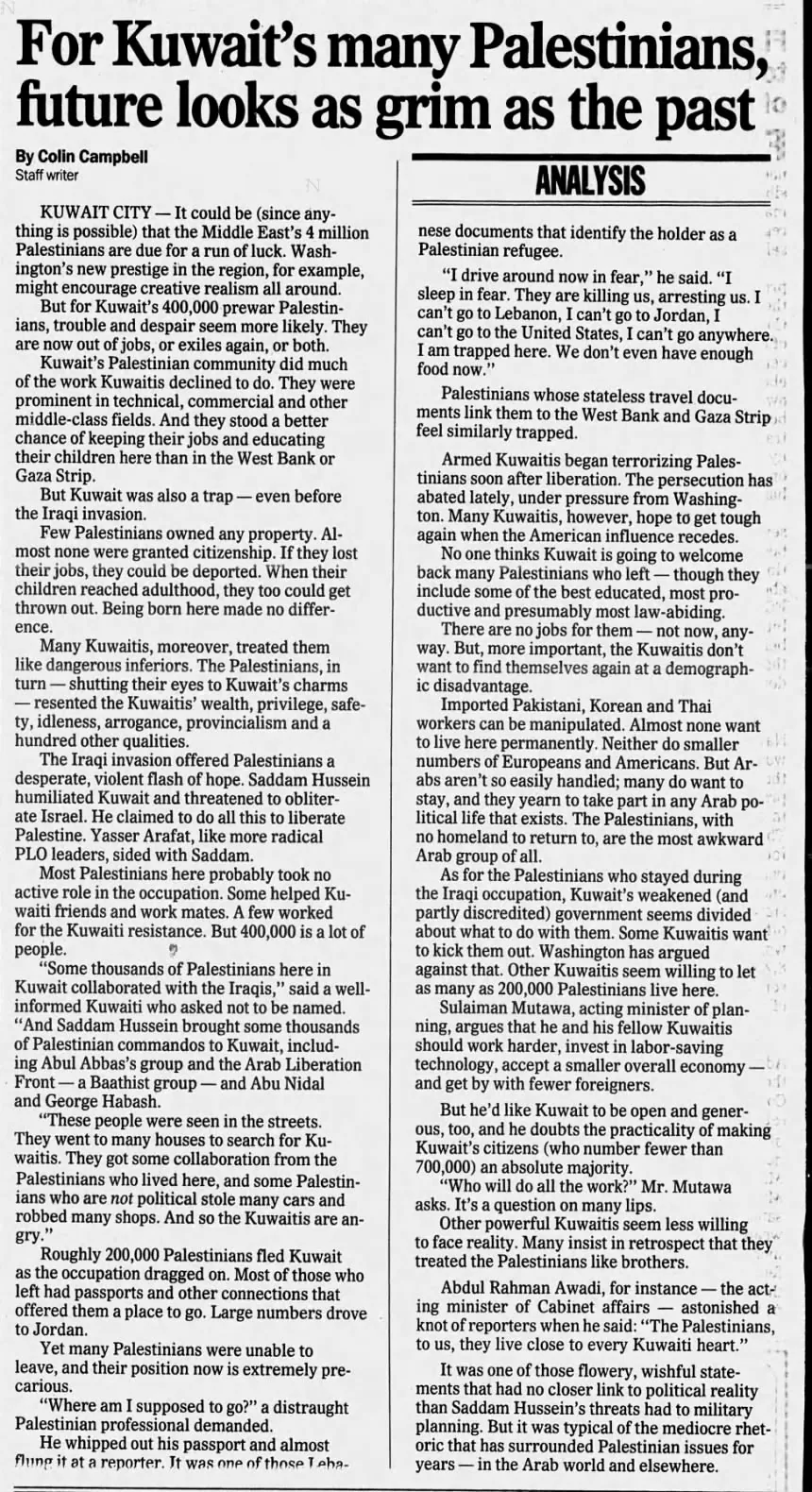
Transcribed from the clipping
KUWAIT CITY — It could be (since anything is possible) that the Middle East’s 4 million Palestinians are due for a run of luck. Washington’s new prestige in the region, for example, might encourage creative realism all around. But for Kuwait’s 400,000 prewar Palestinians, trouble and despair seem more likely.
They are now out of jobs, or exiles again, or both. Kuwait’s Palestinian community did much of the work Kuwaitis declined to do. They were prominent in technical, commercial and other middle-class fields. And they stood a better chance of keeping their jobs and educating their children here than in the West Bank or Gaza Strip.
But Kuwait was also a trap — even before the Iraqi invasion. Few Palestinians owned any property. Almost none were granted citizenship. If they lost their jobs, they could be deported. When their children reached adulthood, they too could get thrown out. Being born here made no difference. Many Kuwaitis, moreover, treated them like dangerous inferiors.
The Palestinians, in turn — shutting their eyes to Kuwait’s charms — resented the Kuwaitis’ wealth, privilege, safety, idleness, arrogance, provincialism and a hundred other qualities. The Iraqi invasion offered Palestinians a desperate, violent flash of hope. Saddam Hussein humiliated Kuwait and threatened to obliterate Israel.
He claimed to do all this to liberate Palestine. Yasser Arafat, like more radical PLO leaders, sided with Saddam. Most Palestinians here probably took no active role in the occupation. Some helped Kuwaiti friends and work mates. A few worked for the Kuwaiti resistance. But 400,000 is a lot of people.
“Some thousands of Palestinians here in Kuwait collaborated with the Iraqis,” said a well-informed Kuwaiti who asked not to be named. “And Saddam Hussein brought some thousands of Palestinian commandos to Kuwait, including Abul Abbas’s group and the Arab Liberation Front — a Baathist group — and Abu Nidal and George Habash.
“These people were seen in the streets. They went to many houses to search for Kuwaitis. They got some collaboration from the Palestinians who lived here, and some Palestinians who are not political stole many cars and robbed many shops. And so the Kuwaitis are angry.” Roughly 200,000 Palestinians fled Kuwait as the occupation dragged on.
Most of those who left had passports and other connections that offered them a place to go. Large numbers drove to Jordan. Yet many Palestinians were unable to leave, and their position now is extremely precarious. “Where am I supposed to go?” a distraught Palestinian professional demanded. He whipped out his passport and almost flung it at a reporter.
It was one of those Lebanese documents that identify the holder as a Palestinian refugee. “I drive around now in fear,” he said. “I sleep in fear. They are killing us, arresting us. I can’t go to Lebanon, I can’t go to Jordan, I can’t go to the United States, I can’t go anywhere. I am trapped here.
We don’t even have enough food now.” Palestinians whose stateless travel documents link them to the West Bank and Gaza Strip feel similarly trapped. Armed Kuwaitis began terrorizing Palestinians soon after liberation. The persecution has abated lately, under pressure from Washington.
Many Kuwaitis, however, hope to get tough again when the American influence recedes. No one thinks Kuwait is going to welcome back many Palestinians who left — though they include some of the best educated, most productive and presumably most law-abiding. There are no jobs for them — not now, anyway.
But, more important, the Kuwaitis don’t want to find themselves again at a demographic disadvantage. Imported Pakistani, Korean and Thai workers can be manipulated. Almost none want to live here permanently. Neither do smaller numbers of Europeans and Americans.
But Arabs aren’t so easily handled; many do want to stay, and they yearn to take part in any Arab political life that exists. The Palestinians, with no homeland to return to, are the most awkward Arab group of all.
Cite this clipping
"For Kuwait’s many Palestinians, future looks as grim as the past," The Atlanta Journal, 4 April 1991. Covering Palestine archive, CP-1991-052. https://coveringpalestine.org/archive/cp-1991-052
More from The Atlanta Journal
- Israelis vow to retaliate for terrorist hijackingThe Atlanta Journal · 14 April 1984
- Israeli police close holy site, fire tear gas at MuslimsThe Atlanta Journal · 9 October 1990
More from the 1990s
- 2 killed in West Bank protestsThe Kansas City Star · 2 January 1991
- Two top men in PLO assassinatedTimes Record News · 17 January 1991
- Both Saddam Hussein, Israel blamed for PLO slayingsLa Crosse Tribune · 18 January 1991
- Palestinians Are Buoyed By the Attacks on Israel(newspaper unidentified) · 21 January 1991
- ‘Administrative detention’: Israelis skip due processThe Baltimore Sun · 6 February 1991
- Books About the Arab WorldSyracuse Herald Journal · 24 February 1991
- All 374 clippings from the 1990s →
Last updated 2 November 2026
This record is part of Covering Palestine, an archive of American newspaper clippings about Palestinians, 1724 to 2023. Researched and assembled by Maria Robles.
The clipping belongs to the newspaper that printed it, or to the news agency that supplied the copy. It is reproduced here for research, criticism and commentary. A city here is where the newspaper was published, not where the story came from, and on most records it was taken from the masthead.
Something wrong here, or something you know about this clipping? The archive is still being built and corrections are wanted: maria@rozumstudio.com, quoting CP-1991-052.
Everything printed in 1991 · Printed on this day · See it in the archive reel · Full text of every clipping · Dataset