The New York Times · 10 April 1991
CP-1991-053
Fear Rises as Another Palestinian Dies in Kuwait
By JOHN KIFNER
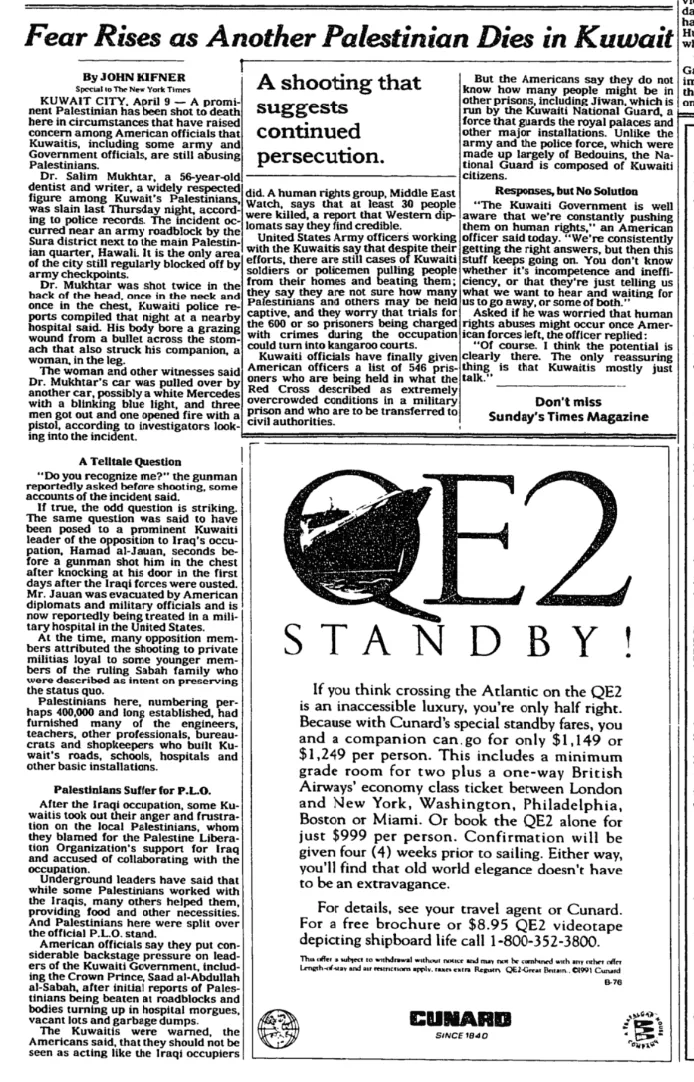
Transcribed from the clipping
KUWAIT CITY, April 9 — A prominent Palestinian has been shot to death here in circumstances that have raised concern among American officials that Kuwaitis, including some army and Government officials, are still abusing Palestinians. Dr.
Salim Mukhtar, a 56-year-old dentist and writer, a widely respected figure among Kuwait’s Palestinians, was slain last Thursday night, according to police records. The incident occurred near an army roadblock by the Sura district next to the main Palestinian quarter, Hawali. It is the only area of the city still regularly blocked off by army checkpoints. Dr.
Mukhtar was shot twice in the back of the head, once in the neck and once in the chest, Kuwaiti police reports compiled that night at a nearby hospital said. His body bore a grazing wound from a bullet across the stomach that also struck his companion, a woman, in the leg. The woman and other witnesses said Dr.
Mukhtar’s car was pulled over by another car, possibly a white Mercedes with a blinking blue light, and three men got out and one opened fire with a pistol, according to investigators looking into the incident. “Do you recognize me?” the gunman reportedly asked before shooting, some accounts of the incident said. If true, the odd question is striking.
The same question was said to have been posed to a prominent Kuwaiti leader of the opposition to Iraq’s occupation, Hamad al-Jauan, seconds before a gunman shot him in the chest after knocking at his door in the first days after the Iraqi forces were ousted. Mr.
Jauan was evacuated by American diplomats and military officials and is now reportedly being treated in a military hospital in the United States. At the time, many opposition members attributed the shooting to private militias loyal to some younger members of the ruling Sabah family who were described as intent on preserving the status quo.
Palestinians here, numbering perhaps 400,000 and long established, had furnished many of the engineers, teachers, other professionals, bureaucrats and shopkeepers who built Kuwait’s roads, schools, hospitals and other basic installations.
After the Iraqi occupation, some Kuwaitis took out their anger and frustration on the local Palestinians, whom they blamed for the Palestine Liberation Organization’s support for Iraq and accused of collaborating with the occupation.
Underground leaders have said that while some Palestinians worked with the Iraqis, many others helped them, providing food and other necessities. And Palestinians here were split over the official P.L.O. stand.
American officials say they put considerable backstage pressure on leaders of the Kuwaiti Government, including the Crown Prince, Saad al-Abdullah al-Sabah, after initial reports of Palestinians being beaten at roadblocks and bodies turning up in hospital morgues, vacant lots and garbage dumps.
A human rights group, Middle East Watch, says that at least 30 people were killed, a report that Western diplomats say they find credible.
United States Army officers working with the Kuwaitis say that despite their efforts, there are still cases of Kuwaiti soldiers or policemen pulling people from their homes and beating them; they say they are not sure how many Palestinians and others may be held captive, and they worry that trials for the 600 or so prisoners being charged with crimes during the occupation could turn into kangaroo courts.
“The Kuwaiti Government is well aware that we’re constantly pushing them on human rights,” an American officer said today. “We’re consistently getting the right answers, but then this stuff keeps going on.
You don’t know whether it’s incompetence and inefficiency, or that they’re just telling us what we want to hear and waiting for us to go away, or some of both.” Asked if he was worried that human rights abuses might occur once American forces left, the officer replied: “Of course. I think the potential is clearly there.
The only reassuring thing is that Kuwaitis mostly just talk.”
Cite this clipping
"Fear Rises as Another Palestinian Dies in Kuwait," The New York Times, 10 April 1991. Covering Palestine archive, CP-1991-053. https://coveringpalestine.org/archive/cp-1991-053
More from The New York Times
- The Maine Colony in PalestineThe New York Times · 12 November 1866
- Jewish Colonization in PalestineThe New York Times · 9 December 1883
- Jewish State in Palestine OpposedThe New York Times · 9 July 1897
- ZIONIST CONGRESS IN BASELThe New York Times · 31 August 1897
- ROME FEARS THE ZIONISTSThe New York Times · 12 September 1897
- PROGRESS OF ZIONISMThe New York Times · 16 December 1901
- 852 more from this paper in the full text →
More from the 1990s
- 2 killed in West Bank protestsThe Kansas City Star · 2 January 1991
- Two top men in PLO assassinatedTimes Record News · 17 January 1991
- Both Saddam Hussein, Israel blamed for PLO slayingsLa Crosse Tribune · 18 January 1991
- Palestinians Are Buoyed By the Attacks on Israel(newspaper unidentified) · 21 January 1991
- ‘Administrative detention’: Israelis skip due processThe Baltimore Sun · 6 February 1991
- Books About the Arab WorldSyracuse Herald Journal · 24 February 1991
- All 374 clippings from the 1990s →
Last updated 2 November 2026
This record is part of Covering Palestine, an archive of American newspaper clippings about Palestinians, 1724 to 2023. Researched and assembled by Maria Robles.
The clipping belongs to the newspaper that printed it, or to the news agency that supplied the copy. It is reproduced here for research, criticism and commentary. A city here is where the newspaper was published, not where the story came from, and on most records it was taken from the masthead.
Something wrong here, or something you know about this clipping? The archive is still being built and corrections are wanted: maria@rozumstudio.com, quoting CP-1991-053.
Everything printed in 1991 · Printed on this day · See it in the archive reel · Full text of every clipping · Dataset