The New York Times · New York, New York · 14 April 1991
CP-1991-026
The Land Of Oz
The novels of Amos Oz deliver an unsentimental view of Israeli life.
BY JAY PARINI
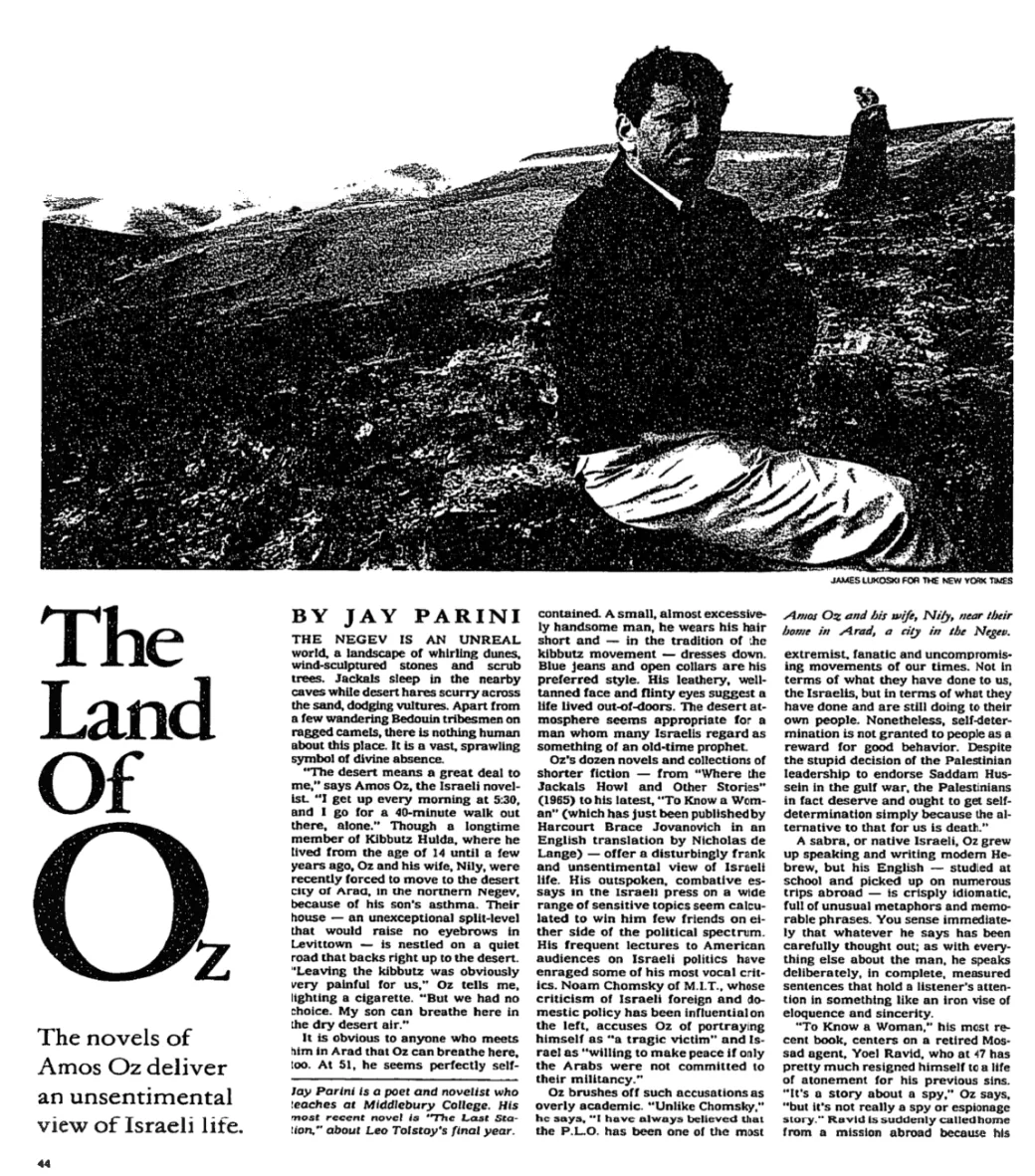
Transcribed from the clipping
THE NEGEV IS AN UNREAL world, a landscape of whirling dunes, wind-sculptured stones and scrub trees. Jackals sleep in the nearby caves while desert hares scurry across the sand, dodging vultures. Apart from a few wandering Bedouin tribesmen on ragged camels, there is nothing human about this place. It is a vast, sprawling symbol of divine absence.
“The desert means a great deal to me,” says Amos Oz, the Israeli novelist. “I get up every morning at 5:30, and I go for a 40-minute walk out there, alone.”
Though a longtime member of Kibbutz Hulda, where he lived from the age of 14 until a few years ago, Oz and his wife, Nily, were recently forced to move to the desert city of Arad, in the northern Negev, because of his son’s asthma.
Their house — an unexceptional split-level that would raise no eyebrows in Levittown — is nestled on a quiet road that backs right up to the desert. “Leaving the kibbutz was obviously very painful for us,” Oz tells me, lighting a cigarette. “But we had no choice. My son can breathe here in the dry desert air.”
It is obvious to anyone who meets him in Arad that Oz can breathe here, too. At 51, he seems perfectly self-contained. A small, almost excessively handsome man, he wears his hair short and — in the tradition of the kibbutz movement — dresses down. Blue jeans and open collars are his preferred style.
His leathery, well-tanned face and flinty eyes suggest a life lived out-of-doors. The desert atmosphere seems appropriate for a man whom many Israelis regard as something of an old-time prophet.
Oz’s dozen novels and collections of shorter fiction — from “Where the Jackals Howl and Other Stories” (1965) to his latest, “To Know a Woman” (which has just been published by Harcourt Brace Jovanovich in an English translation by Nicholas de Lange) — offer a disturbingly frank and unsentimental view of Israeli life.
His outspoken, combative essays in the Israeli press on a wide range of sensitive topics seem calculated to win him few friends on either side of the political spectrum. His frequent lectures to American audiences on Israeli politics have enraged some of his most vocal critics.
Noam Chomsky of M.I.T., whose criticism of Israeli foreign and domestic policy has been influential on the left, accuses Oz of portraying himself as “a tragic victim” and Israel as “willing to make peace if only the Arabs were not committed to their militancy.” Oz brushes off such accusations as overly academic.
“Unlike Chomsky,” he says, “I have always believed that the P.L.O. has been one of the most extremist, fanatic and uncompromising movements of our times. Not in terms of what they have done to us, the Israelis, but in terms of what they have done and are still doing to their own people.
Nonetheless, self-determination is not granted to people as a reward for good behavior. Despite the stupid decision of the Palestinian leadership to endorse Saddam Hussein in the gulf war, the Palestinians in fact deserve and ought to get self-determination simply because the alternative to that for us is death.”
A sabra, or native Israeli, Oz grew up speaking and writing modern Hebrew, but his English — studied at school and picked up on numerous trips abroad — is crisply idiomatic, full of unusual metaphors and memorable phrases.
You sense immediately that whatever he says has been carefully thought out; as with everything else about the man, he speaks deliberately, in complete, measured sentences that hold a listener’s attention in something like an iron vise of eloquence and sincerity.
“To Know a Woman,” his most recent book, centers on a retired Mossad agent, Yoel Ravid, who at 47 has pretty much resigned himself to a life of atonement for his previous sins. “It’s a story about a spy,” Oz says, “but it’s not really a spy or espionage story.”
How this transcription was made
Read from the scan by a machine looking at the image of the page, not by optical character recognition and not by a person. The clipping carries no masthead or date line, so its date and newspaper rest on the record it arrived with, not on anything visible in the scan.
Context added by this archive
Date check: No masthead, but this is a magazine opening spread rather than a news page: the folio 44 is printed at the foot of the display column, and the photograph is credited “JAMES LUKOSKI FOR THE NEW YORK TIMES”, which confirms `pub`. The page prints no date.
Internal evidence puts it after the Gulf war — Oz speaks of “the stupid decision of the Palestinian leadership to endorse Saddam Hussein in the gulf war” in the past tense — and gives Oz’s age as 51 and “To Know a Woman” as having “just been published” in English.
All of that is consistent with `date` (1991-04-14, a Sunday, the Magazine’s day) without confirming it exactly.
Cite this clipping
"The Land Of Oz," The New York Times, 14 April 1991, p. 44. Covering Palestine archive, CP-1991-026. https://coveringpalestine.org/archive/cp-1991-026
More from The New York Times
- The Maine Colony in PalestineThe New York Times · 12 November 1866
- Jewish Colonization in PalestineThe New York Times · 9 December 1883
- Jewish State in Palestine OpposedThe New York Times · 9 July 1897
- ZIONIST CONGRESS IN BASELThe New York Times · 31 August 1897
- ROME FEARS THE ZIONISTSThe New York Times · 12 September 1897
- PROGRESS OF ZIONISMThe New York Times · 16 December 1901
- 852 more from this paper in the full text →
More from the 1990s
- 2 killed in West Bank protestsThe Kansas City Star · 2 January 1991
- Two top men in PLO assassinatedTimes Record News · 17 January 1991
- Both Saddam Hussein, Israel blamed for PLO slayingsLa Crosse Tribune · 18 January 1991
- Palestinians Are Buoyed By the Attacks on Israel(newspaper unidentified) · 21 January 1991
- ‘Administrative detention’: Israelis skip due processThe Baltimore Sun · 6 February 1991
- Books About the Arab WorldSyracuse Herald Journal · 24 February 1991
- All 374 clippings from the 1990s →
Last updated 2 November 2026
This record is part of Covering Palestine, an archive of American newspaper clippings about Palestinians, 1724 to 2023. Researched and assembled by Maria Robles.
The clipping belongs to the newspaper that printed it, or to the news agency that supplied the copy. It is reproduced here for research, criticism and commentary. A city here is where the newspaper was published, not where the story came from, and on most records it was taken from the masthead.
Something wrong here, or something you know about this clipping? The archive is still being built and corrections are wanted: maria@rozumstudio.com, quoting CP-1991-026.
Everything printed in 1991 · Printed on this day · See it in the archive reel · Full text of every clipping · Dataset