The New York Times · New York, New York · 12 May 1991
CP-1991-027
In Defiance of Israel
By Trudy Rubin
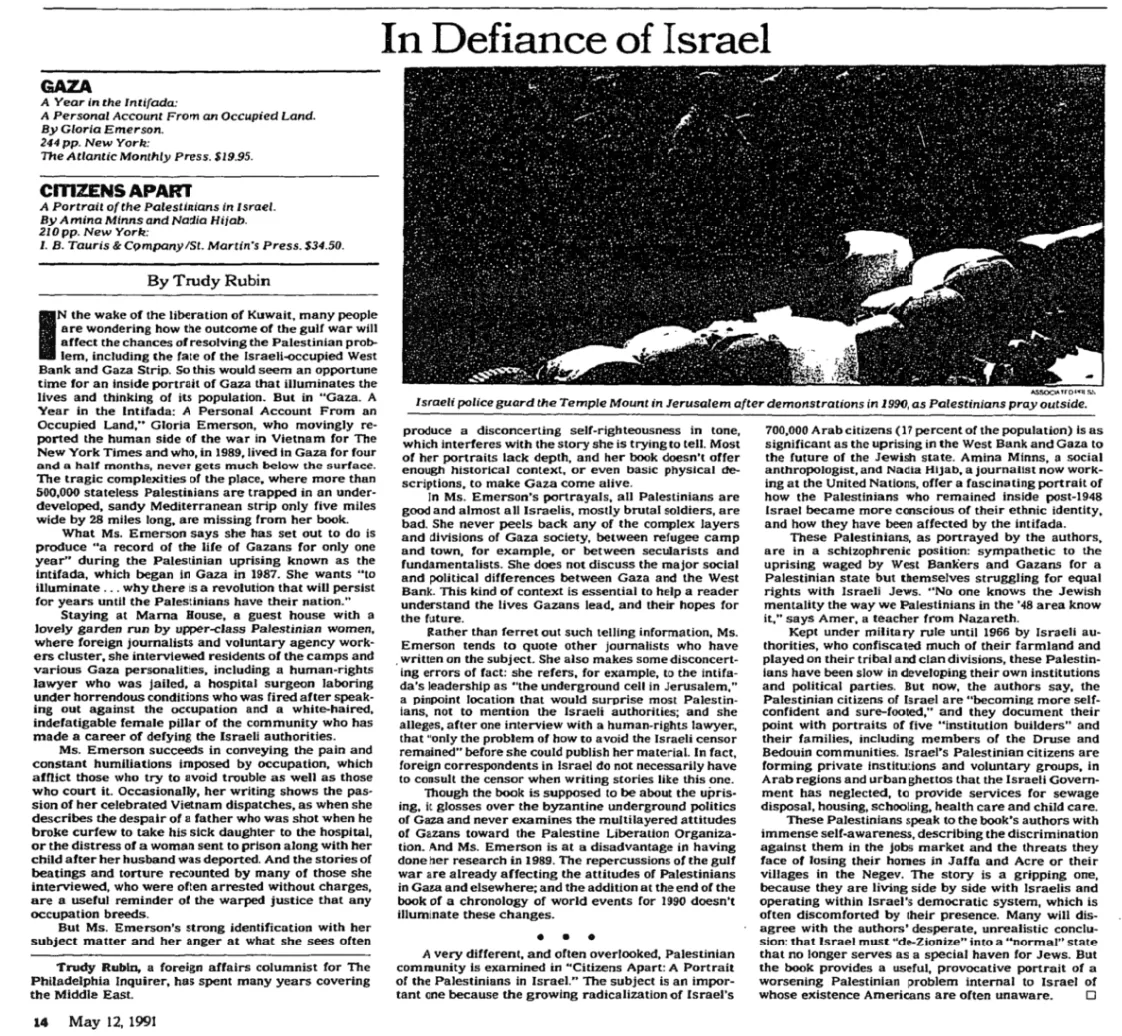
Transcribed from the clipping
IN the wake of the liberation of Kuwait, many people are wondering how the outcome of the gulf war will affect the chances of resolving the Palestinian problem, including the fate of the Israeli-occupied West Bank and Gaza Strip. So this would seem an opportune time for an inside portrait of Gaza that illuminates the lives and thinking of its population. But in “Gaza.
A Year in the Intifada: A Personal Account From an Occupied Land,” Gloria Emerson, who movingly reported the human side of the war in Vietnam for The New York Times and who, in 1989, lived in Gaza for four and a half months, never gets much below the surface.
The tragic complexities of the place, where more than 500,000 stateless Palestinians are trapped in an underdeveloped, sandy Mediterranean strip only five miles wide by 28 miles long, are missing from her book. What Ms.
Emerson says she has set out to do is produce “a record of the life of Gazans for only one year” during the Palestinian uprising known as the intifada, which began in Gaza in 1987. She wants “to illuminate . . . why there is a revolution that will persist for years until the Palestinians have their nation.”
Staying at Marna House, a guest house with a lovely garden run by upper-class Palestinian women, where foreign journalists and voluntary agency workers cluster, she interviewed residents of the camps and various Gaza personalities, including a human-rights lawyer who was jailed, a hospital surgeon laboring under horrendous conditions who was fired after speaking out against the occupation and a white-haired, indefatigable female pillar of the community who has made a career of defying the Israeli authorities.
Ms. Emerson succeeds in conveying the pain and constant humiliations imposed by occupation, which afflict those who try to avoid trouble as well as those who court it.
Occasionally, her writing shows the passion of her celebrated Vietnam dispatches, as when she describes the despair of a father who was shot when he broke curfew to take his sick daughter to the hospital, or the distress of a woman sent to prison along with her child after her husband was deported.
And the stories of beatings and torture recounted by many of those she interviewed, who were often arrested without charges, are a useful reminder of the warped justice that any occupation breeds. But Ms.
Emerson’s strong identification with her subject matter and her anger at what she sees often produce a disconcerting self-righteousness in tone, which interferes with the story she is trying to tell. Most of her portraits lack depth, and her book doesn’t offer enough historical context, or even basic physical descriptions, to make Gaza come alive. In Ms.
Emerson’s portrayals, all Palestinians are good and almost all Israelis, mostly brutal soldiers, are bad. She never peels back any of the complex layers and divisions of Gaza society, between refugee camp and town, for example, or between secularists and fundamentalists. She does not discuss the major social and political differences between Gaza and the West Bank.
This kind of context is essential to help a reader understand the lives Gazans lead, and their hopes for the future. Rather than ferret out such telling information, Ms. Emerson tends to quote other journalists who have written on the subject.
She also makes some disconcerting errors of fact: she refers, for example, to the intifada’s leadership as “the underground cell in Jerusalem,” a pinpoint location that would surprise most Palestinians, not to mention the Israeli authorities; and she alleges, after one interview with a human-rights lawyer, that “only the problem of how to avoid the Israeli censor remained” before she could publish her material.
In fact, foreign correspondents in Israel do not necessarily have to consult the censor when writing stories like this one. Though the book is supposed to be about the uprising, it glosses over the byzantine underground politics of Gaza and never examines the multilayered attitudes of Gazans toward the Palestine Liberation Organization. And Ms.
Emerson is at a disadvantage in having done her research in 1989. The repercussions of the gulf war are already affecting the attitudes of Palestinians in Gaza and elsewhere; and the addition at the end of the book of a chronology of world events for 1990 doesn’t illuminate these changes.
A very different, and often overlooked, Palestinian community is examined in “Citizens Apart: A Portrait of the Palestinians in Israel.”
The subject is an important one because the growing radicalization of Israel’s 700,000 Arab citizens (17 percent of the population) is as significant as the uprising in the West Bank and Gaza to the future of the Jewish state.
Amina Minns, a social anthropologist, and Nadia Hijab, a journalist now working at the United Nations, offer a fascinating portrait of how the Palestinians who remained inside post-1948 Israel became more conscious of their ethnic identity, and how they have been affected by the intifada.
These Palestinians, as portrayed by the authors, are in a schizophrenic position: sympathetic to the uprising waged by West Bankers and Gazans for a Palestinian state but themselves struggling for equal rights with Israeli Jews. “No one knows the Jewish mentality the way we Palestinians in the ’48 area know it,” says Amer, a teacher from Nazareth.
Kept under military rule until 1966 by Israeli authorities, who confiscated much of their farmland and played on their tribal and clan divisions, these Palestinians have been slow in developing their own institutions and political parties.
But now, the authors say, the Palestinian citizens of Israel are “becoming more self-confident and sure-footed,” and they document their point with portraits of five “institution builders” and their families, including members of the Druse and Bedouin communities.
Israel’s Palestinian citizens are forming private institutions and voluntary groups, in Arab regions and urban ghettos that the Israeli Government has neglected, to provide services for sewage disposal, housing, schooling, health care and child care.
These Palestinians speak to the book’s authors with immense self-awareness, describing the discrimination against them in the jobs market and the threats they face of losing their homes in Jaffa and Acre or their villages in the Negev.
The story is a gripping one, because they are living side by side with Israelis and operating within Israel’s democratic system, which is often discomforted by their presence.
Many will disagree with the authors’ desperate, unrealistic conclusion: that Israel must “de-Zionize” into a “normal” state that no longer serves as a special haven for Jews. But the book provides a useful, provocative portrait of a worsening Palestinian problem internal to Israel of whose existence Americans are often unaware.
How this transcription was made
Read from the scan by a machine looking at the image of the page, not by optical character recognition and not by a person. The clipping carries no masthead or date line, so its date and newspaper rest on the record it arrived with, not on anything visible in the scan.
Context added by this archive
Date check: No masthead, but this page carries its own date line: at the foot of the first column it reads “14 May 12, 1991”, the folio and the issue date together.
That confirms `date` (1991-05-12) exactly. `pub` is not named on the clipping; the page is a Book Review page and the date line gives no paper name, so The New York Times could not be verified from the page itself.
Cite this clipping
"In Defiance of Israel," The New York Times, 12 May 1991, p. 14. Covering Palestine archive, CP-1991-027. https://coveringpalestine.org/archive/cp-1991-027
More from The New York Times
- The Maine Colony in PalestineThe New York Times · 12 November 1866
- Jewish Colonization in PalestineThe New York Times · 9 December 1883
- Jewish State in Palestine OpposedThe New York Times · 9 July 1897
- ZIONIST CONGRESS IN BASELThe New York Times · 31 August 1897
- ROME FEARS THE ZIONISTSThe New York Times · 12 September 1897
- PROGRESS OF ZIONISMThe New York Times · 16 December 1901
- 852 more from this paper in the full text →
More from the 1990s
- 2 killed in West Bank protestsThe Kansas City Star · 2 January 1991
- Two top men in PLO assassinatedTimes Record News · 17 January 1991
- Both Saddam Hussein, Israel blamed for PLO slayingsLa Crosse Tribune · 18 January 1991
- Palestinians Are Buoyed By the Attacks on Israel(newspaper unidentified) · 21 January 1991
- ‘Administrative detention’: Israelis skip due processThe Baltimore Sun · 6 February 1991
- Books About the Arab WorldSyracuse Herald Journal · 24 February 1991
- All 374 clippings from the 1990s →
Last updated 2 November 2026
This record is part of Covering Palestine, an archive of American newspaper clippings about Palestinians, 1724 to 2023. Researched and assembled by Maria Robles.
The clipping belongs to the newspaper that printed it, or to the news agency that supplied the copy. It is reproduced here for research, criticism and commentary. A city here is where the newspaper was published, not where the story came from, and on most records it was taken from the masthead.
Something wrong here, or something you know about this clipping? The archive is still being built and corrections are wanted: maria@rozumstudio.com, quoting CP-1991-027.
Everything printed in 1991 · Printed on this day · See it in the archive reel · Full text of every clipping · Dataset