The New York Times · 3 April 1991
CP-1991-051
Kuwaitis Urged to Halt Attacks on Palestinians
By JOHN KIFNER
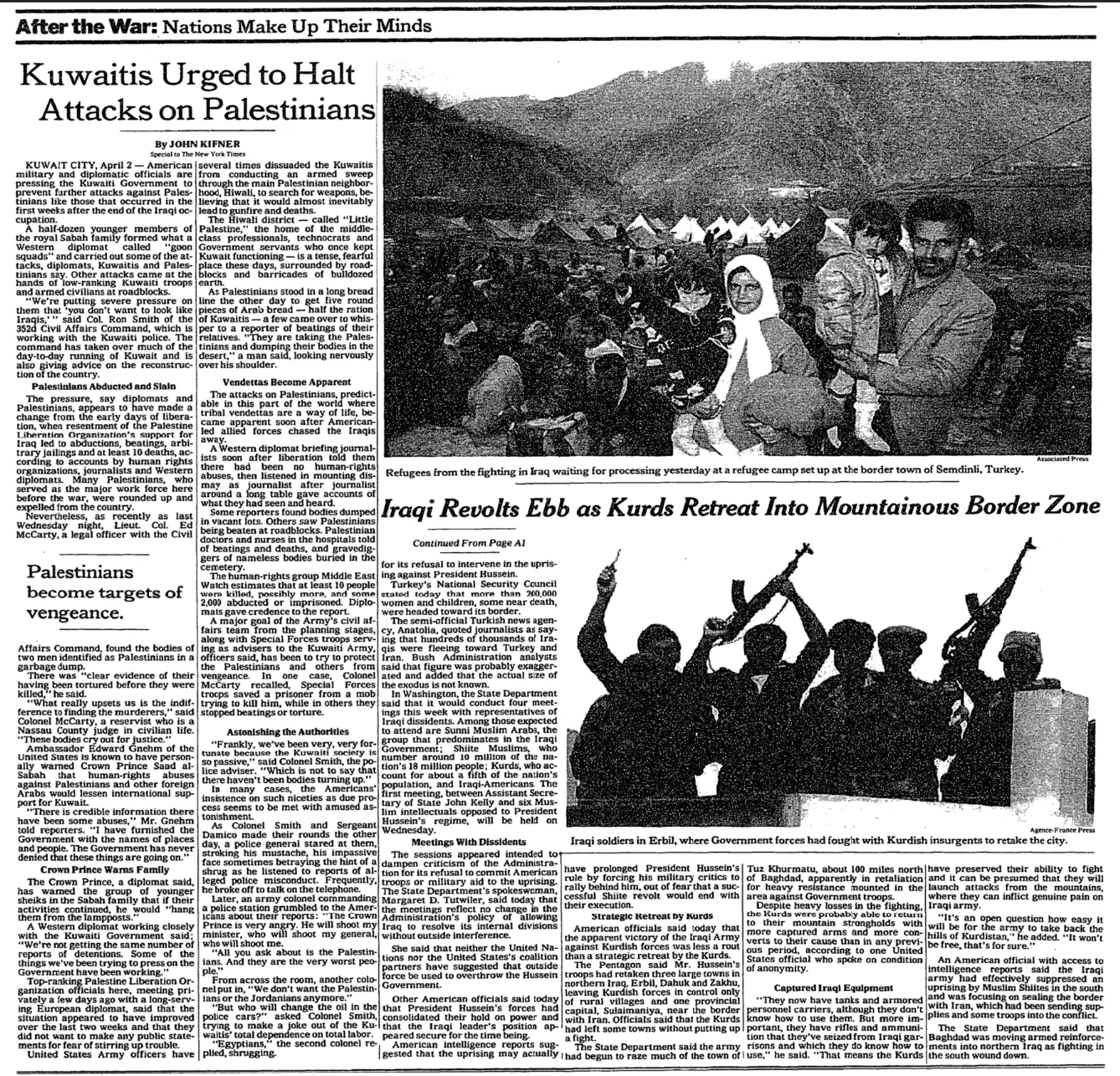
Transcribed from the clipping
KUWAIT CITY, April 2 — American military and diplomatic officials are pressing the Kuwaiti Government to prevent further attacks against Palestinians like those that occurred in the first weeks after the end of the Iraqi occupation.
A half-dozen younger members of the royal Sabah family formed what a Western diplomat called “goon squads” and carried out some of the attacks, diplomats, Kuwaitis and Palestinians say. Other attacks came at the hands of low-ranking Kuwaiti troops and armed civilians at roadblocks.
“We’re putting severe pressure on them that ‘you don’t want to look like Iraqis,’ ” said Col. Ron Smith of the 352d Civil Affairs Command, which is working with the Kuwaiti police. The command has taken over much of the day-to-day running of Kuwait and is also giving advice on the reconstruction of the country.
The pressure, say diplomats and Palestinians, appears to have made a change from the early days of liberation, when resentment of the Palestine Liberation Organization’s support for Iraq led to abductions, beatings, arbitrary jailings and at least 10 deaths, according to accounts by human rights organizations, journalists and Western diplomats.
Many Palestinians, who served as the major work force here before the war, were rounded up and expelled from the country. Nevertheless, as recently as last Wednesday night, Lieut. Col. Ed McCarty, a legal officer with the Civil Affairs Command, found the bodies of two men identified as Palestinians in a garbage dump.
There was “clear evidence of their having been tortured before they were killed,” he said. “What really upsets us is the indifference to finding the murderers,” said Colonel McCarty, a reservist who is a Nassau County judge in civilian life. “These bodies cry out for justice.”
Ambassador Edward Gnehm of the United States is known to have personally warned Crown Prince Saad al-Sabah that human-rights abuses against Palestinians and other foreign Arabs would lessen international support for Kuwait. “There is credible information there have been some abuses,” Mr. Gnehm told reporters.
“I have furnished the Government with the names of places and people. The Government has never denied that these things are going on.” The Crown Prince, a diplomat said, has warned the group of younger sheiks in the Sabah family that if their activities continued, he would “hang them from the lampposts.”
United States Army officers have several times dissuaded the Kuwaitis from conducting an armed sweep through the main Palestinian neighborhood, Hiwali, to search for weapons, believing that it would almost inevitably lead to gunfire and deaths.
The Hiwali district — called “Little Palestine,” the home of the middle-class professionals, technocrats and Government servants who once kept Kuwait functioning — is a tense, fearful place these days, surrounded by roadblocks and barricades of bulldozed earth.
As Palestinians stood in a long bread line the other day to get five round pieces of Arab bread — half the ration of Kuwaitis — a few came over to whisper to a reporter of beatings of their relatives. “They are taking the Palestinians and dumping their bodies in the desert,” a man said, looking nervously over his shoulder.
The human-rights group Middle East Watch estimates that at least 10 people were killed, possibly more, and some 2,000 abducted or imprisoned. Diplomats gave credence to the report. “Frankly, we’ve been very, very fortunate because the Kuwaiti society is so passive,” said Colonel Smith, the police adviser.
“Which is not to say that there haven’t been bodies turning up.” In many cases, the Americans’ insistence on such niceties as due process seems to be met with amused astonishment.
As Colonel Smith and Sergeant Damico made their rounds the other day, a police captain stared at them, stroking his mustache, his impassive face sometimes betraying the hint of a shrug as he listened to reports of alleged police misconduct. Frequently, he broke off to talk on the telephone.
Later, an army colonel commanding a police station grumbled to the Americans about their reports: “The Crown Prince is very angry. He will shoot my minister, who will shoot my general, who will shoot me. “All you ask about is the Palestinians. And they are the very worst people.”
From across the room, another colonel put in, “We don’t want the Palestinians or the Jordanians anymore.” “But who will change the oil in the police cars?” asked Colonel Smith, trying to make a joke out of the Kuwaitis’ total dependence on total labor. “Egyptians,” the second colonel replied, shrugging.
Cite this clipping
"Kuwaitis Urged to Halt Attacks on Palestinians," The New York Times, 3 April 1991. Covering Palestine archive, CP-1991-051. https://coveringpalestine.org/archive/cp-1991-051
More from The New York Times
- The Maine Colony in PalestineThe New York Times · 12 November 1866
- Jewish Colonization in PalestineThe New York Times · 9 December 1883
- Jewish State in Palestine OpposedThe New York Times · 9 July 1897
- ZIONIST CONGRESS IN BASELThe New York Times · 31 August 1897
- ROME FEARS THE ZIONISTSThe New York Times · 12 September 1897
- PROGRESS OF ZIONISMThe New York Times · 16 December 1901
- 852 more from this paper in the full text →
More from the 1990s
- 2 killed in West Bank protestsThe Kansas City Star · 2 January 1991
- Two top men in PLO assassinatedTimes Record News · 17 January 1991
- Both Saddam Hussein, Israel blamed for PLO slayingsLa Crosse Tribune · 18 January 1991
- Palestinians Are Buoyed By the Attacks on Israel(newspaper unidentified) · 21 January 1991
- ‘Administrative detention’: Israelis skip due processThe Baltimore Sun · 6 February 1991
- Books About the Arab WorldSyracuse Herald Journal · 24 February 1991
- All 374 clippings from the 1990s →
Last updated 2 November 2026
This record is part of Covering Palestine, an archive of American newspaper clippings about Palestinians, 1724 to 2023. Researched and assembled by Maria Robles.
The clipping belongs to the newspaper that printed it, or to the news agency that supplied the copy. It is reproduced here for research, criticism and commentary. A city here is where the newspaper was published, not where the story came from, and on most records it was taken from the masthead.
Something wrong here, or something you know about this clipping? The archive is still being built and corrections are wanted: maria@rozumstudio.com, quoting CP-1991-051.
Everything printed in 1991 · Printed on this day · See it in the archive reel · Full text of every clipping · Dataset