The New York Times · New York, New York · 5 November 1995
CP-1995-010
The Rabin Assassination
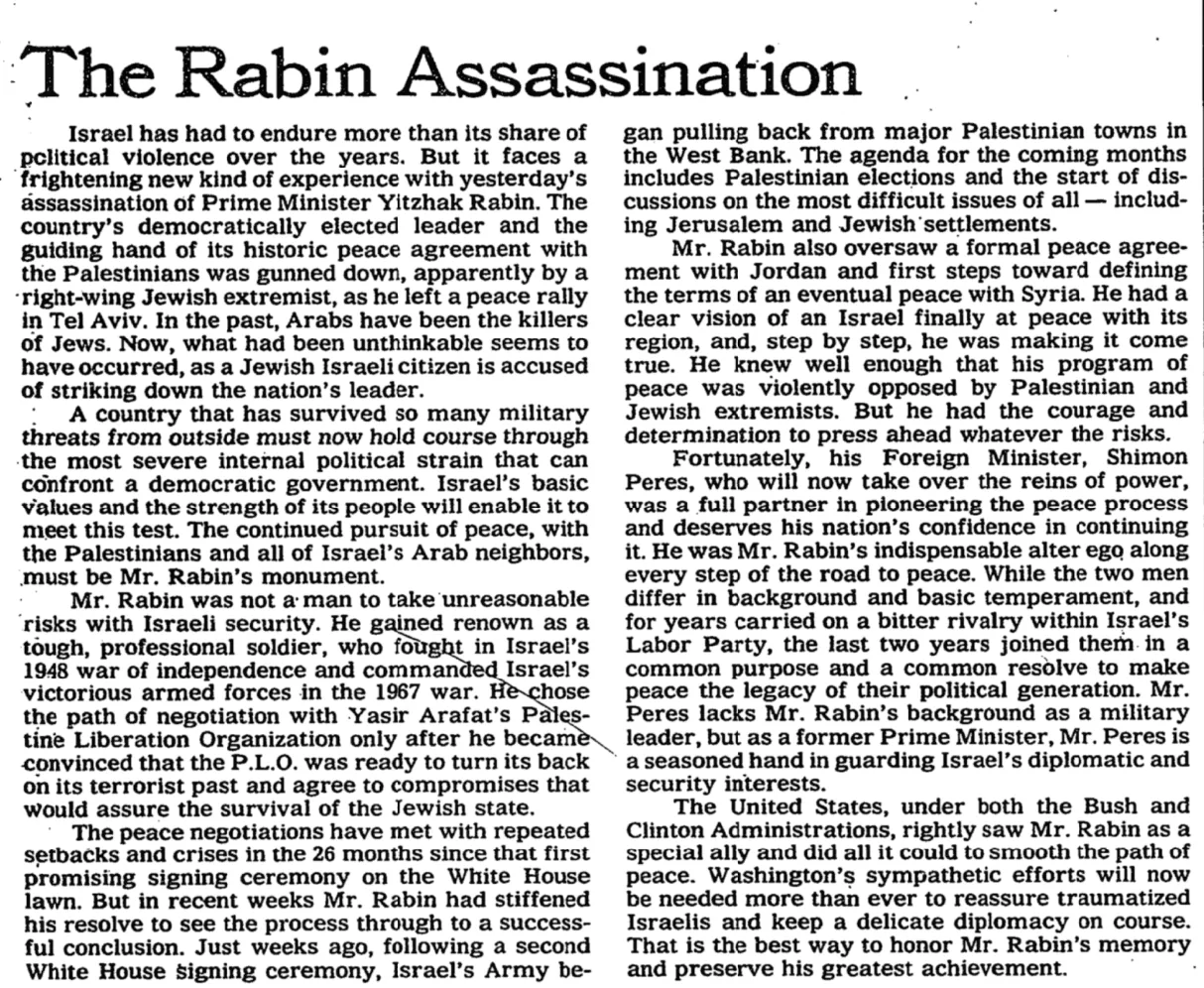
Transcribed from the clipping
Israel has had to endure more than its share of political violence over the years. But it faces a frightening new kind of experience with yesterday’s assassination of Prime Minister Yitzhak Rabin.
The country’s democratically elected leader and the guiding hand of its historic peace agreement with the Palestinians was gunned down, apparently by a right-wing Jewish extremist, as he left a peace rally in Tel Aviv. In the past, Arabs have been the killers of Jews.
Now, what had been unthinkable seems to have occurred, as a Jewish Israeli citizen is accused of striking down the nation’s leader. A country that has survived so many military threats from outside must now hold course through the most severe internal political strain that can confront a democratic government.
Israel’s basic values and the strength of its people will enable it to meet this test. The continued pursuit of peace, with the Palestinians and all of Israel’s Arab neighbors, must be Mr. Rabin’s monument. Mr. Rabin was not a man to take unreasonable risks with Israeli security.
He gained renown as a tough, professional soldier, who fought in Israel’s 1948 war of independence and commanded Israel’s victorious armed forces in the 1967 war.
He chose the path of negotiation with Yasir Arafat’s Palestine Liberation Organization only after he became convinced that the P.L.O. was ready to turn its back on its terrorist past and agree to compromises that would assure the survival of the Jewish state.
The peace negotiations have met with repeated setbacks and crises in the 26 months since that first promising signing ceremony on the White House lawn. But in recent weeks Mr. Rabin had stiffened his resolve to see the process through to a successful conclusion.
Just weeks ago, following a second White House signing ceremony, Israel’s Army began pulling back from major Palestinian towns in the West Bank. The agenda for the coming months includes Palestinian elections and the start of discussions on the most difficult issues of all — including Jerusalem and Jewish settlements. Mr.
Rabin also oversaw a formal peace agreement with Jordan and first steps toward defining the terms of an eventual peace with Syria. He had a clear vision of an Israel finally at peace with its region, and, step by step, he was making it come true. He knew well enough that his program of peace was violently opposed by Palestinian and Jewish extremists.
But he had the courage and determination to press ahead whatever the risks. Fortunately, his Foreign Minister, Shimon Peres, who will now take over the reins of power, was a full partner in pioneering the peace process and deserves his nation’s confidence in continuing it. He was Mr. Rabin’s indispensable alter ego along every step of the road to peace.
While the two men differ in background and basic temperament, and for years carried on a bitter rivalry within Israel’s Labor Party, the last two years joined them in a common purpose and a common resolve to make peace the legacy of their political generation. Mr. Peres lacks Mr. Rabin’s background as a military leader, but as a former Prime Minister, Mr.
Peres is a seasoned hand in guarding Israel’s diplomatic and security interests. The United States, under both the Bush and Clinton Administrations, rightly saw Mr. Rabin as a special ally and did all it could to smooth the path of peace. Washington’s sympathetic efforts will now be needed more than ever to reassure traumatized Israelis and keep a delicate diplomacy on course.
That is the best way to honor Mr. Rabin’s memory and preserve his greatest achievement.
How this transcription was made
Read from the scan by a machine looking at the image of the page, not by optical character recognition and not by a person. The clipping carries no masthead and no dated folio line, so the date recorded here could not be checked against anything printed on the page. Nothing on the page contradicts it.
Cite this clipping
"The Rabin Assassination," The New York Times, 5 November 1995. Covering Palestine archive, CP-1995-010. https://coveringpalestine.org/archive/cp-1995-010
More from The New York Times
- The Maine Colony in PalestineThe New York Times · 12 November 1866
- Jewish Colonization in PalestineThe New York Times · 9 December 1883
- Jewish State in Palestine OpposedThe New York Times · 9 July 1897
- ZIONIST CONGRESS IN BASELThe New York Times · 31 August 1897
- ROME FEARS THE ZIONISTSThe New York Times · 12 September 1897
- PROGRESS OF ZIONISMThe New York Times · 16 December 1901
- 852 more from this paper in the full text →
More from the 1990s
- Arabs Split on Cultural Ties to IsraelThe New York Times · 7 March 1995
- Gaza Arabs Dispute Origin Of Sunday's Mystery BlastThe New York Times · 7 April 1995
- Doctor Says Snapping of Head Killed Palestinian Held in IsraelThe New York Times · 1 May 1995
- Israel Widely Mistreats the DetaineesThe New York Times · 6 May 1995
- Israel Votes To Seize Arab LandOmaha World-Herald · 15 May 1995
- Settler violence in Israel is criminalThe Rock Island Argus · 16 September 1995
- All 374 clippings from the 1990s →
Last updated 2 November 2026
This record is part of Covering Palestine, an archive of American newspaper clippings about Palestinians, 1724 to 2023. Researched and assembled by Maria Robles.
The clipping belongs to the newspaper that printed it, or to the news agency that supplied the copy. It is reproduced here for research, criticism and commentary. A city here is where the newspaper was published, not where the story came from, and on most records it was taken from the masthead.
Something wrong here, or something you know about this clipping? The archive is still being built and corrections are wanted: maria@rozumstudio.com, quoting CP-1995-010.
Everything printed in 1995 · Printed on this day · See it in the archive reel · Full text of every clipping · Dataset