The New York Times · New York, New York · 10 May 1996
CP-1996-021
Suitcase No Longer His Homeland, a Poet Returns
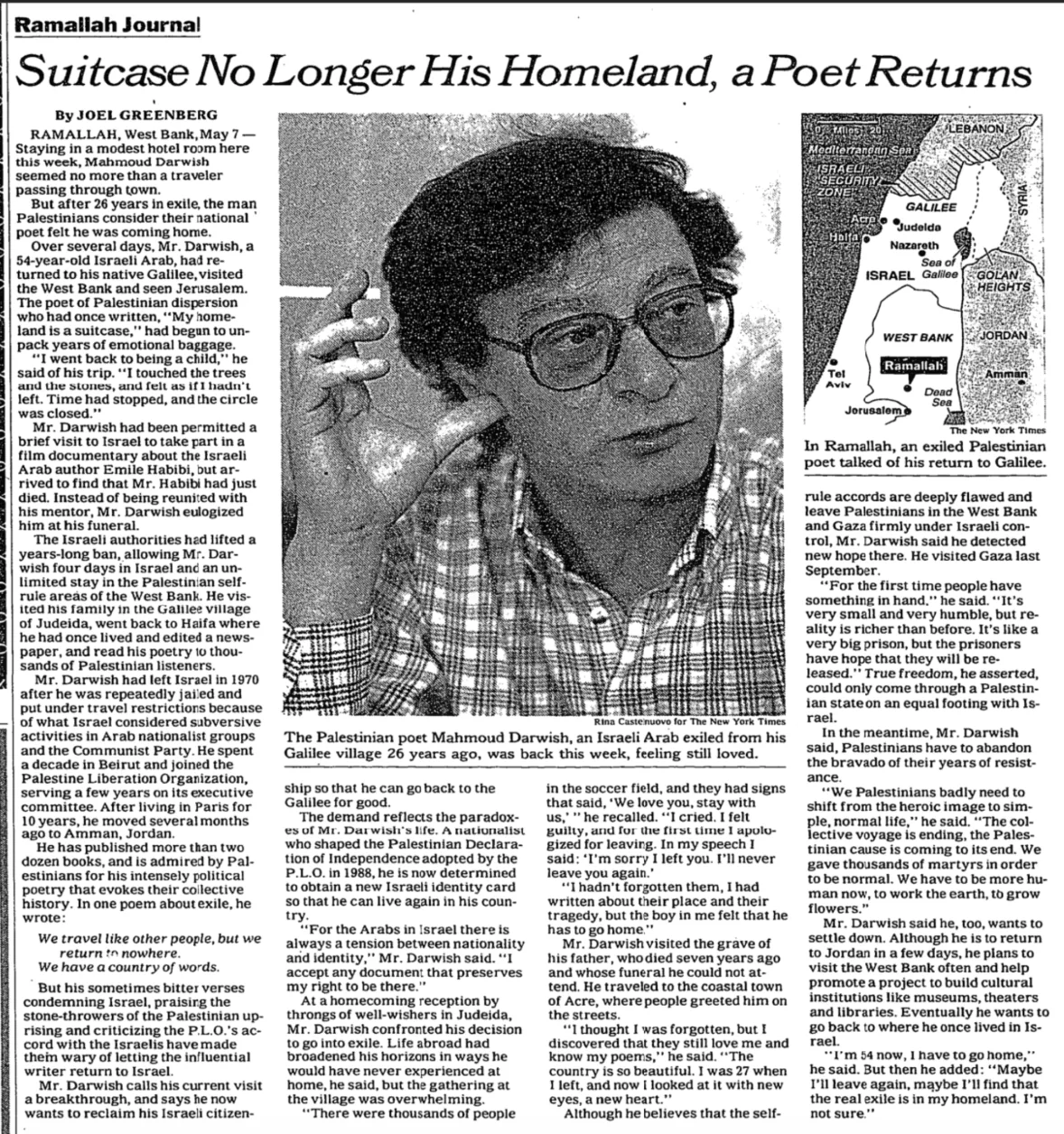
Transcribed from the clipping
RAMALLAH, West Bank, May 7 — Staying in a modest hotel room here this week, Mahmoud Darwish seemed no more than a traveler passing through town. But after 26 years in exile, the man Palestinians consider their national poet felt he was coming home. Over several days, Mr.
Darwish, a 54-year-old Israeli Arab, had returned to his native Galilee, visited the West Bank and seen Jerusalem. The poet of Palestinian dispersion who had once written, “My homeland is a suitcase,” had begun to unpack years of emotional baggage. “I went back to being a child,” he said of his trip.
“I touched the trees and the stones, and felt as if I hadn’t left. Time had stopped, and the circle was closed.” Mr. Darwish had been permitted a brief visit to Israel to take part in a film documentary about the Israeli Arab author Emile Habibi, but arrived to find that Mr. Habibi had just died. Instead of being reunited with his mentor, Mr.
Darwish eulogized him at his funeral. The Israeli authorities had lifted a years-long ban, allowing Mr. Darwish four days in Israel and an unlimited stay in the Palestinian self-rule areas of the West Bank.
He visited his family in the Galilee village of Judeida, went back to Haifa where he had once lived and edited a newspaper, and read his poetry to thousands of Palestinian listeners. Mr.
Darwish had left Israel in 1970 after he was repeatedly jailed and put under travel restrictions because of what Israel considered subversive activities in Arab nationalist groups and the Communist Party. He spent a decade in Beirut and joined the Palestine Liberation Organization, serving a few years on its executive committee.
After living in Paris for 10 years, he moved several months ago to Amman, Jordan. He has published more than two dozen books, and is admired by Palestinians for his intensely political poetry that evokes their collective history. In one poem about exile, he wrote: We travel like other people, but we return to nowhere. We have a country of words.
But his sometimes bitter verses condemning Israel, praising the stone-throwers of the Palestinian uprising and criticizing the P.L.O.’s accord with the Israelis have made them wary of letting the influential writer return to Israel.
How this transcription was made
Read from the scan by a machine looking at the image of the page, not by optical character recognition and not by a person. The clipping carries no masthead or date line, so its date and newspaper rest on the record it arrived with, not on anything visible in the scan.
Context added by this archive
Date check: No masthead or page date line is visible; the scan is cropped to the article, photograph and map. The dateline reads “RAMALLAH, West Bank, May 7”, three days before the slide date of 1996-05-10, so the date could not be confirmed and the gap is unexplained by anything on the page.
Cite this clipping
"Suitcase No Longer His Homeland, a Poet Returns," The New York Times, 10 May 1996. Covering Palestine archive, CP-1996-021. https://coveringpalestine.org/archive/cp-1996-021
More from The New York Times
- The Maine Colony in PalestineThe New York Times · 12 November 1866
- Jewish Colonization in PalestineThe New York Times · 9 December 1883
- Jewish State in Palestine OpposedThe New York Times · 9 July 1897
- ZIONIST CONGRESS IN BASELThe New York Times · 31 August 1897
- ROME FEARS THE ZIONISTSThe New York Times · 12 September 1897
- PROGRESS OF ZIONISMThe New York Times · 16 December 1901
- 852 more from this paper in the full text →
More from the 1990s
- Israel rejects blanket damagesSan Francisco Examiner · 3 January 1996
- Disabled Palestinians Sue Israelis for InjuriesOmaha World-Herald · 3 January 1996
- Israel Eldad, 86, a Top Leader In Palestine Jewish UndergroundThe New York Times · 23 January 1996
- Arrest Puts Israel Arabs Under CloudThe New York Times · 7 March 1996
- Runner on first Palestinian Olympic squadIndex-Journal · 7 April 1996
- Roadblocks blamed in baby’s deathTucson Citizen · 9 April 1996
- All 374 clippings from the 1990s →
Last updated 2 November 2026
This record is part of Covering Palestine, an archive of American newspaper clippings about Palestinians, 1724 to 2023. Researched and assembled by Maria Robles.
The clipping belongs to the newspaper that printed it, or to the news agency that supplied the copy. It is reproduced here for research, criticism and commentary. A city here is where the newspaper was published, not where the story came from, and on most records it was taken from the masthead.
Something wrong here, or something you know about this clipping? The archive is still being built and corrections are wanted: maria@rozumstudio.com, quoting CP-1996-021.
Everything printed in 1996 · Printed on this day · See it in the archive reel · Full text of every clipping · Dataset