The New York Times · 17 December 1996
CP-1996-028
Netanyahu’s Hebron Dilemma
By Geoffrey Wheatcroft
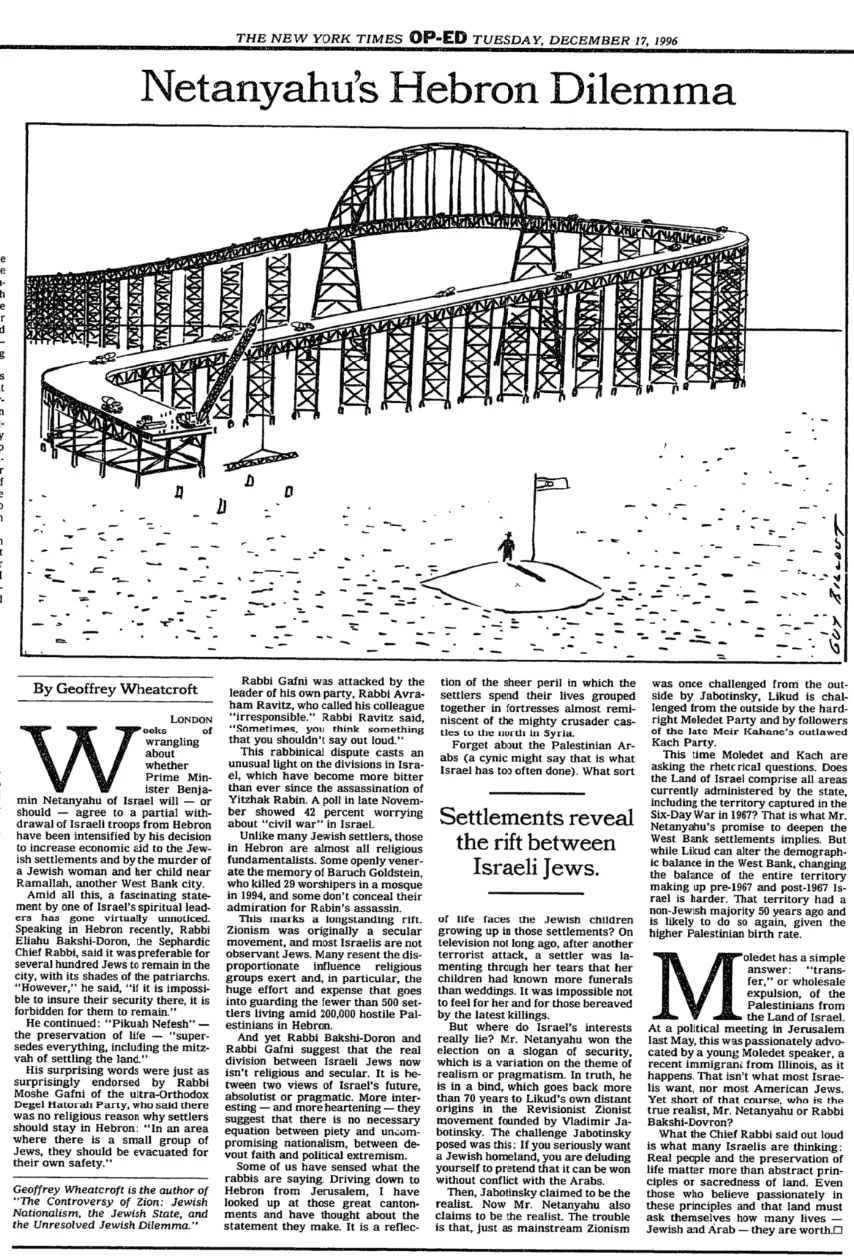
Transcribed from the clipping
LONDON Weeks of wrangling about whether Prime Minister Benjamin Netanyahu of Israel will — or should — agree to a partial withdrawal of Israeli troops from Hebron have been intensified by his decision to increase economic aid to the Jewish settlements and by the murder of a Jewish woman and her child near Ramallah, another West Bank city.
Amid all this, a fascinating statement by one of Israel’s spiritual leaders has gone virtually unnoticed. Speaking in Hebron recently, Rabbi Eliahu Bakshi-Doron, the Sephardic Chief Rabbi, said it was preferable for several hundred Jews to remain in the city, with its shades of the patriarchs.
“However,” he said, “if it is impossible to insure their security there, it is forbidden for them to remain.” He continued: “Pikuah Nefesh” — the preservation of life — “supersedes everything, including the mitzvah of settling the land.”
His surprising words were just as surprisingly endorsed by Rabbi Moshe Gafni of the ultra-Orthodox Degel Hatorah Party, who said there was no religious reason why settlers should stay in Hebron: “In an area where there is a small group of Jews, they should be evacuated for their own safety.”
Rabbi Gafni was attacked by the leader of his own party, Rabbi Avraham Ravitz, who called his colleague “irresponsible.” Rabbi Ravitz said, “Sometimes, you think something that you shouldn’t say out loud.”
This rabbinical dispute casts an unusual light on the divisions in Israel, which have become more bitter than ever since the assassination of Yitzhak Rabin. A poll in late November showed 42 percent worrying about “civil war” in Israel. Unlike many Jewish settlers, those in Hebron are almost all religious fundamentalists.
Some openly venerate the memory of Baruch Goldstein, who killed 29 worshipers in a mosque in 1994, and some don’t conceal their admiration for Rabin’s assassin. This marks a longstanding rift. Zionism was originally a secular movement, and most Israelis are not observant Jews.
Many resent the disproportionate influence religious groups exert and, in particular, the huge effort and expense that goes into guarding the fewer than 500 settlers living amid 200,000 hostile Palestinians in Hebron.
How this transcription was made
Transcribed from the slide scan by a reader working off magnified crops, not by optical character recognition. The date and the newspaper are both printed on the page, in a complete running head reading “THE NEW YORK TIMES OP-ED TUESDAY, DECEMBER 17, 1996”. 17 December 1996 was a Tuesday. Nothing about this record rests on the slide label. The piece is a signed Op-Ed article datelined London, not a news report.
Cite this clipping
"Netanyahu’s Hebron Dilemma," The New York Times, 17 December 1996. Covering Palestine archive, CP-1996-028. https://coveringpalestine.org/archive/cp-1996-028
More from The New York Times
- The Maine Colony in PalestineThe New York Times · 12 November 1866
- Jewish Colonization in PalestineThe New York Times · 9 December 1883
- Jewish State in Palestine OpposedThe New York Times · 9 July 1897
- ZIONIST CONGRESS IN BASELThe New York Times · 31 August 1897
- ROME FEARS THE ZIONISTSThe New York Times · 12 September 1897
- PROGRESS OF ZIONISMThe New York Times · 16 December 1901
- 852 more from this paper in the full text →
More from the 1990s
- Israel rejects blanket damagesSan Francisco Examiner · 3 January 1996
- Disabled Palestinians Sue Israelis for InjuriesOmaha World-Herald · 3 January 1996
- Israel Eldad, 86, a Top Leader In Palestine Jewish UndergroundThe New York Times · 23 January 1996
- Arrest Puts Israel Arabs Under CloudThe New York Times · 7 March 1996
- Runner on first Palestinian Olympic squadIndex-Journal · 7 April 1996
- Roadblocks blamed in baby’s deathTucson Citizen · 9 April 1996
- All 374 clippings from the 1990s →
Last updated 2 November 2026
This record is part of Covering Palestine, an archive of American newspaper clippings about Palestinians, 1724 to 2023. Researched and assembled by Maria Robles.
The clipping belongs to the newspaper that printed it, or to the news agency that supplied the copy. It is reproduced here for research, criticism and commentary. A city here is where the newspaper was published, not where the story came from, and on most records it was taken from the masthead.
Something wrong here, or something you know about this clipping? The archive is still being built and corrections are wanted: maria@rozumstudio.com, quoting CP-1996-028.
Everything printed in 1996 · Printed on this day · See it in the archive reel · Full text of every clipping · Dataset